The Underdog’s Charm: A Comprehensive History of the Daihatsu Compagno
In the automotive world, some cars are destined for greatness, their names etched into the annals of history alongside legends like the Ford Model T or the Toyota Corolla. Others, however, operate in the shadows—capable, reliable, and surprisingly advanced, yet largely forgotten by the global market. The Daihatsu Compagno falls firmly into the latter category. Produced for a brief but impactful four-year window in the 1960s, the Compagno was not just a car; it was Daihatsu’s declaration that it could build a modern, world-class vehicle.
While the name “Compagno” is Italian for “companion,” the car was far more than a simple sidekick. It was a sophisticated entry into the compact car market that bridged the gap between utilitarian kei cars and the burgeoning sedan segment of post-war Japan.
The Genesis: Aiming for the World Stage
To understand the Compagno, one must understand Daihatsu in the early 1960s. At the time, the company was primarily known for manufacturing three-wheeled vehicles and small kei cars. However, as the Japanese economy began its rapid ascent during the “Izanagi Boom,” consumer demand shifted toward four-wheeled passenger cars.
Daihatsu needed a flagship to prove its engineering prowess. The result was the Compagno, launched in 1963. It was designed to compete directly with the Toyota Publica, the Mazda 360, and the Subaru 360. While these competitors relied on rear-engine layouts or extreme minimalism, Daihatsu took a conventional approach: a front-engine, rear-wheel-drive layout that promised better stability and serviceability.
The First Generation: The Sedan and the Spider (1963–1965)
The Compagno made its debut at the 1963 Tokyo Motor Show, entering production shortly after. The initial lineup was divided into two distinct body styles: the Compagno Sedan (F30) and the Compagno Spider (F31).
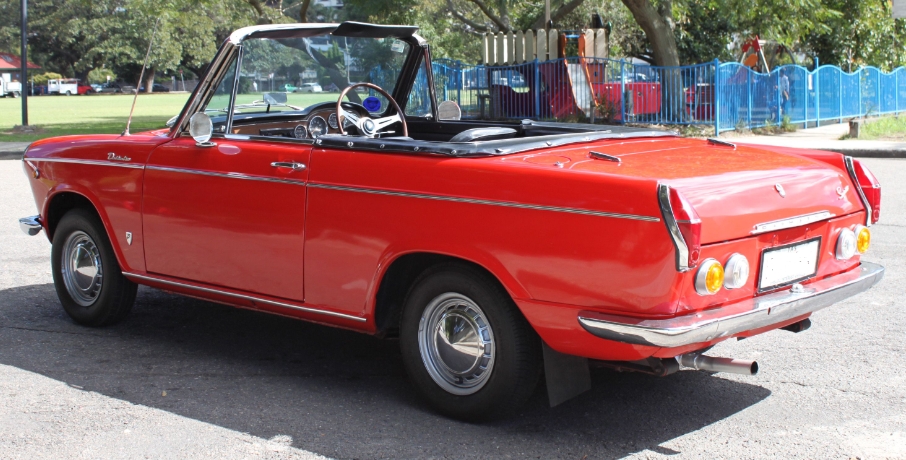
The Compagno Spider (F31) While the sedan was the volume seller, the Spider was the halo car. Unveiled in August 1963, it was designed to capture the youthful spirit of the burgeoning Japanese sports car market. Unlike many “sports cars” of the era which were merely stiffened versions of economy sedans, the Spider featured a distinct, stylish body designed in-house by Daihatsu.
Powered by a water-cooled, OHV (Overhead Valve) 2-cylinder engine displacing 356cc, the Spider produced a modest 19 horsepower. While not blisteringly fast, its lightweight construction (under 600 kg) made it sprightly. The styling was the main draw; it featured a trendy hardtop silhouette with a “grille-less” front end, giving it a modern, European aesthetic. The interior was equally surprisingly upscale, featuring bucket seats and a wood-grained dashboard, a far cry from the spartan interiors of its kei car rivals.
The Compagno Sedan (F30) The sedan, launched in November 1963, shared the Spider’s mechanical underpinnings but utilized a more traditional 2-door sedan body. It was designed to be a “luxury” compact. While the Toyota Publica was utilitarian, the Compagno offered features like an automatic choke and a heater as standard equipment—innovations for a 360cc car in 1963.
The suspension setup was independent at the front with torsion bars, and a leaf spring solid axle at the rear, providing a ride quality that was surprisingly comfortable for roads that were still largely unpaved in rural Japan.
.
THIS might be a great place to get your new car from!
Or for those who are into the “car flipping” business, here’s an excellent resource for you!

.
The Engine Upgrade: The 471cc Era (1965–1967)
As the market evolved, the 356cc engine began to show its limitations, particularly as Japanese highway infrastructure improved. In August 1965, Daihatsu released a significant update to the Compagno line, increasing the engine displacement to 471cc. This new engine, the AB-20, featured an improved cylinder head and increased compression, pushing output to 23 horsepower.
This update applied to all Compagno models, but it also coincided with the introduction of new trim levels and body styles to broaden the car’s appeal.
The Compagno Van (F35) Recognizing the utility market, Daihatsu introduced the Compagno Van (or “Commercial” model) in June 1965. Based on the sedan platform, the Van removed the rear side windows in favor of pressed steel panels and simplified the interior. It was a nod to the commercial use of small cars in Japan, a segment dominated by the Subaru Sambar and the Mazda B360. Despite its utilitarian purpose, it retained the more powerful 471cc engine.
The Compagno Familia (F30) In a confusing naming convention (which Mazda would later use for their own “Familia”), Daihatsu introduced the “Familia” trim in 1965. This was essentially a deluxe version of the standard sedan. It featured upgraded trim, two-tone paint options, and more comprehensive chrome brightwork. The Familia trim was aimed at the family man who wanted a touch of prestige without stepping up to a full-size sedan.
The Compagno De Luxe (F30) The top-tier trim was the “De Luxe.” Distinguished by its full wheel covers, dual chrome mirrors (on some models), and improved upholstery, the De Luxe represented the pinnacle of the Compagno lineup. It was priced competitively against the Toyota 700, leveraging Daihatsu’s reputation for precision engineering.
The Final Evolution: The 550cc Compagno (1967)
The Japanese government’s “Car Nox” emission regulations and the changing tax structure eventually forced the phasing out of the 360cc class. By 1966, the law had been amended to encourage slightly larger vehicles. In response, Daihatsu made one final, crucial update before retiring the name.
In January 1967, the engine was enlarged once again, this time to 550cc (Type AB-30). This bumped horsepower to 28 PS. This model was strictly a stop-gap measure as Daihatsu prepared the Charade, but for a brief period, the Compagno 550 was one of the most powerful cars in its class.
However, by this time, the Compagno’s styling was beginning to look dated. The compact “kei” size (under 3 meters) that defined the early models felt cramped compared to newer, larger compacts like the Toyota Corolla (1966) and the Datsun 1000.
Technical Overview and Engineering
What made the Compagno special was not just its styling, but its engineering philosophy.
- Engine: The 2-cylinder air-cooled (and later water-cooled) engine was mounted in the front. It utilized a gear-driven camshaft, which was a robust design choice for the era.
- Transmission: It featured a 4-speed manual transmission with a shift lever mounted on the steering column in early models (a space-saving technique), moving to the floor in later De Luxe trims.
- Safety and Comfort: Daihatsu equipped the Compagno with a safety glass windshield and a high-mounted brake light (a rare feature in 1963). The electrical system was 12-volt, whereas many competitors still used 6-volt systems, allowing for better accessory integration.
The Compagno’s Legacy and Discontinuation
Despite its technical merit and stylish appearance (particularly the Spider), the Compagno struggled to gain significant market share. The Japanese market in the mid-1960s was fiercely competitive. Toyota and Nissan had massive dealer networks and brand loyalty that Daihatsu could not match.
Production of the Spider ceased in 1966, likely due to low sales volumes of the niche sports model. The Sedan, Van, and Familia trims continued until March 1967. In total, approximately 38,000 units of the Compagno were produced—a modest figure compared to the hundreds of thousands of Corollas and Sunny sedans that would soon flood the roads.
Upon its discontinuation, Daihatsu shifted its focus to the Daihatsu Midget (a three-wheeler) and the new Daihatsu Fellow, which would carry the company’s passenger car banner into the 1970s. The Compagno name was retired, never to be used again.
The Compagno Today: A Cult Classic
Today, the Daihatsu Compagno is a rare sight. In Japan, it holds “Classic” status under the Japanese Automobile Federation (JAF) regulations. Because of its rarity, particularly the Spider, it is highly sought after by collectors. The “F31” Spider, with its targa-style removable roof and Italian-inspired lines, commands the highest prices on the used classic market.
For enthusiasts, the Compagno represents a specific moment in automotive history: the transition from the “kei car” era to the “passenger car” era. It captures the optimism of 1960s Japan, where a smaller manufacturer could produce a car that was as well-engineered and stylish as those from the industry giants.
Future Outlook
While Daihatsu has no plans to resurrect the Compagno nameplate, the brand’s current strategy mirrors its original intent. Today, Daihatsu dominates the kei car market in Japan (through partnerships with Toyota and Subaru) and exports compact, efficient vehicles to emerging markets. The Compagno’s DNA—the focus on maximizing space, reliability, and economy in a small package—lives on in models like the Daihatsu Rocky and the Toyota Raize.
However, for the vintage car market, the Compagno remains a hidden gem. As interest in 1960s Japanese classics grows (alongside the popularity of the Mazda Cosmo and Honda S800), the Compagno is slowly being rediscovered. It serves as a reminder that even the “underdogs” of the automotive world produced machines of substance and style.
In the end, the Compagno was indeed a “companion” to Daihatsu—helping the company navigate the treacherous waters of the 1960s auto industry and establishing a foundation of four-wheel engineering that would support the brand for decades to come.