Zimmer Golden Spirit: The Evolution of America’s Neo-Classic Luxury Icon
The Zimmer Golden Spirit stands as one of the most fascinating — and visually unforgettable — neoclassical automobiles ever produced in the United States. A blend of American V-8 power, coachbuilt retro styling, and bespoke luxury appointments, the Golden Spirit captured the imagination of buyers who wanted classic 1930s flair with the convenience and reliability of modern drivetrains. Its story spans the 1980s neoclassic boom, a revival in the late 1990s, and niche production into the 21st century — evolving with changing tastes and chassis sources along the way.
Birth of a Neoclassic (1980–1981)
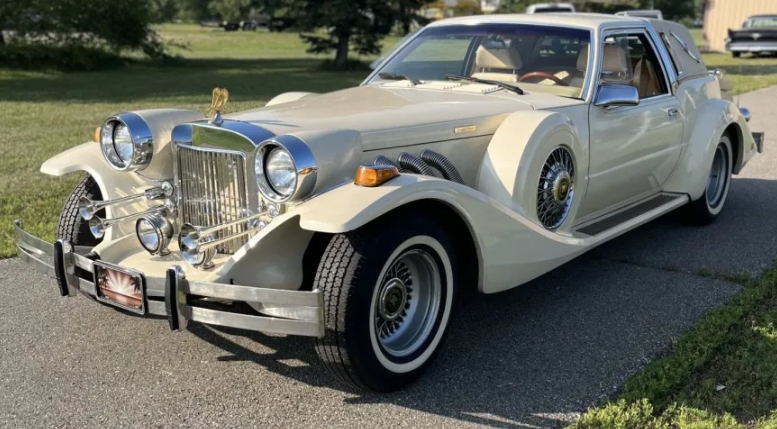
The Zimmer Motor Cars Corporation was founded in 1980 by Paul Zimmer and his son Bob Zimmer. Drawing inspiration from vehicles like the Duesenberg and classic European coachbuilt automobiles, they set out to build their own neoclassical luxury car. The result was the Zimmer Golden Spirit, a hand-finished vehicle that married 1930s aesthetics with contemporary Ford mechanicals.
The Golden Spirit was officially introduced in 1980, with early production likely extending into 1981. The company began by sourcing new Ford Mustang donor cars, removing most body panels, retaining only the roof and doors, and stretching the chassis dramatically to fit the new coachbuilt bodywork.
Innovative yet unusual, the Golden Spirit was designed to turn heads: lengthy hood, sweeping fenders, chrome bumpers, side-mounted spare tires, and even faux external exhaust pipes gave it a look that seemed lifted from the 1930s. However, underneath the flamboyant coachwork was solid, modern mechanicals that allowed the car to be serviced at any Ford dealer.
Original Production Run (1980–1988)
Chassis, Engine, and Construction
Throughout its original production run, from 1980 until Zimmer Motor Cars’ bankruptcy in 1988, the Golden Spirit was based on the Ford Mustang’s drivetrain and chassis — most notably the Fox-body Ford Mustang V-8 — with Zimmer’s own fiberglass bodywork and extended wheelbase structure added in their Pompano Beach, Florida factory. The Mustang’s VIN was retained, ensuring compliance with safety standards and simplifying titling.
Variation in power output followed Ford Mustang’s evolution: early models used the 4.2-liter V8, later switching to the popular 5.0-liter V8 with power ranging through the years from roughly 157 hp to 225 hp depending on donor car and year.
.

.
Models & Trim Levels (1980s)
The Golden Spirit’s original production run did not follow the typical “base/premium/limited” trim structure seen in mass-market cars, but Zimmer did offer distinct variants and styling packages over the years. These were often marketed more as model names or styles rather than formal trims.
Two-Door Variants:
- Classic / Coupe – The core version, usually featuring a half-vinyl padded roof and landau bars. In some brochures, this was simply called Coupe or Classic.
- Elegance / Formal – A more upscale version with full vinyl roof, optional luggage rack, and richer appointments.
Open and Specialty Variants:
- Cabriolet/Convertible – True open-top model, rarer than the hardtop versions.
- Limousine & Sedan – Limited examples built, often requested for bespoke clientele or special uses; conversions included extended-body sedans.
It wasn’t uncommon for owners to personalize features such as matching pinstriping, special upholstery, and accessory “bling” like ornate horns and eagles on the hood.
Yearly Evolution (1980–1988)
Though Zimmer kept the Golden Spirit’s overall appearance consistent, subtle changes occurred year by year. Major differences through the 1980s included:
- 1980–1981: Initial rollout with extended wheelbase and classic styling cues; early cars more closely tied to early Mustangs.
- 1982–1983: Standardization of the 302-ci (5.0L) V8 with varying outputs; improvements in transmission and suspension to accommodate the heavier body.
- 1984–1985: Introduction of four-speed automatic transmissions and interior upgrades, including leather re-trim and improved audio options.
- 1986–1988: Later cars offered higher output Mustang V8s and refreshed interior touches. Production tapered by 1988 as Mustang donor availability declined.
Overall production for this era is estimated at around 1,350 to 1,500 cars, making original Golden Spirits relatively rare today.
Design Philosophy and Customer Appeal
Zimmer Motor Cars purposefully embraced a design philosophy that set the Golden Spirit apart. Rather than following mainstream automotive trends, they leaned into exaggerated neoclassical styling — a theatrical fusion of pre-war luxury cues with late-20th-century mechanicals. Many buyers were drawn to the Golden Spirit not for performance, but as a personal statement piece or collector’s item.
The lavish interiors were often re-trimmed from Mustang components with Recaro leather seats, real wood veneers, gold accents, and custom gauges — creating an ambiance more akin to luxury yachts than pony cars.
Bankruptcy and Brand Dormancy (1988–1996)
Despite early success — Zimmer Motor Cars employed over 170 people with a nationwide dealer network in the mid-1980s — financial troubles at parent company Zimmer Corporation precipitated a bankruptcy filing in 1988. Production ceased and the original company dissolved.
For nearly a decade, the Golden Spirit seemed destined to remain a quirky footnote in automotive history. However, its story was far from over.
Rebirth Under Art Zimmer (1997–2020)
In 1996–1997, a new chapter began when Art Zimmer — unrelated to the original founders — acquired the Zimmer name and assets. He launched the Art Zimmer Neo-Classic Motor Car Company, reviving the Golden Spirit with modernized production and new platform options.
Second-Generation Golden Spirit
Under Art Zimmer’s ownership, production resumed in 1998 with models built from more recent Ford platforms such as:
- Ford Mustang (continued use for two-door coupes and convertibles).
- Lincoln Town Car (used for larger four-door sedans and rarer four-door convertibles).
This era expanded the Golden Spirit lineup significantly, offering authentic 2-door coupes, 2-door convertibles, 4-door sedans, and even 4-door convertible models — a unique segment rarely seen in production cars.
Cars were often built “to order,” with production limited to roughly 10–20 vehicles per year. Each was highly customizable, often with bespoke interior leatherwork, wood trim, premium sound systems, and modern luxury options carried over from donor vehicles.
Trim Levels and Variants (1998–2020)
Unlike the early 1980s cars that were mostly defined by roof style and optional features, the revived Golden Spirit era offered more distinct body and trim variants thanks to chassis diversity and broader customer customization. Examples included:
- Classic Coupé: Traditional two-door with roof and neoclassical styling cues.
- Convertible / Cabriolet: Two-door open-top for a more dramatic look.
- Four-Door Sedan: More practical luxury with classic styling.
- Four-Door Convertible: Extremely rare luxury cruiser, blending uncommon convertible form with generous cabin space.
Powertrains shifted with donor platforms — Lincoln Town Car variants received larger V8s and smoother automatic transmissions, delivering a more comfortable touring experience than earlier Mustang-based cars.
End of Production and Legacy (2020)
Production of the Zimmer Golden Spirit under Art Zimmer ceased in 2020, marking the end of an era for one of America’s longest-produced neoclassic vehicles.
While never a mainstream automotive success in terms of volume or performance benchmarks, the Golden Spirit’s legacy lies in its distinct aesthetic, bespoke craftsmanship, and the passion it inspired among collectors. Its place in automotive history is cemented by the dedicated registry of surviving cars and ongoing interest among enthusiasts of unique and obscure automobiles.
Future Outlook
Although no new Golden Spirit models are expected following the 2020 production end, the model’s legacy will likely continue in several ways:
- Collector Interest: Original 1980s Golden Spirits and later Art Zimmer examples continue to trade among collectors, with interest based on rarity, condition, and unique styling.
- Restoration Culture: Given their coachbuilt nature, many owners and specialists focus on restoration, preservation of original details, and bespoke reproduction parts.
- Heritage Recognition: The Golden Spirit remains one of the most iconic examples of American neoclassical automotive design — a nod to classic luxury interpreted through the lens of American V-8 and coachbuilt ingenuity.
Conclusion
The Zimmer Golden Spirit stands as a remarkable chapter in automotive history: an audacious blend of old-world style and new-world mechanicals that captured the imagination of buyers during the 1980s neoclassic craze and beyond. Its evolution from Mustang-based coachbuilt coupe to bespoke Lincoln-based luxury custom under Art Zimmer reflects a unique journey through changing tastes and market conditions. Though production has ended, the Golden Spirit’s charismatic presence and dedicated following ensure its voice will continue to echo in automotive circles for years to come.