The Glassfiber Grand Tourer: A Chronicle of the Jensen 541, 541R, and 541S
In the annals of British automotive history, few marques capture the unique intersection of post-war optimism, technical innovation, and boutique craftsmanship quite like Jensen Motors. While the brand is perhaps best known today for the all-wheel-drive Interceptor and the fire-breathing CV8, it was the 541 series that truly established the West Bromwich manufacturer as a builder of sophisticated, high-performance grand tourers. Produced during the mid-1950s, the Jensen 541, 541R, and 541S represent a fascinating evolutionary step in the use of fiberglass, the application of modern engineering, and the pursuit of continental speed.
The Genesis: A Vision for the Modern GT
To understand the 541, one must appreciate the context of its birth. The early 1950s were a period of recovery and reinvention in Britain. Jensen, a family-run firm with deep roots in bodybuilding and auto-trailers, sought to move beyond producing bodies for other manufacturers (such as Austin and Ford) and establish its own identity.
The result, unveiled at the 1953 London Motor Show, was the Jensen 541. It was a car that looked like nothing else on the road. While British sports cars of the era—like the MG TF or the Jaguar XK120—adhered to traditional styling with exposed headlights and running boards, the 541 was a radical departure. It was a sleek, aerodynamic coupe that prioritized style, comfort, and high-speed stability.
The Jensen 541 (1954–1957)
The “standard” 541, produced from 1954 to 1957, laid the groundwork for the series. Approximately 243 units were built during this period.
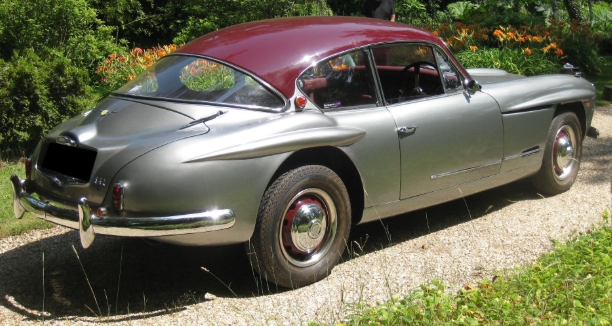
Body and Design: The most striking feature of the 541 was its body. It was one of the first production cars to utilize a fully stressed fiberglass monocoque chassis. Unlike earlier fiberglass cars that simply placed a plastic body over a steel ladder frame (such as the early Chevrolets or the Lotus Elite), the 541’s body was the structural core of the vehicle. This approach saved weight and allowed for complex aerodynamic shapes that would have been prohibitively expensive to stamp in steel.
The design, penned by Eric Neale (a former Wolseley designer), featured fully enclosed wheels, a low drag coefficient, and a panoramic wrap-around windscreen. The rear window was particularly distinctive, wrapping around the rear pillars to create a “greenhouse” effect that maximized visibility.
Mechanical Specifications: Under the hood, the 541 was powered by the reliable Austin A90 Six engine—a 2.7-liter inline-six producing 95 horsepower. While not a fire-breathing monster, the engine was robust and torquey. Mated to a four-speed manual transmission (with an optional Laycock de Normanville overdrive for cruising), the 541 could achieve a top speed of around 95 mph, with respectable acceleration for the time.
Interior and Trim: The interior was a showcase of Jensen’s attention to detail. It featured high-quality leather upholstery, burr walnut veneers, and comprehensive instrumentation. The 541 was designed as a true grand tourer—capable of crossing the country in comfort and style.
.

.
The Jensen 541R (1955–1957)
As the 541 gained a reputation for refinement, Jensen recognized the need to cater to the sporting driver. In 1955, the company introduced the 541R, a model designed with performance as its primary focus. Approximately 173 units were produced.
Performance Enhancements: The “R” designation stood for “Racing” or “Rally,” reflecting the car’s intended purpose. The most significant change was under the bonnet. The 541R utilized the tuned version of the Austin Six, known as the “Blue Streak” engine. This unit featured a higher compression ratio and twin SU carburetors, boosting output to 110 horsepower.
This increase in power, combined with a lighter interior (often featuring aluminum door cards and less sound deadening), improved the car’s performance envelope. The 541R was capable of reaching 105 mph, making it a genuine high-speed cruiser that could compete with the Jaguar XK120 on the open road.
Trim and Styling: Visually, the 541R was distinguished by its lack of chrome trim around the wheel arches—a subtle but effective nod to its sportier intentions. The interior remained luxurious but was stripped back slightly to reduce weight. The 541R represented the perfect balance between Jensen’s inherent luxury and the burgeoning demand for higher performance.
The Jensen 541S (1957–1960)
By 1957, the automotive landscape was changing. American V8 engines were becoming the gold standard for performance, and buyers were demanding more power and modern amenities. Jensen responded with the 541S, the final and most produced variant of the series, with approximately 306 units built between 1957 and 1960.
The American Heart: The most significant change in the 541S was the engine. The Austin Six was retired in favor of the 3.9-liter (later 4.0-liter) Buick OHV V8. This was a bold move for a small British manufacturer, but it paid dividends. The Buick engine produced 140 horsepower in its initial iteration, with later models offering up to 160 horsepower.
This engine swap transformed the car. The V8 provided effortless torque and a smooth power delivery that suited the grand touring ethos perfectly. The 541S could now sprint from 0 to 60 mph in under 9 seconds and top out at approximately 110 mph.
Aerodynamic Refinements: The 541S also received a significant aesthetic and aerodynamic update. The front end was redesigned with a lower nose line and a distinctive “cathedral” grille, giving the car a more modern, aggressive stance. The rear window, previously a wrap-around design, was replaced with a flat screen to simplify manufacturing and reduce wind noise at high speeds.
Trim Levels and Features: The 541S was offered in two primary trim levels:
- Standard: Continued the luxurious tradition with leather upholstery, comprehensive instrumentation, and high-quality finishes.
- De Luxe: This was the pinnacle of the 541 series. It featured power steering (a rarity in British sports cars of the time), improved heating and ventilation, and even more opulent interior materials. The De Luxe model also included a comprehensive tool kit and a vanity mirror, emphasizing its status as a high-end touring car.
Technical Innovation: The Birth of All-Wheel Drive
While the 541S was the end of the line for this specific model, its legacy is cemented by a technical innovation that would define Jensen’s future. The 541S was the first production car to feature an automatic transmission coupled with an all-wheel-drive system.
Developed by Jensen engineer Harry P. Miller, the system utilized a Borg-Warner three-speed automatic gearbox. The transmission sent power to a transfer case that drove both the front and rear differentials. This was not a “slip-and-grip” system like modern AWD; it was a full-time, mechanical engagement designed to provide exceptional traction on wet British roads and stability at high speeds.
This technology was revolutionary. While the 541S was the first to debut it, the system was complex and expensive. It would be refined and popularized in Jensen’s next car, the Interceptor, but the 541S was the proof of concept.
Ownership and Production Numbers
Throughout its six-year production run, the 541 series remained a low-volume, hand-built car. Total production figures are often debated due to the custom nature of the build, but the generally accepted numbers are:
- Jensen 541: ~243 units (1954–1957)
- Jensen 541R: ~173 units (1955–1957)
- Jensen 541S: ~306 units (1957–1960)
Owning a 541 series car today is a unique experience. The fiberglass body is resistant to rust, a major advantage over contemporary steel-bodied cars. However, the monocoque construction means that structural damage can be difficult to repair, requiring specialized skills. The Austin Six engines are bulletproof, while the Buick V8s are reliable but require proper cooling management.
The Future Outlook: A Modern Classic
For decades, the Jensen 541 was an overlooked curiosity, overshadowed by the more flamboyant Interceptor. However, the tide has turned. As the automotive world pivots toward electrification and retro-futurism, the 541 series has found a new appreciation among collectors.
Value and Collectibility: Today, the 541 series is considered a “sleeper” in the classic car market. While prices for pristine examples have risen significantly in the last decade, they remain relatively affordable compared to a contemporary Jaguar XK120 or Aston Martin DB2.
- 541 and 541R: Valued for their purity and the “Blue Streak” engine note. They appeal to purists who enjoy the mechanical engagement of the manual gearbox.
- 541S: Particularly the De Luxe models with the all-wheel-drive system, are commanding the highest premiums. The V8 power and the unique AWD layout make them highly desirable for touring rallies.
Restomods and Preservation: The 541’s fiberglass body and spacious engine bay have made it a candidate for modern restomods. Several examples now feature modern LS V8 engines, disc brakes, and upgraded suspension, transforming the 541 into a reliable, high-performance modern classic capable of 130+ mph cruising with air conditioning.
Furthermore, the “future” of the 541 is secure in museums and collections worldwide. Its historical significance as one of the first mass-produced fiberglass monocoque cars ensures its place in automotive history.
Conclusion
The Jensen 541, 541R, and 541S were more than just cars; they were a statement of intent. They proved that a small British manufacturer could innovate with the best of them, utilizing advanced materials and drivetrain technology to create a vehicle that was years ahead of its time.
From the aerodynamic purity of the original 541 to the V8-powered muscle of the 541S, this series represents the zenith of Jensen’s early engineering prowess. As we look back, the 541 stands as a testament to a time when the open road beckoned, and Jensen was building the perfect vehicle to answer the call. For the modern enthusiast, the 541 offers a rare blend of historical significance, tactile driving pleasure, and timeless style that remains as engaging today as it was in 1954.