A Comprehensive History of the Jensen CV8
In the pantheon of British motoring, the 1960s are often remembered for the rise of the “Grand Tourer”—sleek, fast, and capable of crossing continents in style. While names like Aston Martin and Jaguar dominate this narrative, there exists a lesser-known yet historically significant contender: the Jensen CV8.
Produced for a brief but impactful window in the early 1960s, the CV8 represented a pivotal moment for the West Bromwich-based manufacturer. It was a car that bridged the gap between the hand-built exclusivity of the 1950s and the mass-production efficiency of the modern era. With its controversial styling, American power, and innovative construction, the Jensen CV8 remains a fascinating study of a British independent manufacturer attempting to conquer the high-performance market.
The Genesis: West Bromwich in Transition
To understand the CV8, one must understand Jensen Motors in the late 1950s. By 1959, the company’s previous flagship, the Jensen 541, was aging. The 541 had been a pioneer, utilizing a lightweight fiberglass body and disc brakes, but the automotive landscape was shifting. Buyers demanded more speed, more comfort, and more modern aesthetics.
Jensen’s engineering philosophy was unique. While rivals like Jaguar and MG built their own engines, Jensen relied on powerplants from the “Big Three” in Detroit. This allowed them to offer performance that often outstripped their British competitors. The CV8 was designed to capitalize on this strategy, aiming to be a high-speed executive express that could comfortably cruise at the newly implemented 70 mph motorway speed limits.
Development began under the code name “P66.” The brief was simple: create a car that was faster, more spacious, and more modern than the 541, while retaining the Jensen flair for innovation.
Design and Engineering: A Controversial Silhouette
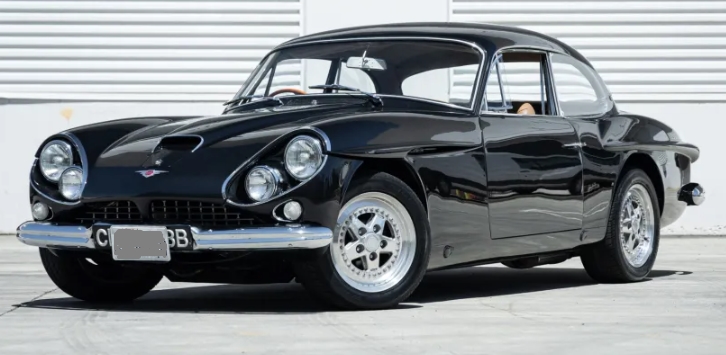
The CV8 was unveiled to the public in 1960, and its appearance was polarizing. Designed by the in-house team, the car featured a distinct “glasshouse” design. The cabin was almost entirely surrounded by glass, utilizing pillars so thin they were almost invisible, giving the car an airy, panoramic view. This was an engineering feat, as the structural integrity had to be maintained without thick A-pillars.
However, the rear of the car drew the most criticism. The tail fins, while aerodynamically functional in directing airflow over the rear window, were considered overly flamboyant by some. The front end featured a wide, chrome-laden grille that gave the car a muscular, American-inspired stance.
Beneath the skin, the CV8 was pure Jensen. It utilized a box-section chassis with independent front suspension (double wishbones) and a live rear axle with a Panhard rod. Crucially, it retained the 541’s disc brakes all around—a rarity at the time, as many competitors still used drum brakes at the rear.
The interior was a blend of British craftsmanship and American opulence. High-quality leather, deep-pile carpets, and extensive wood veneers covered the dashboard. The switchgear was a mix of Lucas and American parts, reflecting the car’s transatlantic mechanical heart.
.

.
The Heart of the Beast: The Chrysler V8
The car’s name, “CV8,” left no doubt about its power source. Jensen had a long-standing relationship with Chrysler, and for the CV8, they selected the Chrysler A-engine: a 313 cubic inch (5.1-liter) V8.
This was not a small engine by British standards. In fact, it was enormous. Mated to a Torqueflite three-speed automatic transmission, the engine produced approximately 250 horsepower. This was a staggering figure for the early 1960s, allowing the CV8 to reach speeds of over 120 mph.
The choice of the Chrysler V8 was strategic. It provided the torque and smoothness required for a Grand Tourer, eliminating the vibration and noise associated with the four-cylinder and six-cylinder engines common in British sports cars of the era. However, the sheer size of the engine created packaging challenges. The hood (bonnet) had to be long and low, contributing to the car’s imposing stance, but it also made maintenance difficult, with minimal clearance around the cylinder heads.
Production Years and Model Evolution
The Jensen CV8 had a relatively short production run, lasting from 1962 to 1966. During this time, the model underwent subtle but important evolutions.
Mark I (1962–1963) The initial launch model. Visually, it was defined by its large, chrome front bumper and prominent tail fins. The interior featured bucket seats and a center console.
- Key Features: 313 cu in (5.1L) Chrysler V8, Torqueflite automatic, disc brakes all round.
- Notable Quirks: Early models suffered from cooling issues due to the tight engine bay and the lack of an effective fan shroud. The rear axle ratio was optimized for high-speed cruising, which sacrificed some low-speed acceleration.
Mark II (1963–1965) In late 1963, Jensen introduced the Mark II in response to customer feedback and rising production costs. This was the most significant update during the car’s life.
- Engine Change: The 313 cu in engine was replaced by the newer, more efficient 361 cu in (5.9L) Chrysler V8. While the displacement increased, the power output remained roughly the same (around 250-260 hp) due to lower compression ratios mandated for unleaded fuel compatibility. However, torque improved significantly.
- Styling Tweaks: The most obvious change was the rear. The controversial tail fins were smoothed out, and the rear number plate moved from the bumper to the bodywork. The chrome bumpers were slightly redesigned.
- Interior: The dashboard was updated with a full-width instrument panel, replacing the individual dials of the Mark I. Air conditioning became an increasingly popular option.
Mark III (1965–1966) The final iteration of the CV8. By this time, the car was nearing the end of its lifecycle, and Jensen was already developing its successor (which would eventually become the Jensen-Healey).
- Trim Levels: The Mark III was largely a specification update. The “De Luxe” trim became standard, featuring improved sound deadening and upgraded leather upholstery.
- Mechanicals: The engine remained the 361 cu in V8, but with minor calibration changes to improve fuel economy.
- The End: By 1966, the CV8’s styling was looking dated, and the weight of the car (over 3,000 lbs) made it thirsty for fuel in an era of rising gas prices. Production ceased in late 1966, with a total of just over 500 units built across all years and trim levels.
Trim Levels and Variations
Unlike modern cars with complex trim hierarchies, the Jensen CV8 was offered in a relatively streamlined configuration. However, there were distinct variations:
- Standard Trim: The base model, featuring leather seats, a walnut dashboard, and basic chrome trim. This was the “driver’s” spec, lighter and more focused.
- De Luxe Trim: This added extensive sound insulation, upgraded wool carpets, and often a heated rear window. It also included a more comprehensive chrome package, including side mirrors and window surrounds.
- Factory Hardtop: While the CV8 was technically a convertible (with a folding soft top), a removable steel hardtop was available. This transformed the car into a coupe, improving aerodynamics and noise levels for long-distance touring.
There were no “convertible” vs. “coupe” body styles—the CV8 was a two-door pillarless design that could be configured as an open-air car or a closed coupe via the hardtop.
Performance and Driving Dynamics
Contemporary road tests praised the CV8 for its straight-line speed. 0-60 mph was achievable in under 8 seconds, putting it in supercar territory for the time. The ride was compliant, absorbing British B-roads with ease, thanks to its soft suspension settings.
However, the car had its drawbacks. The steering was heavy and lacked the precision of a Jaguar E-Type. The weight of the V8 engine over the front axle meant understeer was a characteristic of the driving experience. Furthermore, the fuel consumption—often returning 12-14 mpg—was a significant running cost.
Historical Significance and Legacy
The Jensen CV8 is often overshadowed by the more famous Interceptor, which arrived in 1966. However, the CV8 was crucial in keeping Jensen Motors solvent during the early 1960s. It proved that a British independent could build a car with American power and European handling.
The CV8 also marked a shift in manufacturing. It was one of the first Jensen models to utilize more standardized components to speed up production, a necessity for a company with limited resources. This philosophy would pave the way for the later CKD (Completely Knocked Down) assembly projects that Jensen undertook for Volvo and other manufacturers.
Today, the CV8 is a rare sight. With only 522 units produced, it is a collector’s item. Its value lies in its obscurity and its character. It is unapologetically British in its craftsmanship yet undeniably American in its heartbeat.
Future Outlook
As the automotive world pivots toward electrification, the Jensen CV8 faces a unique future. Its heavy, V8-powered nature stands in stark contrast to modern sustainability goals, ensuring it will likely never see mass restoration or daily use. However, its future lies in the hands of dedicated enthusiasts and classic car museums.
There is a growing appreciation for “underdog” classics—cars that were not the best-selling sports cars of their day but offered something unique. The CV8 fits this niche perfectly. Its rarity ensures that values are likely to remain stable, if not appreciate, as collectors seek out alternatives to the ubiquitous MGB or Triumph TR.
Furthermore, the CV8’s simple mechanical layout makes it an ideal candidate for electric conversion. The large engine bay could easily accommodate modern battery packs, potentially giving the “Glasshouse GT” a second life as a silent, zero-emissions cruiser—a fitting evolution for a car that was always ahead of its time in engineering, if not in styling.
Conclusion
The Jensen CV8 was a product of a transitional era. It was a car that looked back to the flamboyant styling of the 1950s while looking forward to the high-speed motoring of the 1960s. It was flawed, thirsty, and controversial, but it was also fast, comfortable, and uniquely British-American.
For six short years, the CV8 offered a glimpse into what a small British manufacturer could achieve with a big engine and a bold vision. It remains a testament to Jensen’s ingenuity—a glasshouse on wheels that housed a roaring V8 heart.