Edsel Roundup: The Short-Lived Wagon That Became a Classic Curiosity
Few cars in American automotive history capture as much fascination and infamy as the Edsel marque from Ford Motor Company. Introduced with enormous fanfare for the 1958 model year, the Edsel brand was marketed as a new, mid-range American automobile that would bridge the gap between Ford and Mercury. While the brand as a whole is remembered as one of the most notorious commercial failures in automotive history, it nonetheless produced some rare and interesting vehicles — among them the Edsel Roundup. Though produced for only a single model year, the Roundup holds a unique place in automotive lore as Edsel’s base station wagon offering and a symbol of the ambition and missteps that defined the brand.
Historical Context: The Birth of Edsel
To understand the Edsel Roundup, it helps to first understand the environment in which it was developed. Ford Motor Company, under the leadership of then-president Robert McNamara, saw an opportunity in the mid-1950s to create a new automotive division positioned between Ford’s mainstream models and the more upscale Mercury line. The result was Edsel, named after Edsel Ford, son of Ford Motor Company founder Henry Ford. Ford invested heavily in the brand, unveiling it with extensive marketing in 1957 for the 1958 model year launch.
Unfortunately, the timing was poor: a recession hit the U.S. economy in the late 1950s, buyers were wary of new designs, and much of Edsel’s styling and features — particularly its controversial “horsecollar” grille — failed to resonate with consumers. Despite this, Edsel’s inaugural lineup included a variety of sedans, hardtops, convertibles, and station wagons.
Introducing the Edsel Roundup (1958)
The Edsel Roundup was introduced as part of Edsel’s initial 1958 model lineup and existed only for that one model year. Essentially, it was the base-trim station wagon in the Edsel family, positioned below the more upscale Villager and Bermuda wagons.
Design and Purpose
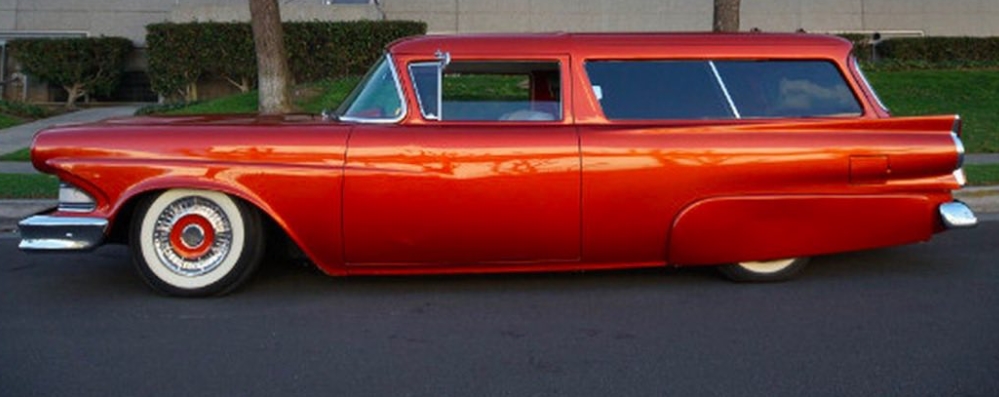
The Roundup was a two-door station wagon with seating for six occupants — a unique and increasingly rare configuration in a market that was gradually favoring four-door wagons. Built on a 116-inch wheelbase shared with Ford’s equivalent wagons, the Roundup borrowed much of its underlying body structure and mechanical parts from Ford but applied Edsel-specific styling cues to distinguish it from its corporate siblings.
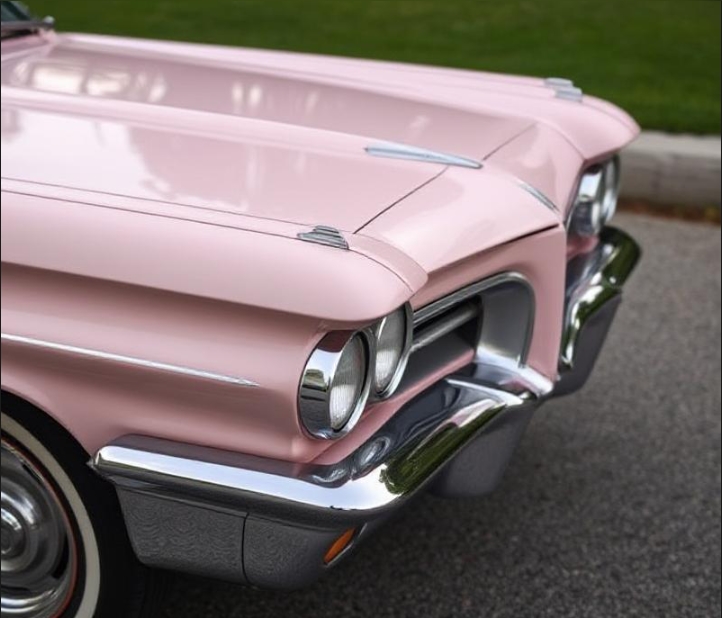
Visually and mechanically, the Roundup was in many ways similar to the Ford Ranch Wagon of the era, but with distinctive Edsel front end styling, including the divisional grille and other trim elements. Standard equipment reflected its base-level positioning: black rubber floor mats, armrests, front and rear ashtrays, dome and courtesy lights, and a white vinyl headliner. Rather than roll-down rear windows, it featured sliding rear windows — a rugged and practical detail.
Inside, the front bench seat was a split-back unit that allowed easier access to the rear seating area, an unusual choice for a wagon and one that distinguished the Roundup from some competitors.
.

.
Powertrain and Performance
Under the hood, the Edsel Roundup was powered by Ford’s 361 cubic-inch FE series V8 engine, which produced approximately 303 horsepower — considerable output for its class at the time. Buyers could choose between a three-speed manual transmission and an optional three-speed automatic, though very few Roundups were equipped with the latter.
This V8 drove the rear wheels, and the wagon was designed as a practical family hauler first and foremost, balancing performance with utility. Its overall length was over 205 inches, and it shared many mechanical and structural components with Ford’s full-size wagons.
Trim Levels and Options
Unlike sedans or hardtops that often offered a wide range of trim levels and optional packages, the Edsel Roundup’s trim and configuration options were relatively limited due to its base-level positioning and short production life.
In essence, the Roundup was available only in one body style and seating configuration:
- 6-Passenger, 2-Door Station Wagon: The sole version offered, designed as an affordable and utilitarian wagon.
Within that configuration, buyers could choose exterior paint and interior trim color combinations typical of the era, but beyond transmission choices, options and upgrades were minimal compared to higher-trim Edsel wagons like the Villager and Bermuda.
Production Numbers and Market Reception
Production of the Edsel Roundup was limited. Official figures show that only 963 Roundups were manufactured for the 1958 model year. This low output reflected not only the short lifespan of the model but also declining consumer interest in two-door wagons, which were falling out of favor compared to four-door designs.
For comparison, in the same year Edsel produced thousands of the four-door Villager and Bermuda wagons combined — a stark contrast that illustrated how buyers preferred more conventional family-oriented models.
The low numbers, coupled with Edsel’s broader struggles, meant that the Roundup quickly faded into obscurity. For the 1959 model year, both the Roundup and the premium Bermuda wagon were dropped entirely, leaving the Edsel Villager as the sole wagon offering for the brand.
Why the Roundup Was a One-Year Model
Several key factors contributed to the Roundup’s disappearance after just one model year:
1. Market Trends Away from Two-Door Wagons
In the late 1950s, the American car market increasingly favored family-friendly vehicles with four doors for convenience and accessibility. Two-door wagons like the Roundup — once popular in earlier decades — were falling out of favor.
2. Edsel’s Brand Struggles
The Edsel brand struggled to attract buyers overall, in part due to controversial styling and an economic downturn in the U.S. shortly after its debut. These factors depressed sales across the entire lineup, making marginal models like the Roundup easier targets when pruning the brand’s offerings.
3. Simplification of the Wagon Lineup
With the Roundup and Bermuda gone after 1958, Edsel focused on the more popular and practical Villager four-door wagon for 1959 and beyond, streamlining production and reducing complexity — a common strategy when facing financial challenges.
The Legacy of the Edsel Roundup
Though short-lived, the Edsel Roundup has become a point of fascination among collectors and enthusiasts. Its rarity — fewer than 1,000 units produced — makes it a desirable find for those who specialize in obscure and unusual American classics.
Collectors appreciate the Roundup not only for its scarcity but also for what it represents: a snapshot of a specific moment in automotive history when American manufacturers were experimenting with new designs and market segments. Its unique combination of station wagon practicality and two-door form factor makes it stand out amid other Edsel models and period wagons.
Though pricing at auctions and among collectors varies widely based on condition, originality, and completeness, well-preserved Roundups are increasingly rare finds. Like other Edsel models, they appeal to enthusiasts drawn to stories of ambitious engineering and marketing that didn’t quite meet expectations — but remain compelling decades later.
What Came After: The Edsel Brand’s End and Wagon Nameplates
While the Roundup vanished after 1958, the Edsel brand itself endured through the 1960 model year before being discontinued amid poor sales and mounting losses for Ford.
Station wagons continued to evolve within the Ford family of marques. Notably, the Villager nameplate lived on beyond Edsel, later appearing on various Mercury station wagons, and much later (in the 1990s) as a compact minivan developed jointly with Nissan.
These later uses of the Villager name reflect the continued appeal of flexible family-oriented vehicles, even as consumer tastes shifted toward SUVs and minivans in the decades following Edsel’s demise.
Future Outlook and Collector Appeal
Today, the Edsel Roundup is unlikely to ever see a revival, given that it was a product of a specific brand and era. However, its story continues to resonate with automotive historians and collectors alike. As American automotive culture embraces preservation and celebration of rare and unusual models, the Roundup and its Edsel siblings serve as reminders of a bold — if flawed — experiment in brand and product creation.
For collectors, the future outlook for Roundups remains strong within a niche segment: well-restored and documented examples can attract interest at auctions and classic car events. Their rarity adds cachet, and as automotive history continues to be appreciated by new generations of enthusiasts, the Roundup’s story — of ambition, challenge, and rarity — will remain compelling.
The Edsel Roundup may have lasted only a single model year, but its impact on automotive history is far larger than its numbers would suggest. As Edsel’s base station wagon, it embodied both the promise and the pitfalls of a brand that dared to do things differently — even if the market wasn’t ready. Its rarity, quirky design choices, and place in the broader Edsel story make it a fascinating chapter in the evolution of American cars.