The Evolution of the Austin A30: A Classic British Economy Car
The Austin A30, a small economy car produced by the Austin Motor Company between 1951 and 1956, played a significant role in post-war British motoring. Aimed at the growing demand for affordable, compact cars for the working and middle classes, the A30 captured the spirit of a nation emerging from the hardships of World War II. Known for its simplicity, efficiency, and practicality, the A30 was one of the early models in the era of the “small car revolution” in the UK.
This article will examine the evolution of the Austin A30, covering its history, models, trim levels, and legacy. The A30’s place within Austin’s wider portfolio, its role in the British automotive landscape, and its continued relevance today among classic car enthusiasts will also be explored.
Origins and Development of the Austin A30
In the aftermath of World War II, the British automotive industry faced a period of recovery, with manufacturers shifting from war-time production to the development of civilian vehicles. The demand for affordable, practical, and fuel-efficient cars grew rapidly, as many families who had lived through the war were now eager to own their first car. This period saw the rise of small cars designed to meet the needs of working-class families.
The Austin Motor Company, which was a key player in the UK auto industry, saw an opportunity to fill the void in the small car market. After the success of the Austin 7 (which was discontinued in 1939), the company recognized the demand for a replacement that would cater to post-war customers looking for an affordable and functional car. The result was the Austin A30, introduced in 1951 as a compact, affordable economy car.
The A30 was built on a completely new design, with its small footprint and simple mechanicals making it easy to produce and maintain. It was positioned as an entry-level car for the middle classes, offering a perfect blend of practicality, economy, and the promise of modernity. Its initial release marked the beginning of Austin’s push into the small-car market, which would later include models like the Austin A35 and A40.
.

.
Introduction of the Austin A30 (1951)
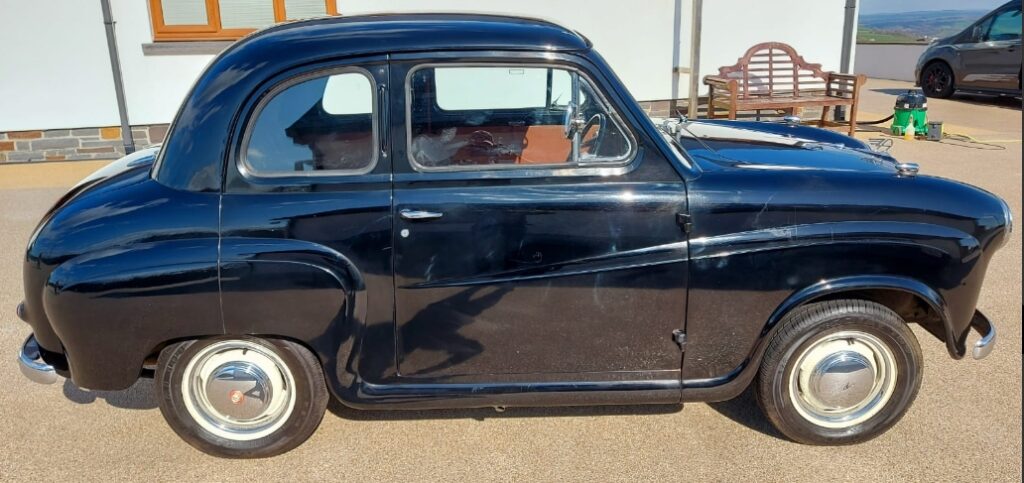
The Austin A30 was launched in 1951 and immediately attracted attention for its compact design, reliability, and efficiency. With its 803 cc four-cylinder engine, the A30 produced around 30 horsepower, which was enough to give the car a top speed of around 60 mph (97 km/h). While this performance was modest by today’s standards, it was more than adequate for the A30’s intended role as a practical city and rural runabout.
One of the most notable features of the A30 was its unibody construction, which reduced weight and contributed to its fuel efficiency. The car was available in both two-door and four-door saloon (sedan) body styles, providing customers with some flexibility in terms of space and seating capacity. Both body styles were characterized by a simple yet attractive design, with smooth curves and a distinctive front grille.
The A30 featured a three-speed manual transmission, a reliable but basic setup. The car was also equipped with hydraulic drum brakes, which were common for small cars of the era. Inside, the A30 had a straightforward dashboard with easy-to-read instruments, and the interior was spacious for its size, offering seating for four passengers.
When it was launched, the A30 was priced at an affordable level, making it accessible to a wide range of British families. The car’s fuel efficiency, reliability, and low maintenance costs made it an attractive option for those looking for an economical way to travel. The A30 quickly gained popularity, and production ramped up to meet demand.
Austin A30: Facelift and Updates (1952–1954)
In the early years of production, the A30 saw a number of minor updates and improvements, which were common for vehicles in this era. In 1952, Austin introduced a number of refinements aimed at improving the car’s comfort, handling, and overall driving experience.
One notable update was the introduction of improved suspension components, which made the ride smoother and more comfortable, especially on rough or uneven roads. The A30 was equipped with a leaf-spring rear suspension, which was typical of the time, and the updated design improved handling and stability.
In terms of exterior changes, the car received some slight revisions to its grille and front end, making it look more modern and in line with the aesthetic trends of the early 1950s. While the overall design remained largely unchanged, these small updates helped to keep the A30 competitive against similar vehicles from manufacturers like Morris and Ford.
Introduction of the Austin A35 (1956) and End of the A30 (1956)
By 1956, the Austin A30 had been in production for five years. While it remained a popular choice for British drivers, the car was beginning to show its age in terms of design and performance. To stay competitive in the rapidly evolving small car market, Austin decided to introduce a successor: the Austin A35.
The A35, which was launched in 1956, was a revised version of the A30. It featured a new, more powerful engine (948 cc), a freshened-up design, and several other improvements. The A35 also benefited from a more modernized body design and improved handling characteristics, making it a more attractive option for buyers.
With the introduction of the A35, production of the A30 was officially discontinued. Although the A35 shared many components with the A30, it represented a clear step forward in terms of both performance and style. The A30 was thus phased out after just five years of production, but its place in the development of British compact cars remained significant.
Trim Levels and Variants of the Austin A30
The Austin A30 was available in a few different trim levels and body styles during its production run, which allowed buyers to choose the model that best suited their needs and budget.
- Two-Door Saloon: The two-door saloon (sedan) version of the A30 was the most basic configuration, offering seating for four passengers and a straightforward layout. It was the most affordable model in the range and was ideal for customers who needed a small, no-frills car for daily commuting or short trips.
- Four-Door Saloon: The four-door saloon version of the A30 provided extra passenger space and convenience, making it an attractive option for families. The added rear doors made access to the back seats easier, particularly for those with children or those who needed to use the car for longer journeys.
- Van Version: In addition to the saloon models, the A30 was also available as a van variant. The A30 Van was designed for small business owners and tradespeople who needed an affordable and practical vehicle for carrying goods. The van version had a larger cargo area and was available with the same 803 cc engine as the passenger cars.
Legacy and Impact of the Austin A30
The Austin A30 was one of the first cars in the UK to cater to the growing demand for small, affordable vehicles in the post-war years. While it was never a high-performance or luxury car, it fulfilled an important role in the market by providing a practical, reliable, and economical mode of transportation for many British families.
The A30’s popularity also helped establish the Austin brand as a leader in the small car market. Its success laid the foundation for the development of future Austin models, such as the Austin A35 and the Austin Mini, both of which would become even more iconic in the coming decades.
Despite being discontinued in 1956, the A30’s legacy has lived on through the classic car community. Well-preserved examples of the A30 can still be found at classic car shows and in collections, with enthusiasts appreciating the car for its simplicity, reliability, and its place in British automotive history.
The Austin A30’s Influence on Later Models
The A30 was a key part of the evolution of British small cars. Its compact design, efficient engine, and simple mechanics set the stage for the next generation of economy cars in Britain. The Austin A35, which followed the A30, was a more refined and powerful version of the same basic design, and it became one of the most successful small cars of the 1950s and early 1960s.
The A30’s influence also extended beyond the Austin brand. It helped shape the design and development of future economy cars from other British manufacturers, including the Morris Minor and the Ford Anglia. These cars would continue to define the small car segment in the UK for many years to come.
Conclusion: A Significant Chapter in British Automotive History
The Austin A30 may not be as famous as some of the iconic British cars that followed in its wake, but it holds an important place in the history of the UK automotive industry. As one of the first affordable, practical cars for the post-war British public, the A30 helped to shape the small car market and provided many families with their first taste of personal motoring.
Though it was only in production for five years, the A30’s impact was significant, laying the groundwork for future models and helping to establish Austin as a leader in the compact car segment. Today, the A30 remains a cherished classic among vintage car enthusiasts, and its legacy continues to be celebrated as part of Britain’s motoring heritage.