Rover 400: A Compact British Classic and Its Evolution
The Rover 400 represents an important chapter in the history of the British marque Rover — a compact car that sought to blend modern engineering, European dynamics, and British design flair during a decade of rapid change in the automotive industry. Produced between 1990 and 1999, the 400 range spanned two distinct generations and numerous models and trim levels in both saloon and hatchback forms. While ultimately overtaken by shifting market trends and internal corporate upheavals, the Rover 400 left an indelible mark as a significant, if sometimes underrated, offering in the small family car segment.
Origins & Automotive Context
When the Rover 400 first appeared in 1990, it was designed to fill the gap between smaller family cars and larger executive models in the UK market. Built under the internal designation R8, the first-generation 400 was essentially a four-door saloon version of the contemporary Rover 200 hatchback, sharing its structure and much of its mechanical layout. This early period of Rover’s history was heavily influenced by technical collaboration with Honda — the R8 family of cars shared platforms with the Honda Concerto, allowing Rover to modernize its small and compact car offerings with reliable underpinnings and competitive dynamics.
This collaboration with Honda was typical of Rover’s strategy in the 1980s and early 1990s, with technical partnerships aiming to improve build quality and market appeal. The 400 was positioned to compete with rivals like the Ford Sierra, Vauxhall Astra, and others in the European small family car class.
.

.
First Generation: R8 (1990–1995)
Launched in early 1990, the first-generation Rover 400 (R8) was a four-door saloon derived from the Rover 200 hatchback. It established the series’ identity and was Rover’s attempt to offer a more upmarket compact car by combining British design with modern underpinnings.
Body & Model Variants
- Saloon: The core of the 400 lineup; a traditional four-door sedan appealing to buyers seeking comfort and class above economy.
- Tourer Estate (1994–1998): Developed by Rover Special Products and introduced in 1994, this estate version — often referred to as the 400 Tourer — expanded the model’s appeal to families and buyers seeking extra practicality. Unlike the later second generation, no estate version was produced after 1998.
Trim Levels & Engines
Over its five-year production life, the R8 400 was available with a wide variety of engines, indicative of Rover’s strategy to offer broad choice:
- Petrol engines:
- 1.4 L K-series (Twin-Cam)
- 1.6 L Honda D-series (SOHC / DOHC)
- 2.0 L Rover M/T-series naturally aspirated
- 2.0 L Rover T-series (including limited-run turbocharged performance variants)
- Diesel engines:
- 1.8 L turbo diesel (XUD7T) and 1.9 L diesel (XUD9) supplied by PSA (Peugeot/Citroën)
Trim designations typically reflected engine size and equipment, such as 414, 416, 418D, and 420 — with suffixes like Si, GSI, GTi, Turbo or Sport denoting higher-performance or better-equipped versions. Fuel-injected petrol versions and diesel-powered options broadened the range’s appeal across European markets.
A key mid-life update — often referred to as “Phase 2” — occurred around 1993, with cosmetic tweaks to bumpers, grille and trim that aligned the 400 more closely with Rover’s corporate styling cues and helped maintain competitive appeal.
Second Generation: HH-R (1995–1999)
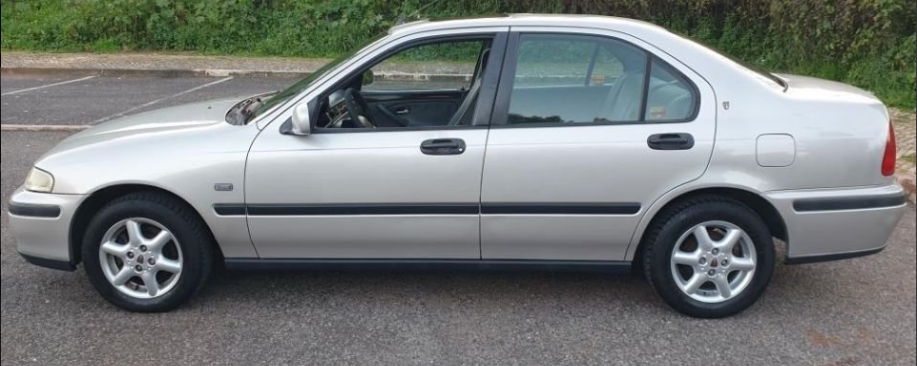
By 1995, the Rover 400 required a significant redesign to meet evolving market expectations. This resulted in the second-generation 400, codenamed HH-R (also known as the Theta generation), which launched initially as a hatchback and, shortly afterwards, as a saloon.
Platform & Design Shift
Unlike the earlier R8, the HH-R 400 was based on the Honda Civic platform — specifically the Domani variant sold in Japan — but with bodywork and interior design tailored by Rover. This change marked a shift toward a more mature, refined compact model, sharing less directly with the Rover 200 and aiming for broader market acceptance.
The HH-R generation was offered in:
- Five-door hatchback: The primary body style on launch.
- Four-door saloon: Added shortly after initial launch to broaden appeal.
No estate version was developed for this generation, unlike the R8 range.
Engine Options & Trim Levels
The second-generation 400 lineup offered a range of petrol and diesel engines:
- Petrol:
- 1.4 L K-series (base models such as 414i)
- 1.6 L K-series (416Si / 416Si Auto)
- Honda-derived 1.6 L D-series (automatic-only in some markets)
- 2.0 L Rover T-series petrol (upper-end models such as 420i)
- Diesel:
- 2.0 L L-series turbo diesel offering better fuel economy for buyers seeking refinement with economy.
Common trim designations included 414i, 416Si, 416Si Auto, 420i and 420Di — where suffixes like Si indicated a higher standard of equipment and sometimes sportier tuning, and Di denoted diesel models. Special editions such as iS, SEi and iL appeared toward the end of the model’s life with additional comfort features like air conditioning, alloy wheels, central locking and audio upgrades.
A minor facelift in 1997 refreshed styling elements like bumpers, lights and trim. This aimed to keep the 400 competitive amid newer rivals, although overall sales did not reach the heights of earlier Rover models.
Market Position & Reception
Throughout both generations, the Rover 400 attempted to balance British flair and character with the aggressive pricing and performance of continental rivals. Early R8 models — especially sporty variants with the turbocharged 2.0 L T-series petrol engine — were among the more engaging compact saloons available in the early 1990s.
The second generation offered more refinement, with improved equipment and comfort for daily driving, but it faced stiff competition from newer rivals such as the Ford Mondeo and Volkswagen Golf. While enthusiast communities appreciated its handling and features, the 400 struggled to maintain strong sales toward the late 1990s.
End of Production & Legacy
In 1999, Rover concluded production of the 400 series and replaced it with the Rover 45, which essentially continued the HH-R’s platform with updated styling and enhanced equipment.
Though the 400 nameplate ended, the lineage continued — with the 45 remaining in production until 2005 — even after the collapse of MG Rover. Produced in the same Longbridge factory where many iconic Rover models had been built, the 400 and its successors represent the final generation of home-grown Rover family cars before the company’s demise.
Today, surviving Rover 400 models are increasingly rare on UK roads, with only a handful still registered — a testament to both their age and their niche appeal among classic British car enthusiasts.
The Rover 400 occupies a unique place in British automotive history. Launched during a period of intense competition and evolving market tastes, it demonstrated Rover’s willingness to embrace technical collaboration while retaining a distinct brand identity. Across its two generations (1990–1995 R8 and 1995–1999 HH-R), the 400 offered a broad range of engines, trims and body styles — from practical estates to diesel-economy hatchbacks, saloons with elegant interiors, and more performance-oriented variants.
Though it was eventually succeeded and overshadowed by newer designs, the Rover 400 remains an interesting example of British automotive adaptation and ambition at the turn of the 1990s — a period when Rover sought to balance heritage, innovation and competitiveness in a rapidly globalizing industry.