The Jensen FF Legacy: How Jensen’s All-Wheel Drive Pioneer Rewrote the Rules of Performance
In the pantheon of automotive history, few vehicles can claim to have fundamentally altered the physics of driving. While names like Porsche, Audi, and Subaru are often celebrated for their performance innovations, the true genesis of the high-performance all-wheel-drive (AWD) grand tourer lies with a small, independent British manufacturer. The Jensen FF (Ferguson Formula) was not merely a car; it was a technological leap forward that arrived a decade before its time. It was the first non-all-terrain vehicle to feature permanent all-wheel drive, the first to incorporate anti-lock braking (ABS), and the definitive answer to the question of how to harness massive power on slippery roads.
The Genesis: A Partnership of Visionaries
To understand the Jensen FF, one must first understand the landscape of the early 1960s. Jensen Motors, based in West Bromwich, England, was known for building handcrafted bodies around American powertrains. Their flagship, the Interceptor, was a brutish, handsome GT car powered by a Chrysler V8. However, despite its looks, the Interceptor suffered from the inherent flaws of rear-wheel-drive physics: it was prone to wheelspin and treacherous handling in wet or icy conditions, particularly in the UK.
Enter Tony Bangham, Jensen’s chief engineer, and a fortuitous meeting with Harry Ferguson, the founder of the Ferguson tractor company. Ferguson had a deep interest in vehicle dynamics and had previously collaborated with Ford on the Ferguson 4WD project (which eventually became the Ford RS200 Rally car). In 1964, Ferguson established the Ferguson Research company to develop a revolutionary concept: a passenger car with a formula one-inspired 4WD system.
Jensen, always eager to innovate, agreed to provide the body and chassis for this experiment. The result, unveiled at the London Motor Show in 1965, was the Jensen FF (Ferguson Formula).
The Technology: More Than Just Traction
The FF was not simply a Jensen Interceptor with extra driveshafts. It was a complete re-engineering of the vehicle. The system, designed by Ferguson engineer John H. F. Keep, utilized a viscous coupling unit (VCU) to distribute power. Unlike modern electronic systems, this was purely mechanical.
The VCU could send up to 85% of the engine’s torque to the rear wheels under normal conditions, maintaining the rear-drive dynamics enthusiasts craved. However, when the rear wheels lost traction, the fluid inside the coupling would heat up and expand, instantly locking the unit and transferring power to the front wheels. This provided seamless, imperceptible traction control long before the term existed.
Furthermore, the FF featured the world’s first production car anti-lock braking system (ABS), supplied by Dunlop. This system, known as the Maxaret system, prevented wheel lock-up during heavy braking, allowing the driver to maintain steering control—a safety feature that would not become standard on mass-market vehicles for another decade.
.

.
Production Models and Trim Levels (1966–1971)
The Jensen FF was produced from 1966 to 1971. Unlike modern vehicles that receive yearly facelifts or mid-cycle refreshes, the FF remained largely consistent throughout its life, though there were distinct evolutionary stages and trim variations based on the underlying chassis and engine configurations.
It is important to note that the FF was built on the chassis of the Jensen Interceptor. Therefore, the FF models correspond closely to the Interceptor phases, but with the added complexity of the AWD system.
Phase 1 (1966–1967)
- Chassis: Mk I
- Engine: Chrysler 383ci (6.3L) V8
- Transmission: 3-speed TorqueFlite automatic
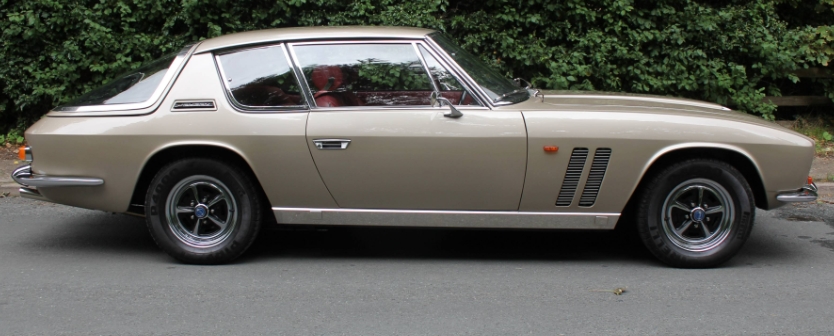
- Trim/Features: The initial launch model was visually similar to the Interceptor Mk I but featured a distinct elongated roofline to accommodate the rear driveshaft tunnel. The interior was pure 1960s luxury, featuring leather upholstery, wood veneer dashboards, and comprehensive instrumentation. The exterior trim included the signature “clam-shell” bonnet (hood) and a chrome grille. The FF was available in a variety of period colors, with British Racing Green, Signal Red, and Ivory being popular choices.
- Production Numbers: Approximately 32 units.
Phase 2 (1967–1969)
- Chassis: Mk II
- Engine: Chrysler 383ci (6.3L) V8
- Transmission: 3-speed TorqueFlite automatic
- Trim/Features: The Mk II FF is considered by many to be the definitive version. The most significant change was the introduction of a split front grille (replacing the single piece) and a revised interior with a full-width instrument panel. Technically, the Mk II featured improved cooling for the viscous coupling unit, addressing early reliability concerns. The trim levels remained luxurious, with air conditioning becoming a more common option. The Mk II also saw the introduction of the “DeLuxe” specification, which included power steering (essential given the weight of the AWD components) and upgraded chrome trim.
- Production Numbers: Approximately 140 units.
Phase 3 (1969–1971)
- Chassis: Mk III
- Engine: Chrysler 440ci (7.2L) V8 (in most US-spec models and later UK models)
- Transmission: 3-speed TorqueFlite automatic
- Trim/Features: The final iteration of the FF coincided with the Interceptor Mk III. The most notable change was the rear window; the Mk III featured a large, single curved glass rear window replacing the three-piece setup of earlier models. Due to tightening emissions regulations in the United States, the smaller 383ci engine was phased out in favor of the larger 440ci V8 in export models. This engine provided even more torque, which the FF’s AWD system handled with ease. Trim levels were refined to include improved sound deadening and updated upholstery materials. The exterior received a slightly more integrated look with revised bumpers.
- Production Numbers: Approximately 60 units.
The Driving Experience
Driving a Jensen FF was, and remains, a unique experience. The car weighed nearly two tons, yet it could accelerate from 0 to 60 mph in under 8 seconds—a respectable figure even by modern standards. The 4WD system meant that the FF could accelerate out of corners with a ferocity that rear-wheel-drive contemporaries like the Jaguar E-Type or Aston Martin DB6 could not match on wet roads.
The cabin was a sanctuary of leather and walnut, but it was also loud. The V8 engine rumbled with a distinct American burble, and the lack of sound insulation meant the mechanical symphony was ever-present. The steering was heavy, even with power assistance, and the turning circle was notoriously wide due to the front driveshafts. However, the ride quality was sublime, soaking up bumps with the composure of a luxury liner.
Why Did It Fail?
Despite its technological superiority, the Jensen FF was a commercial failure. Only 323 units were ever built. Several factors contributed to this:
- Cost: The FF was significantly more expensive than the Interceptor. In 1966, an FF cost around £3,000, while a standard Interceptor was closer to £2,000. For the price, buyers could purchase more prestigious marques like Ferrari or Aston Martin.
- Complexity: The AWD system was advanced but heavy and complex. It reduced the boot (trunk) space and added mechanical weight.
- Image: In the 1960s, the “muscle car” ethos was about raw, rear-wheel-drive power. The concept of AWD was often associated with tractors or off-road vehicles, not high-performance GT cars. It was ahead of its time culturally as well as mechanically.
- Reliability: While robust in design, the FF’s complex drivetrain required specialized maintenance that many mechanics of the era were unfamiliar with.
The Legacy and Future Outlook
Although production ceased in 1971, the Jensen FF’s DNA survived. The technology developed by Ferguson Formula was sold to Nissan in Japan, which used it to pioneer their own 4WD systems in the 1970s. The viscous coupling concept eventually found its way into the Audi Quattro and Subaru WRX, the cars that would later popularize performance AWD.
Today, the Jensen FF is a highly sought-after collector’s item. It is recognized not as a failure, but as a visionary masterpiece. Its value has skyrocketed in recent years, with pristine examples fetching six-figure sums at auction.
The future outlook for the FF is one of preservation and reverence. Because so few were made, they are rarely driven hard, preserved in private collections and museums. However, the spirit of the FF has seen a modern revival. In 2020, a company called Jensen International Automotive (JIA) began offering remanufactured FFs. These modern recreations utilize the original body shells but are fitted with contemporary 6.2-liter GM V8 engines and updated AWD systems, offering the classic FF experience with modern reliability.
Conclusion
The Jensen FF stands as a monument to British engineering audacity. It was a car that dared to challenge the status quo, offering a glimpse into a future where traction was not a limitation, but a tool for performance. While it may have been born ahead of its time, its influence is undeniable. Every time an Audi RS6 or a Subaru WRX accelerates through a rain-slicked corner with unshakeable stability, it is paying homage to the pioneering spirit of the Jensen FF. It remains the unsung hero of the automotive world—a quiet, leather-clad revolution on four wheels.