Edsel Citation: The Flagship of America’s Most Infamous Automobile Experiment
The Edsel Citation occupies an extraordinary niche in American automotive history — a car that was both the flagship model of a highly ambitious brand and one of the rarest and most collectible vehicles from that marque’s short life. Produced only for the 1958 model year, the Citation was the top-of-the-line offering from the Edsel Division of Ford Motor Company, designed to represent luxury and prestige at a time when mid-century American car buyers were drawn to bold styling and powerful performance. Despite its brief lifespan, the Citation’s story offers valuable insight into corporate ambition, market dynamics, automotive design, and collector culture.
Origins: The Edsel Vision and the Role of the Citation
The Edsel brand was launched by Ford in late 1957 as a new division positioned between Ford and Mercury, aimed at capturing buyers seeking something more upscale than a Ford but not as costly as a Lincoln or Mercury flagship. Ford poured significant resources into the project, building excitement through extensive marketing and publicity. The plan was to offer several distinct model lines tailored to various market segments.
Within this hierarchy, the Edsel Citation was conceived as the top tier — the most luxurious, most fully equipped, and most visually distinctive vehicle in the lineup. While lower-tier models like the Ranger and Pacer shared platforms with Ford products, the Citation (along with the Corsair) was built on the larger Mercury-based chassis. This was intended to lend the car greater presence, comfort, and refinement compared to Edsel’s more mainstream offerings.
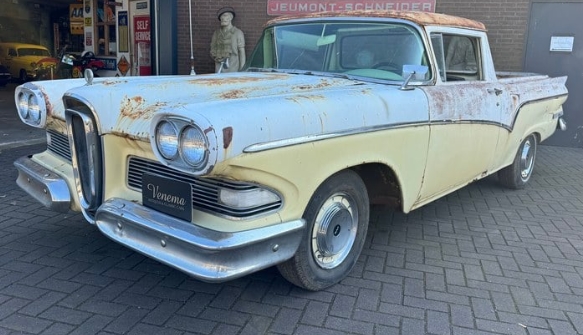
However, the Citation’s launch coincided with a broader decline in Edsel’s market performance. Consumer skepticism about the brand’s styling — particularly the controversial vertical “horse-collar” grille — and a recession dampened sales across the entire lineup, including the prestigious Citation.
.

.
1958: The Only Year of Production
Model Year Context
The 1958 model year was the only year in which the Edsel Citation was produced. Unlike many cars of the era that evolved over several years, the Citation had a single model run — a consequence of the broader failure of the Edsel brand to meet sales expectations and quickly subsequent restructuring.
Body Styles and Production Figures
Despite its single year of production, the Citation offered multiple body styles, giving buyers choice within the flagship series:
- 2-Door Hardtop Coupe
- 4-Door Hardtop Sedan
- 2-Door Convertible
According to production records, a total of 9,299 Citations were built in 1958 — a relatively modest figure, but significant for a flagship model from a new brand. The breakdown of those units shows:
- 4-Door Hardtop: 5,588 units
- 2-Door Hardtop Coupe: 2,781 units
- Convertible: 930 units — making the convertible one of the rarest Edsel body styles produced that year.
The convertible, in particular, has become highly coveted among collectors, not only for its rarity but for its expressive styling and presence.
Design and Features
As Edsel’s flagship, the Citation was distinguished from other Edsels by higher levels of trim and distinctive styling cues. These included:
- Additional stainless-steel trim
- Gold-anodized aluminum cove panels on the rear quarter, evocative of the Mercury Turnpike Cruiser
- A more luxurious interior with deluxe upholstery and appointments
- Elegant hardtop rooflines and a convertible top option
The Citation’s longer wheelbase and broader stance — a direct result of sharing underpinnings with Mercury models — gave it a commanding presence on the road and a greater sense of luxury than the smaller Edsels.
Performance and Mechanics
Under the hood, the Citation was powered by Ford’s 410-cubic-inch MEL (Mercury–Edsel–Lincoln) V8 engine, rated in period advertising at around 345 horsepower. Power was routed through a three-speed automatic transmission — typically Ford’s Cruise-O-Matic — emphasizing smooth performance consistent with the car’s flagship positioning.
Interestingly, the Citation’s mechanical package was fully competitive with other full-size luxury cars of the era — the powertrain and chassis dynamics were similar to those found in Mercury’s Montclair and Monterey models with which it shared components.
Why Just One Year? Market Forces and Brand Retrenchment
Despite the Edsel division’s significant launch effort, the brand struggled almost immediately. Sales in 1958 fell far short of Ford’s forecasts — just over 63,000 Edsels were sold across all models, a fraction of the projected 200,000 units.
The Citation, despite its top-tier status, could not escape the broader market’s rejection of Edsel. In response to declining demand and mounting financial losses, Ford significantly scaled back the Edsel lineup for 1959, dropping several models — including the Citation and Pacer — and retooling the remainder to share even more components with mainstream Ford vehicles.
By the time Ford decided to discontinue the Edsel brand entirely — effective after the 1960 model year — the Citation had already been gone for a year, having been replaced in 1959 by a streamlined lineup focused on the Ranger and Villager wagon (with Corsair carried over into 1959).
Trim Levels and Variants: A Singular Offering
Because it was produced for only one model year, the Edsel Citation did not have multiple generations of trim evolution as many other classic cars did. Instead, all of its distinctions came from body style and available options:
- 2-Door Hardtop Coupe: A stylish version with a sportier roofline.
- 4-Door Hardtop Sedan: The most common and practical variant.
- 2-Door Convertible: The rarest and most collectible edition.
Within these, buyers could choose from various factory options typical of the era — two-tone paintwork, power accessories, and other comfort and convenience features — but there was no multi-year trim evolution to track beyond these 1958 offerings.
Market Reception Then and Now
Contemporary Reception
At the time of its release, the Edsel brand — including the Citation — was greeted with tremendous hype but quickly became fodder for critics. Many buyers were put off by the unusual styling, and the brand’s marketing positioned Edsel vehicles at price points that sometimes overlapped with established Mercury models without delivering clearly superior value.
Even though the Citation boasted premium appointments and a powerful engine, it could not overcome the broader market’s lukewarm reception to the Edsel name. The result was short production life and low sales, even for the flagship model.
Collector Appreciation
In the decades since the Edsel’s demise, the Citation has become highly prized among classic car collectors. Its rarity — and particularly the scarcity of the 930 convertibles produced — make well-preserved examples valuable and sought after at auctions and classic car shows.
Some restored Citations, especially those with original documentation and rare color schemes, have fetched significant prices at auction, reflecting the enduring interest in the car among enthusiasts of vintage American automobiles.
Collector communities and enthusiast clubs frequently feature the Citation as a highlight of Edsel heritage, emphasizing its unique combination of design ambition and the poignancy of its truncated history.
Legacy and Cultural Significance
The Edsel Citation’s legacy is inseparable from that of the Edsel brand as a whole — often cited in business and marketing circles as a cautionary example of how even well-funded projects with innovative engineering can falter if they misread consumer demand or miss key market signals.
Yet for all its reputation as a “failure,” Edsel — and particularly models like the Citation — has become an icon of automotive culture. The Citation’s distinctive 1950s styling, rare variants, and top-tier positioning within the infamously short-lived Edsel lineup make it an enduring subject for enthusiasts and historians alike.
Future Outlook: Preservation and Interest
Given that the Edsel brand has not been revived and there are no current plans to resurrect the Edsel nameplate, the future of the Citation is rooted firmly in classic car preservation and collector interest. Unlike some vintage marques that are reborn or reimagined in modern era, the Citation remains a frozen piece of automotive history — a snapshot of late-1950s design and marketing ambition.
Classics markets continue to appreciate rare and unusual vehicles, and the Edsel Citation — especially convertible examples — remains among the most compelling pieces from its era. Well-documented, original, and restored Citations often command strong interest from collectors who value both its rarity and its story.
Conclusion: An Immortal One-Year Flagship
The Edsel Citation may have lived for only a single model year, but its impact on automotive history is outsized. As the flagship of a brand that sought — and failed — to redefine the American mid-range car market, the Citation stands as a testament to bold design, corporate ambition, and the unpredictable nature of consumer tastes. Today, it is remembered not as a commercial success but as a treasured rarity — a classic example of how even automotive failures can become enduring classics.