Edsel Corsair: From Ambitious Luxury to Classic Rarity — The Full Story
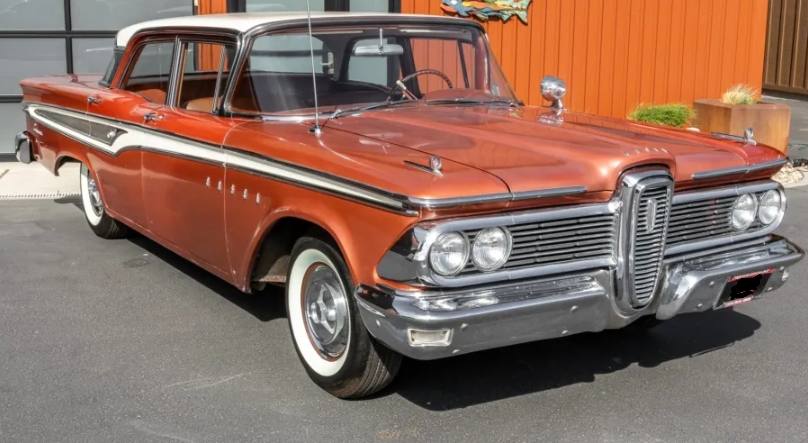
The Edsel Corsair stands as one of the most interesting and rare automobiles from America’s mid-century automotive era. Developed as a premium model for the ill-fated Edsel Division of Ford Motor Company, the Corsair was produced only for the 1958 and 1959 model years — yet its evolution, engineering choices, and subsequent legacy offer a rich story about innovation, market missteps, and the value of classic cars today.
Origins: Edsel’s Ambitious Entry into the Mid-Price Market
In the 1950s, Ford executives saw an opportunity between their mainstream Ford lineup and the more upscale Mercury cars. They conceived a new mid-price brand that could compete head-to-head with General Motors’ Oldsmobile and Buick levels. This idea became the Edsel Division, named for Edsel Ford, son of company founder Henry Ford. The marque debuted in late 1957 for the 1958 model year with a large and varied lineup that included sedans, coupes, convertibles, and station wagons.
Among these offerings was the Corsair, positioned above the entry-level Ranger and Pacer but below the luxury Citation. The Corsair was intended to be a step up for buyers desiring comfort and premium appointments without moving into full luxury territory.
.

.
1958: A Bold Debut on Mercury Underpinnings
For its inaugural year, the Edsel Corsair was built on a longer, wider chassis derived from Mercury vehicles. This set it apart from the smaller Ranger and Pacer models, which were based on Ford frames.
Body Styles and Production
In 1958, the Corsair was offered in two primary body styles:
- 2-Door Hardtop Coupe
- 4-Door Hardtop
During that year, Corsair production was just under 10,000 units, with roughly 3,632 two-door hardtops and 6,355 four-door hardtops produced.
Premium Features and Engineering
The Corsair was designed to convey a sense of upscale design and comfort. It featured:
- Deluxe interior appointments with higher-grade fabrics and trim
- Additional stainless steel exterior accents and unique wheel covers
- A deep-dished safety steering wheel as standard equipment
- A larger wheelbase (124 inches) compared with smaller Edsels
Under the hood, the Corsair shared a large V8 engine, often a 410-cubic-inch unit producing ample power for the era — a performance feature aiming to match or exceed competitor cars.
1959: Restructuring and Expansion of the Corsair Line
Edsel’s first year sales fell dramatically short of expectations — only about 63,000 cars were sold in 1958 against a projected 200,000 — leading to immediate retrenchment.
For 1959, the Edsel lineup was significantly simplified. The Citation and Pacer models were discontinued, leaving the Ranger and Corsair as the two main passenger car offerings. The Corsair, now effectively the top Edsel passenger car, represented the premium end of the reduced brand lineup.
New Body Styles
The 1959 Corsair expanded its body style offerings:
- 4-Door Sedan
- 4-Door Hardtop
- 2-Door Hardtop Coupe
- 2-Door Convertible
This was a notable expansion from 1958, especially with the addition of the convertible, which remains one of the rarer and most desirable Corsair body types today.
Shared Underpinnings and Refined Features
Unlike the earlier year where the Corsair shared much with Mercury design, the 1959 model rode on the same 120-inch wheelbase platform as the Ranger, sharing body panels but preserving higher trim levels and unique interior details to distinguish it.
The 1959 Corsair offered a 361-cubic-inch V8 engine as standard, with manual or automatic transmission options — including the Mile-O-Matic two-speed and a three-speed automatic.
Production Numbers
A total of 9,318 Corsairs were built in 1959 across all body types — with approximately 1,343 convertibles, 2,468 two-door hardtops, 1,812 four-door hardtops, and 3,695 four-door sedans.
1960: Corsair’s End and the Death of Edsel
Despite the changes for 1959, Edsel sales continued to slide, prompting Ford’s decision to discontinue the marque entirely. In late 1959, Ford announced that the Edsel brand would end after the 1960 model year.
Importantly, the Corsair was not produced for 1960. The final Edsel lineup was pared down even further to just the Ranger series and the Villager wagon — all of which shared much with contemporary Ford models.
This means that the Corsair’s production lifespan was strictly limited to 1958 and 1959, making it rarer than many other cars of its era.
Trim Levels and Configuration Summary
Across its brief life, the Corsair was offered only in a handful of configurations, reflecting both changes in Edsel’s sales strategy and its repositioning within the brand:
1958 Corsair:
- 2-Door Hardtop
- 4-Door Hardtop
(Built on Mercury-derived long wheelbase, premium trim)
1959 Corsair:
- 2-Door Hardtop
- 4-Door Hardtop
- 4-Door Sedan
- 2-Door Convertible
(Shared platform with Ranger but higher trim and feature set)
Market Reception: Then and Now
At the time of its release, the Corsair — like all Edsels — suffered from the brand’s broader misfortunes: consumers often criticized its unusual styling, particularly the vertical grille, and the brand’s pricing and marketing strategy seemed confused to buyers. The Corsair’s overlap in price with Mercury models also diluted its appeal, making some buyers wonder why they would not go to the supposedly more established brand.
However, in the decades since Edsel’s demise, the Corsair — especially the 1959 convertible — has become a sought-after classic among collectors. While overall production numbers were low in only two model years, this rarity adds to the Corsair’s desirability and value in the classic car market today.
Collector interest often focuses on:
- Original condition and matching numbers Corsairs
- Convertible models as some of the rarest survivors
- Well-restored examples that highlight the design and engineering of the late 1950s
Legacy and Cultural Significance
Despite its commercial failure, the Corsair — and Edsel as a whole — holds a unique place in American automotive history as an ambitious attempt at a new brand that ultimately failed due to timing, market conditions, and product positioning. Today, cars like the Corsair are celebrated not for their original sales success, but for what they represent: bold design experimentation, engineering ambition, and a cautionary tale in automotive marketing.
The Corsair’s legacy also lives on through collector clubs, enthusiast communities, and classic car shows where these rare vehicles continue to generate interest. Their relative scarcity, combined with mid-century styling and engineering that still impresses today, ensures that Corsairs remain cherished among vintage automobile aficionados.
Future Outlook: Preservation and Appreciation
With no modern Edsel rebirth on the horizon, the Corsair’s future lies entirely in the realm of automotive heritage and preservation. Classic car markets remain strong for well-kept Corsairs, especially those with original components and documented provenance.
As classic car insurance values and collector interest continue to rise, rare variants — particularly the convertibles and hardtops from 1959 — may see increasing appreciation in value over time. This reflects broader trends in the collector vehicle market, where rarity, originality, and historical significance drive demand.
The Edsel Corsair may have existed for just two model years, but its evolution encapsulates much of Edsel’s broader story: ambitious engineering, bold design, a shifting marketplace, and eventual obscurity followed by rediscovery. From its premium 1958 Mercury-based origins to its more mainstream 1959 redesign, the Corsair remains a compelling automotive artifact — a testament to a brand that dared to innovate, even if it failed commercially. Today, Corsair models, especially the rare convertibles, stand as treasured classics that remind us of an era when American carmakers weren’t afraid to take big risks.