Edsel Ranger: From Entry-Level Ambition to Automotive Rarity
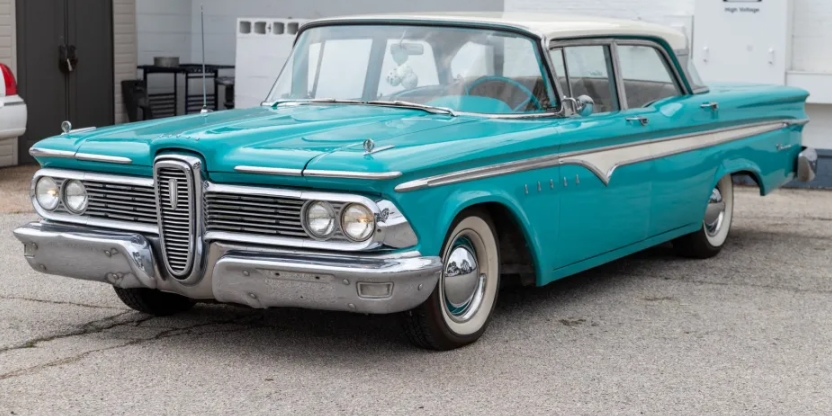
The Edsel Ranger stands as one of the most historically significant — and intriguing — automobiles produced by the short-lived Edsel Division of the Ford Motor Company. Sold for just three model years, from 1958 through 1960, the Ranger was Edsel’s entry-level passenger car, reflecting both the promise and challenges of a make that entered the American automotive market with high expectations but faltered almost from the start. Though often overshadowed by the brand’s controversial reputation, the Ranger represents an important chapter in mid-century automotive design and marketing.
Origins: The Birth of Edsel and the Ranger (1958)
Edsel was conceived in the mid-1950s as a new division of Ford Motor Company, intended to fill a perceived product gap between Ford’s mainstream models and its more upscale Mercury line. Named after Edsel Ford, son of company founder Henry Ford, the marque was unveiled amid significant marketing hype and launched for the 1958 model year.
From the outset, the Ranger was positioned as the brand’s base trim level, providing affordable access to Edsel’s distinctive styling and features. In 1958, Edsel’s model lineup was remarkably broad, spanning four sedans — including the Ranger — and three station wagons. The Ranger sedan was offered alongside other Edsel models like the Pacer, Corsair, Citation, and the Villager and Bermuda wagons.
1958: The Ranger Debuts as Edsel’s Foundation
The 1958 Edsel Ranger was designed to appeal to buyers who wanted the image of a “new” brand with practical, straightforward features. Built on a platform shared with Ford’s Fairlane series, the Ranger was available in multiple body styles to attract a broad audience:
- Two-Door Sedan
- Four-Door Sedan
- Two-Door Hardtop Coupe
- Four-Door Hardtop Sedan
Exterior and interior appointments for the Ranger were modest compared to higher-trim Edsels. Standard features included armrests, a cigarette lighter, and black rubber floor mats, with optional two-tone paint and amenities like a heater, radio, or even air conditioning. Ranger models lacked the extensive stainless trim found on upscale Edsels, giving them a simpler — and more affordable — appearance.
Under the hood, the 1958 Ranger was powered by a 361 cubic-inch V8 engine, shared with the Pacer and station wagon models, delivering respectable mid-century performance. Transmission choices included a three-speed manual or available three-speed automatic.
Production numbers for 1958 show the Ranger as one of the most produced Edsel models that year, with over 19,000 units built across all body styles — a significant portion of Edsel’s total 63,000-plus production.
.

.
1959: Refinement and Edsel’s Shrinking Lineup
In the 1959 model year, Edsel’s lineup was drastically restructured as Ford responded to disappointing sales and market criticism. Several models — including the Citation and Pacer — were dropped, and the once-diverse lineup grew more streamlined.
Despite the cutbacks, the Ranger remained as Edsel’s entry-level sedan, continuing to offer a range of body styles:
- Two-Door Sedan
- Four-Door Sedan
- Two-Door Hardtop Coupe
- Four-Door Hardtop Sedan
In 1959, the Ranger adopted some of the design changes seen across the Edsel lineup, such as more restrained exterior trim and the elimination of the controversial push-button automatic controls. Engine options expanded slightly, with a 292 cubic-inch V8 becoming common, and some Ranger models even offered an inline six-cylinder powerplant as a lower-cost choice.
The production figures for 1959 Ranger models reflect continued demand within the narrowed Edsel lineup. Nearly 28,000 Rangers were built that year, with four-door sedans being particularly popular.
1960: The Final Year — A Model Line Nearly Alone
By 1960, Edsel’s presence in the market had dwindled dramatically. The brand was officially discontinued by Ford in late 1959, and only a small number of cars were built and sold for the 1960 model year.
For this final iteration, the Ranger became the only non-wagon passenger car in the Edsel lineup. The Villager name was assigned to the remaining station wagon offerings, but the Ranger stood alone among sedans and coupes.
The 1960 Ranger was offered in a wide range of body configurations despite the shrinking market:
- Two-Door Sedan
- Four-Door Sedan (Standard and Deluxe trims)
- Two-Door Hardtop (Standard and Deluxe trims)
- Four-Door Hardtop (Standard and Deluxe trims)
- Convertible (Deluxe only)
Remarkably, the convertible Ranger was the rarest Edsel of all, with only 76 units built.
Mechanically, the 1960 Ranger typically used a 292 cubic-inch V8, with a two-barrel carburetor and around 185 horsepower. An optional 223 cubic-inch inline six provided a lower-cost alternative.
However, production was cut brutally short. Because the Edsel marque was terminated in November 1959, the 1960 models were never sold in their actual calendar year, and the final Rangers — including sedans, coupes, and convertibles — were completed and delivered before the end of 1959.
Trim Levels and Configurations: A Complete Overview
Across its three model years, the Edsel Ranger offered a mix of body styles and trim levels:
1958 Ranger Offerings:
- Two-Door Sedan
- Four-Door Sedan
- Two-Door Hardtop Coupe
- Four-Door Hardtop Sedan
1959 Ranger Offerings:
- Two-Door Sedan
- Four-Door Sedan
- Two-Door Hardtop Coupe
- Four-Door Hardtop Sedan
(Engine options included V8s and available inline six)
1960 Ranger Offerings:
- Two-Door Sedan
- Four-Door Sedan (Standard and Deluxe)
- Two-Door Hardtop (Standard and Deluxe)
- Four-Door Hardtop (Standard and Deluxe)
- Convertible (Deluxe only; extremely rare)
This variety allowed the Ranger to cover much of the market spectrum for sedans and coupes, from basic family transport to more personal and upscale configurations.
Market Reception and Legacy
Despite its breadth of configurations and Ford’s aspirations for the Edsel brand, the Ranger — like its siblings — was constrained by the broader commercial failure of Edsel. Critics and buyers alike responded poorly to the brand’s styling, pricing, and timing amid an economic downturn.
Yet, in spite of these setbacks, the Ranger enjoyed relatively stronger production figures than many Edsel nameplates, especially in 1958 and 1959. Its combination of practicality, variety, and comparative affordability made it, for some buyers, a sensible choice among Edsel’s often criticized offerings.
Today, the Ranger is a prized find for classic car collectors. Early models — particularly hardtops and sedans in good condition — attract attention at auctions and car shows. The rare 1960 convertible Ranger stands out as a highly collectible example due to its extremely limited production.
Future Outlook and Collector Appeal
With no modern Edsel marque revival on the horizon, the Edsel Ranger’s future lies squarely in the realm of automotive history and classic car culture. As enthusiasts continue to appreciate mid-century American cars, the Ranger’s story — as the foundation of Edsel’s passenger car lineup — ensures its ongoing relevance.
Classic car values fluctuate with condition, originality, and rarity. Rangers from 1958 and 1959 often command respectable prices among collectors, while the 1960 models — especially rare body styles — can achieve premium valuations. Preservation and restoration efforts also keep interest alive, with owners participating in shows, clubs, and historical events dedicated to the Edsel legacy.
Conclusion: A Model of Ambition and Rarity
The Edsel Ranger encapsulates both the promise and pitfalls of the Edsel brand. As the entry-level backbone of Edsel’s passenger car lineup, it offered a broad range of models and configurations across three model years. From its 1958 launch as a fresh name in American automotive choices to its truncated and rare 1960 run, the Ranger remains a testament to mid-century design ambition and marketplace unpredictability.
Today, the Ranger enjoys a legacy as a classic and collectible vehicle — not because it achieved commercial success, but because it represents a bold, if flawed, chapter in automotive history. Enthusiasts appreciate it as a distinctive and rare survivor from an era of experimentation and change on the American road.