Evolution of The Oldsmobile Calais
Of all the names to grace the sheet metal of an Oldsmobile, “Calais” was one of the most evocative. It conjured images of the rugged, windswept coastline of northwestern France, a place of endurance and gateway to new worlds. For a brief, pivotal period in the late 1980s and early 1990s, the Oldsmobile Calais was intended to be just that: a gateway, a stylish and modern entry point for a new generation of buyers into the Oldsmobile family. Yet, its story is one of a car caught between eras, a testament to ambitious engineering and corporate restructuring, and a nameplate that was ultimately a casualty of a rapidly changing automotive landscape.
A New Era, A New Platform
To understand the Calais, one must first understand the monumental shift occurring at General Motors in the mid-1980s. The automotive giant was grappling with the aftermath of its downsizing efforts of the early decade, which had resulted in a lineup of cars that were efficient but often homogenous and uninspired in their engineering. The front-wheel-drive “A-body” cars (Chevrolet Celebrity, Pontiac 6000, Oldsmobile Cutlass Ciera, Buick Century) were competent but lacked the sophistication and efficiency of foreign competitors. GM’s answer was the N-Body platform.
The N-Body was a clean-sheet design focused on the burgeoning “sport compact” and mid-size segments. It was front-wheel drive, offered a more compact footprint than the A-body, and was engineered for a new generation of four-cylinder engines, promising better fuel economy without sacrificing performance. The first fruit of this new platform was the 1985 Pontiac Grand Am. Following its success, GM planned to expand the N-Body to its other divisions, creating distinct models with unique identities. For Oldsmobile, this new model would be the Calais.
The name itself was a significant departure. Since the early 1960s, the venerable “Cutlass” name had been Oldsmobile’s trump card, appearing on everything from a nimble personal luxury coupe to a full-size sedan. By 1985, the name was stretched thin. The Calais was introduced as a replacement for the rear-wheel-drive Oldsmobile Cutlass Supreme sedan, a car with a vastly different character. This was the first sign of the Calais’s difficult task: to inherit a legacy while forging a completely new path.
.
NO MORE dead batteries with this:

.
The First Generation (1985-1987): The “Quad 4” Pioneer
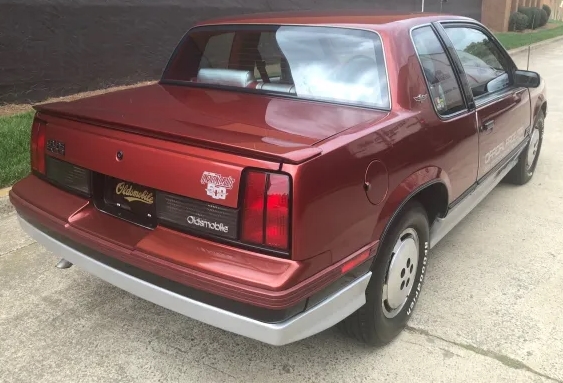
The Oldsmobile Calais debuted for the 1985 model year as a sleek four-door sedan. Its design was crisp and modern, with a long hood, a fast-roofline, and distinctive wraparound taillights that gave it a European flair. The interior was a showcase of GM’s new “CAT” (Computer Aided Testing) design philosophy, featuring a driver-centric dashboard with deeply hooded gauges and ergonomic controls.
Trim Levels (1985-1987): The Calais lineup was structured to appeal to both the value-conscious and the performance-seeking buyer.
- Base: The entry-level model, well-equipped for its time. It typically came with the venerable OHV 2.5-liter “Tech IV” four-cylinder engine (a joint GM-Pontiac design, also used by Isuzu), a 4-speed manual transmission (with a 3-speed automatic optional), power steering, and basic cloth upholstery. It was a solid, economical family car.
- Supreme: The volume seller and the direct descendant of the Cutlass Supreme name. The Supreme added a host of popular features, including air conditioning, upgraded trim, a more plush interior, and often a tachometer. It was the comfortable, well-appointed choice.
- International Series: This was the top-tier trim, focused on luxury and comfort. It featured unique “piston” style aluminum wheels, bodyside moldings, velour upholstery, and a higher level of standard equipment, including a premium sound system. It was Oldsmobile’s statement that the Calais could be as refined as any traditional sedan.
The Calais S and the Quad 4 Engine: The most important event in the Calais’s early life was the arrival of the engine that would define Oldsmobile’s final decade of innovation: the Quad 4. Introduced in 1987 for the ’88 model year, the Quad 4 was a modern, all-aluminum, 16-valve, dual-overhead-cam four-cylinder engine. It was a technological marvel for a domestic automaker, designed to compete directly with the high-revving engines from Honda and Toyota.
This powerhouse was not intended for the base model. Its first home was the Oldsmobile Calais S. The “S” denoted “Sport,” and it was a significant departure from the other trims. The Calais S featured the high-output Quad 4 engine (coded L46), producing an impressive 150 horsepower (165 in later years). It was paired with a sport-tuned suspension, aggressive 15-inch sport tires, and unique alloy wheels. Visually, it was distinguished by a decklid spoiler, aero package mirrors, and “Quad 4” badging. The Calais S was the true enthusiast’s choice, a genuine “sleeper” that could outperform many V6-powered competitors of its day.
The Second Generation (1988-1991): Refinement and a New Identity
For 1988, the Calais received a significant refresh, though it remained on the same N-Body architecture. The updates were focused on the front and rear fascias. The most notable change was the front end, which adopted a more aerodynamic look with flush-mounted composite headlights and a lower, more sloped grille. The rear received a cleaner, more integrated bumper and taillight design. The interior was also upgraded with improved materials and sound insulation.
This generation saw a strategic realignment of the trim levels and a broader application of the Quad 4 engine.
Trim Levels (1988-1991): The “International Series” name was retired, and the hierarchy was simplified and made more evocative.
- Base: Carried over as the value leader. By now, the 4-speed manual was likely dropped in favor of a 3-speed automatic, with a 4-speed automatic available as an option.
- SL: This trim replaced the Supreme. The “SL” (which some believe stood for “Sport Luxury”) was the new heart of the Calais lineup. It bundled many of the features that were optional on the base model, offering a more complete package. It was the best-selling Calais model.
- S: The sport model continued, now with the Quad 4 as its standard and only engine. It remained the performance king of the lineup, with its stiffened suspension and distinctive spoilers.
- GT: A new top-of-the-line performance trim was introduced for 1989, positioned above the S. The GT combined the aggressive look of the S with the luxury features of the SL. It featured the more powerful Quad 4 HO engine, unique “GT” alloy wheels, a leather-wrapped steering wheel, and a more comprehensive standard equipment list. It was an attempt to create a “do-it-all” Calais, blending sport and comfort.
Engine Evolution: The engine lineup saw some shuffling during this period. In 1988, a new 3.3-liter V6 was introduced as a torquey, relaxed alternative to the four-cylinder engines. However, it was short-lived, being replaced for the 1990 model year by the more modern and popular 3.8-liter V6. Meanwhile, the Quad 4 family expanded. Alongside the standard 150 hp version and the 165 hp HO version, a lower-output 120 hp version was introduced in 1990 for the SL and base models, providing a noticeable step up from the old Tech IV engine without the high-strung nature of the HO motor.
The Final Act: The Calais Gets a V8 (1991-1992)
In a surprising and somewhat incongruous move for a front-wheel-drive compact sedan, Oldsmobile decided to give the Calais a final injection of muscle for its last two years. Starting in late 1991 for the 1992 model year, a 3.1-liter V6 (originally an LG5 turbo engine in other GM models, but naturally aspirated here) was added to the options list.
More significantly, for 1992, Oldsmobile offered the Calais GT with the 5.7-liter V8. This was the legendary small-block V8 from the Chevrolet Corvette, detuned for front-wheel-drive duty in the Calais. This engine, available for a single year, produced 170 horsepower and a massive 255 lb-ft of torque. It was a true sleeper, capable of surprising many modern performance cars off the line. However, it was an awkward fit. The Calais’s chassis was never designed to handle that much torque, leading to torque steer and a compromised ride. It was a “kitchen sink” approach, a last-ditch effort to generate excitement for a car nearing the end of its life.
The End of the Line and Legacy
By the early 1990s, the automotive world was moving away from the “sport compact” sedan that the Calais had helped define. The focus shifted toward larger, more refined mid-size sedans. GM’s response was the all-new W-Body platform, which debuted in 1990 with the Oldsmobile Cutlass Supreme (the name once again returning to a more premium car).
The Oldsmobile Calais was discontinued after the 1992 model year. Its mission was largely taken over by the redesigned Oldsmobile Achieva for the 1992 model year, which was also an N-Body car but with a much more modern aesthetic and interior.
So, what became of the Calais name? In a testament to GM’s often-confusing naming strategies, the “Calais” nameplate was immediately repurposed. In Europe, the Opel Vectra was sold in the UK as the Vauxhall Vectra and in other markets as the… Opel Calais. For a brief time, a version of the Calais name lived on, but on a completely different car, an ocean away.
The Oldsmobile Calais itself, however, vanished. It left behind a legacy as a car that was both ahead of its time and a product of its time. It was a pioneer in bringing sophisticated four-cylinder technology (the Quad 4) to the American mainstream, a bold and important chapter in Oldsmobile’s history. It served as a vital bridge between Oldsmobile’s traditional past and its uncertain future. Today, the Calais is a rare sight on the road, a forgotten footnote in the annals of General Motors history, but it remains a fascinating look at a moment when an established American brand tried, with earnest and interesting engineering, to reinvent itself for a new generation.