Evolution of The Sunbeam Lotus: Britain’s Rally-Bred Hot Hatch Pioneer
The Sunbeam Lotus is one of the most celebrated performance cars to emerge from the British automotive industry in the late 1970s and early 1980s. A product of collaboration between the Rootes Group’s successor Chrysler UK (later taken over by Peugeot-Talbot) and the renowned sports car manufacturer Lotus, the Sunbeam Lotus combined a humble supermini body with a potent sports car powertrain. Its brief production run, spanning 1979 to 1981, delivered a cult classic that left a lasting impression on rally stages and road enthusiasts alike.
Origins and Brief History
The Sunbeam Lotus began life as a performance project to create a competitive rally car. By the mid-1970s, Chrysler UK needed a successor to its rallying Hillman Avenger and Hunter models. The company’s new Talbot Sunbeam supermini, introduced in 1977, provided a lightweight and compact platform, but in standard form it lacked the muscle for international competition.
To solve this, Chrysler UK turned to Lotus, with whom it had previously collaborated on performance engineering. Lotus was tasked with developing a high-performance engine and drivetrain package that could transform the unassuming Sunbeam into a rally-winning machine. The project was internally referred to as the “Super Sunbeam” before it received its official name: the Sunbeam Lotus.
By 1978, Lotus engineers had fitted their Type 911 2.2-litre inline-four engine—based on the Lotus 907 unit used in the Lotus Esprit—to the Sunbeam’s shell. The engine featured twin overhead camshafts, 16 valves, and twin Dell’Orto carburettors, producing around 150 horsepower for the road version. Mated to a close-ratio 5-speed gearbox from the Chrysler Avenger Tiger and driving the rear wheels, the Sunbeam Lotus was a rare example of a rear-wheel-drive hot hatch.
.

.
Production Years and Development
The Sunbeam Lotus officially entered production in 1979. Initially, the cars were assembled in a two-stage process: the basic Sunbeam bodyshells were built at Chrysler’s Linwood plant in Scotland, then shipped to Lotus in Hethel, Norfolk, where they were fitted with the engine, gearbox, suspension, and other performance components.
In 1980, following Chrysler Europe’s sale to Peugeot, the car was rebranded under the Talbot marque and became known as the Talbot Sunbeam Lotus. This was largely a name change; the engineering remained the same, though minor cosmetic and trim updates were introduced.
Production ended in 1981 after approximately 2,300 road cars were built, alongside a number of competition-spec rally cars. The relatively short production run adds to the model’s rarity and desirability today.
Models and Trim Levels
The Sunbeam Lotus was produced in essentially one performance specification, though there were distinctions between early models and later updates under the Talbot badge.
1979–1980: Chrysler Sunbeam Lotus
- Trim level: Single high-performance specification
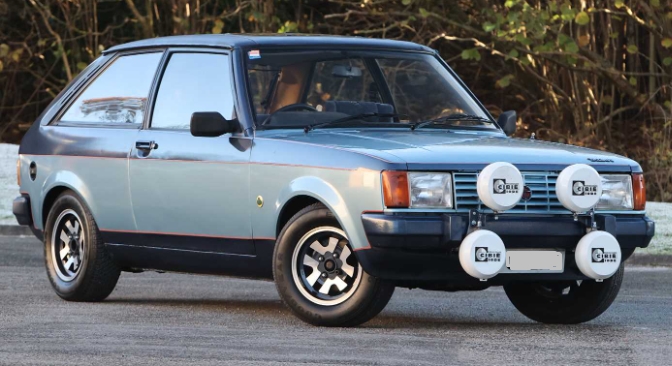
- Exterior: Initially offered in Black with silver striping and “Sunbeam Lotus” decals. Alloy wheels were standard, painted silver with polished rims.
- Interior: Sports seats, three-spoke sports steering wheel, comprehensive instrumentation (including tachometer and auxiliary gauges).
- Mechanical: Lotus 2.2L DOHC engine producing ~150 hp, rear-wheel drive, 5-speed manual gearbox, uprated suspension and brakes.
1980–1981: Talbot Sunbeam Lotus
- Trim level: Again, only one main high-performance trim, but with minor cosmetic changes.
- Exterior: Expanded colour options including Moonstone Blue with silver stripes, and some export markets received different decal arrangements. The Talbot badge replaced the Chrysler and Sunbeam branding.
- Interior: Largely similar to earlier models, with subtle trim updates and minor detail changes to reflect Talbot branding.
- Mechanical: Essentially unchanged from earlier models, though some cars saw slight tuning variations for different markets.
Competition Specification
In addition to the road-going versions, Lotus and Talbot produced rally homologation versions for Group 4 competition. These competition cars featured:
- Higher output engines (up to 250 hp in rally trim)
- Strengthened drivetrain components
- Lightweight panels and stripped interiors
- Rally-specific suspension and braking systems
These rally-prepped Sunbeam Lotuses were not road trim levels per se, but they were integral to the car’s identity.
Rally Success and Motorsport Heritage
The Sunbeam Lotus was conceived as a rally car, and in that arena it achieved remarkable success. Its most famous achievement came in the 1981 World Rally Championship, when the Talbot Sunbeam Lotus helped Talbot win the Manufacturers’ Championship, defeating the likes of Ford and Datsun. Notably, rally driver Henri Toivonen piloted a Sunbeam Lotus to victory in the 1980 Lombard RAC Rally at just 24 years old, making him one of the youngest drivers to win a WRC event at that time.
The car’s compact size, rear-wheel-drive layout, and powerful engine made it a formidable competitor on tarmac and gravel stages alike. Even as four-wheel-drive rally cars like the Audi Quattro began to dominate in the early 1980s, the Sunbeam Lotus remained competitive thanks to its light weight and agility.
Technical Specifications (Road Version)
- Engine: 2,172 cc Lotus Type 911 DOHC inline-four, 16 valves
- Power Output: ~150 bhp at 5,750 rpm
- Torque: ~150 lb-ft
- Induction: Twin side-draught Dell’Orto carburettors
- Transmission: 5-speed manual
- Drive Layout: Rear-wheel drive
- Suspension: Front – MacPherson strut; Rear – live axle with coil springs and trailing arms
- Brakes: Front disc, rear drum
- Performance: 0–60 mph in approximately 6.6 seconds; top speed around 118 mph
- Weight: Around 960 kg (2,116 lbs)
Distinguishing Features
The Sunbeam Lotus stood out in the hot hatch segment for several reasons:
- Rear-Wheel Drive – While many later hot hatches adopted front-wheel drive, the Sunbeam Lotus retained a traditional rear-drive layout, giving it a distinct handling character.
- Lotus Engineering – The powertrain and chassis tuning came directly from Lotus, lending the car sports car pedigree.
- Rally Pedigree – It was designed for motorsport first, with road cars serving as homologation specials.
- Understated Looks – Apart from stripes and badging, the Sunbeam Lotus looked like a regular supermini, making it something of a “sleeper” in its day.
Collectibility and Enthusiast Market
Due to its limited production numbers, motorsport success, and connection to Lotus, the Sunbeam Lotus is a sought-after classic today. Surviving examples are prized by collectors, particularly those in original specification and with documented history. Prices have risen steadily since the early 2000s, with concours-quality cars commanding significant sums.
Rally-prepared examples and genuine works cars from the era are even more valuable, often appearing at historic rally events and in specialist auctions. Parts availability can be a challenge, particularly for Lotus-specific engine components, but an active enthusiast community helps keep the cars on the road.
The Sunbeam Lotus in Context
When it debuted, the Sunbeam Lotus predated the era of iconic front-wheel-drive hot hatches like the Volkswagen Golf GTI Mk2 and Peugeot 205 GTI. It was, in many ways, a bridge between the classic rear-drive sports sedans of the 1970s and the practical performance hatchbacks of the 1980s. Its success in rallying came at a transitional moment in motorsport, just before four-wheel-drive revolutionized the sport.
In the broader automotive landscape, the Sunbeam Lotus demonstrated how manufacturers could leverage specialist engineering firms to create halo performance models from mainstream platforms. This formula would be seen later in cars like the Ford Sierra RS Cosworth (with Cosworth replacing Lotus in the engineering role).
Future Outlook
While the Sunbeam Lotus will never return as a production car—it was tied to a specific moment in automotive history—the model’s legacy continues in several ways:
- Historic Motorsport – The Sunbeam Lotus remains a favorite in historic rallying, where its agility and period-correct appeal make it a competitive and crowd-pleasing entry.
- Collector Market Growth – As interest in 1970s and 1980s performance cars grows, the Sunbeam Lotus is likely to appreciate further in value, particularly well-preserved and original examples.
- Cultural Nostalgia – For enthusiasts who grew up during the golden age of Group 4 rallying, the Sunbeam Lotus represents a connection to a more raw and mechanical era of performance cars.
- Restoration Projects – Increasingly, enthusiasts are restoring tired examples to factory specification, which helps preserve the model’s history for future generations.
Given the limited number produced and the attrition rate from motorsport use, the number of roadworthy Sunbeam Lotuses will likely continue to decline, adding to their exclusivity.
Conclusion
The Sunbeam Lotus is a fascinating chapter in the story of British performance cars. Produced between 1979 and 1981, it combined the modest Sunbeam supermini body with a potent Lotus-engineered 2.2-litre engine, resulting in one of the most memorable homologation specials of its era. Offered in a single high-performance trim—first as the Chrysler Sunbeam Lotus, then as the Talbot Sunbeam Lotus—it delivered exceptional performance, a distinctive rear-wheel-drive driving experience, and genuine rally pedigree.
Its motorsport achievements, including helping Talbot secure the 1981 World Rally Championship Manufacturers’ title, cemented its place in automotive history. Today, it stands as a reminder of a time when small cars could be transformed into giant-killers through ingenuity and engineering flair. For collectors, drivers, and rally fans alike, the Sunbeam Lotus remains a shining example of what happens when purpose meets passion in the automotive world.