Falcon Motorsports F7: The Rise and Legacy of a Rare American Supercar
The Falcon Motorsports F7 represents one of the most unusual and rare supercars ever built in the United States. Produced in extremely limited numbers and developed by a small Michigan-based company, the F7 was designed to compete with established European exotic cars while maintaining a distinctly American engineering philosophy.
Although it never reached mass production, the F7 remains notable for its bold design, powerful V8 engine, and handcrafted construction. Built between 2012 and 2017, only seven examples were produced, making it one of the rarest modern supercars.
This article explores the origins, development, specifications, models, and legacy of the Falcon Motorsports F7.
Origins of Falcon Motorsports
The company behind the F7, Falcon Motorsports, was founded in 2009 by American automotive designer and engineer Jeff Lemke. Based in Holly, Michigan, the company sought to produce a limited-run American supercar capable of competing with global high-performance brands.
Lemke began developing the concept shortly after establishing the company. His goal was to combine lightweight construction with large-displacement American power—essentially blending the philosophy of American muscle cars with the architecture of mid-engine exotic sports cars.
A prototype version of the vehicle was unveiled at the North American International Auto Show in 2010, generating interest among automotive enthusiasts and journalists. Two years later, the production version debuted at the same show, officially launching Falcon Motorsports’ first production car.
.
THIS is GOOD stuff if your car is in need:

.
Development of the Falcon F7
The F7’s development focused on creating a lightweight chassis combined with high horsepower and analog driving characteristics.
Engineers used a carbon fiber and aluminum monocoque chassis, which provided high rigidity while keeping weight low. The body panels were also made largely from carbon fiber and Kevlar composites, helping the car achieve a curb weight of approximately 2,750–2,800 pounds (around 1,250–1,270 kg).
The vehicle was configured with a rear mid-engine, rear-wheel-drive layout, a configuration typical of exotic sports cars.
Power came from a naturally aspirated 7.0-liter LS7 V8 engine, derived from the engine used in the Chevrolet Corvette Z06 (C6). The engine produced roughly 620–629 horsepower, delivering strong acceleration and a raw driving experience.
The engine was paired with a six-speed manual transaxle, sending power to the rear wheels. With this configuration, the F7 could accelerate from 0–60 mph in roughly 3.3 seconds and reach a top speed near 200 mph.
Production Years and Manufacturing
Production period: 2012–2017
Total units produced: 7 cars
Despite initial plans to produce more vehicles annually, Falcon Motorsports struggled to scale production. Early projections suggested the company might build 15 cars in its first year and up to 100 annually in later years, but those targets were never achieved.
Instead, the company produced cars slowly and largely by hand in Michigan. Each vehicle was assembled individually, contributing to the extremely low production numbers.
By the end of production in 2017, only seven F7 supercars had been completed.
Models and Trim Levels
Unlike mainstream automakers, Falcon Motorsports offered very few formal trim levels for the F7 due to its bespoke production approach. However, two main configurations emerged during the vehicle’s lifecycle.
Falcon F7 (Standard Production Model)
Years produced: 2012–2017
This version represented the primary production configuration of the vehicle.
Key specifications:
- Engine: 7.0-liter LS7 naturally aspirated V8
- Power output: approximately 620–629 hp
- Transmission: 6-speed manual transaxle
- Drivetrain: Rear-wheel drive
- Weight: approximately 2,750–2,800 lbs
- 0–60 mph: about 3.3 seconds
- Top speed: roughly 190–200 mph
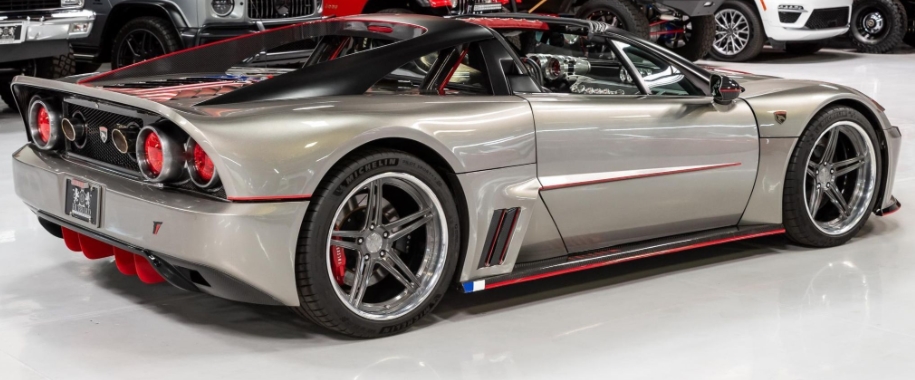
The standard F7 featured a carbon-fiber body, aggressive aerodynamic styling, and a removable roof section between the windshield and seats, giving it a targa-style configuration.
Suspension components were influenced by the Corvette platform, and the car featured Penske coilover suspension and Brembo carbon-ceramic brakes for high-performance handling and stopping power.
Falcon F7 Twin-Turbo (High-Performance Variant)
Year introduced: mid-2010s (limited modification builds)
A later evolution of the F7 featured a twin-turbocharged version of the 427-cubic-inch V8, developed in partnership with Lingenfelter Performance Engineering.
Key specifications:
- Engine: twin-turbo 427-cu-in V8
- Power output: approximately 1,100 horsepower
- 0–60 mph: around 2.7 seconds
This configuration dramatically increased the car’s performance, pushing it into the territory of modern hypercars while still maintaining a traditional manual gearbox.
Due to the extremely small production volume, this variant was more of a special build or upgrade rather than a widely available trim level.
Design and Interior
The Falcon F7 featured styling inspired by both American muscle cars and European supercars. Its exterior design included:
- Sharp front fascia with wide air intakes
- Low, wedge-shaped profile
- Sculpted carbon fiber body panels
- Narrow headlights and aggressive side vents
Inside, the F7 combined handcrafted materials with motorsport-inspired elements. The interior included leather upholstery, aluminum trim pieces, and billet-machined gauge surrounds.
Despite the exotic appearance, the cabin emphasized simplicity and driver engagement rather than luxury.
Price and Market Position
When the Falcon F7 debuted, it carried a price tag around $195,000 to $250,000, depending on configuration.
This pricing placed it among other high-performance supercars but significantly below some exotic rivals. Falcon Motorsports hoped the car would compete with vehicles like the Saleen S7 and other boutique American supercars.
However, limited brand recognition and extremely low production capacity prevented the company from becoming a serious competitor in the global supercar market.
Media Appearances and Cultural Impact
Despite its rarity, the Falcon F7 received modest media attention. One example appeared in the television series How It’s Made: Dream Cars, which showcased the car’s handcrafted manufacturing process.
The F7 also appeared at several automotive exhibitions and was occasionally displayed at auto shows and private collections.
Because of its extremely low production numbers, the car has become a curiosity among collectors and enthusiasts who specialize in rare American performance vehicles.
Challenges and Limited Production
Several factors contributed to the F7’s limited production run:
- Small company resources – Falcon Motorsports operated as a small independent manufacturer.
- High development costs – Producing a supercar requires substantial engineering investment.
- Limited marketing and distribution – The brand lacked global dealer networks or major advertising campaigns.
- Hand-built manufacturing – Each vehicle required extensive manual assembly.
These factors made scaling production difficult, ultimately limiting the number of vehicles built.
Collectibility and Current Status
Because only seven cars were produced, the Falcon F7 has become highly collectible among enthusiasts of rare supercars.
Many examples have surfaced at auctions or private sales, often drawing attention due to their unique origin story and extreme rarity. One vehicle reportedly accumulated only a few thousand miles over many years of ownership, reflecting how these cars are often preserved as collector items rather than daily drivers.
Future Outlook
While the Falcon F7 is no longer in production, the brand has discussed other potential supercar projects, including models such as the Falcon F5, which was announced as a successor concept.
Whether Falcon Motorsports will successfully expand its lineup remains uncertain. The company’s future depends on funding, engineering development, and the ability to compete in an increasingly competitive hypercar market.
Nevertheless, the F7 has already secured its place in automotive history.
The Falcon Motorsports F7 stands as a fascinating example of independent American automotive ambition. Built in Michigan by a small team of engineers and craftsmen, it attempted to deliver exotic-car performance using a distinctly American formula—lightweight construction paired with a powerful V8 engine.
Produced from 2012 to 2017, the F7 never achieved the large production volumes originally envisioned. Instead, it became one of the rarest modern supercars ever made, with just seven examples built.
Although its commercial success was limited, the Falcon F7 demonstrated that even small manufacturers can create vehicles capable of rivaling the world’s most prestigious performance machines. Today, it remains a unique chapter in the story of American supercars—an ambitious project that blended passion, engineering, and rarity into a truly remarkable automobile.