Small Stature, Big Ambitions: Charting the Evolution of the Volkswagen T-Cross
In the automotive landscape of the 2010s, a seismic shift was underway. Drivers, once content with traditional hatchbacks and saloons, were flocking in droves to the high-riding, practical, and stylistically bold world of the Sports Utility Vehicle (SUV). This booming demand wasn’t just for large, off-road capable machines; a new, fiercely competitive segment was emerging at the smaller end of the scale: the subcompact crossover, or B-SUV. Volkswagen, a titan of the industry, watched as rivals like the Nissan Juke and Renault Captur carved out significant market share. To remain dominant, it needed a contender. That contender, arriving in late 2018, was the Volkswagen T-Cross—a vehicle that was much more than just a Polo on stilts, and one whose evolution tells a fascinating story of global market adaptation and refinement.
The Genesis: Built on a Solid Foundation (Pre-2018)
The groundwork for the T-Cross was laid by Volkswagen’s revolutionary MQB (Modularer Querbaukasten or Modular Transversal Toolkit) platform. This highly flexible architecture allowed the company to develop a wide range of vehicles with shared components, drastically reducing costs and development time. For its smaller cars, VW engineered the MQB A0 platform, which debuted with the SEAT Ibiza in 2017 and was subsequently used for the sixth-generation Volkswagen Polo.
This platform was the key. It provided the perfect base for a small crossover, offering modern safety features, advanced infotainment capabilities, and efficient powertrains. Volkswagen previewed its intentions with the T-Cross Breeze concept at the 2016 Geneva Motor Show—a quirky, convertible crossover that hinted at the design language and youthful spirit the production model would embody. While the convertible top was pure concept fantasy, the bold grille, sharp character lines, and compact dimensions were a clear sign of what was to come.
.
THIS could come in handy for your auto garage (and everywhere else!):

.
The Global Debut: A Tale of Two T-Crosses (2018-2019)
The production Volkswagen T-Cross was officially unveiled in October 2018 through a series of coordinated events in Amsterdam, Shanghai, and São Paulo, a strategy that immediately highlighted its global ambitions. Crucially, from its very inception, the T-Cross was not a single, one-size-fits-all vehicle. Volkswagen cleverly developed two distinct versions based on the same MQB A0 DNA to cater to different regional demands.
- The European-Specification T-Cross: Launched for the 2019 model year, this version was built in Pamplona, Spain, alongside the Polo. It featured a wheelbase of 2,551 mm, identical to its hatchback sibling. This shorter wheelbase made it exceptionally agile and perfectly suited for narrow European city streets and tight parking spaces. Its focus was on style, technology, and urban maneuverability.
- The Global/Emerging Market T-Cross: Produced in Brazil and China, this version was built on a stretched version of the MQB A0 platform, sharing its longer 2,651 mm wheelbase with the Volkswagen Virtus saloon. That extra 100 mm between the axles was dedicated almost entirely to rear passenger legroom and a slightly larger boot, transforming the T-Cross into a more practical family-oriented vehicle. This LWB (Long Wheelbase) version acknowledged the market reality in regions like South America and China, where subcompact crossovers are often used as the primary family car.
This dual-platform strategy was a masterstroke, allowing the T-Cross to be both a chic urban runabout in Europe and a spacious, value-focused family hauler elsewhere.
The First Generation (2019 – 2023): Establishing a Foothold
Upon its full market release in 2019, the T-Cross quickly established itself with a clear, well-defined model range.
Powertrains: The engine lineup was focused on efficiency and reliability, borrowing heavily from the Polo.
- 1.0 TSI: The cornerstone of the range, this three-cylinder turbocharged petrol engine was available in two states of tune: 95 PS and 115 PS (later revised to 110 PS). It could be paired with a 5-speed manual (95 PS version), a 6-speed manual, or a 7-speed DSG dual-clutch automatic transmission.
- 1.5 TSI Evo: The most powerful option, this four-cylinder turbocharged petrol engine produced 150 PS and featured Active Cylinder Technology (ACT) to shut down two cylinders under light load for improved fuel economy. It was typically available only with the 7-speed DSG.
- 1.6 TDI: A four-cylinder turbodiesel engine producing 95 PS was offered in the early years, catering to long-distance drivers. However, as the market shifted decisively away from diesel in the small car segment, it was gradually phased out in many countries.
In other markets, like South America, the engine lineup was adapted to local fuel types and naming conventions, such as the ethanol-compatible “200 TSI” (1.0L) and “250 TSI” (1.4L) engines in Brazil.
Trim Levels (Primarily European Market Structure):
The T-Cross launched with a logical trim structure that mirrored other Volkswagen models, though names could vary slightly by country (e.g., SE in the UK, Life in Germany).
- S (or T-Cross): The entry-level model was functional but basic. It typically came with 16-inch steel wheels, a simple Composition Colour infotainment system, manual air conditioning, and a suite of essential safety features like Front Assist with City Emergency Braking and Lane Assist.
- SE (or Life): This was the volume seller, adding crucial upgrades that most buyers desired. Features included 16-inch alloy wheels, an upgraded 8-inch Composition Media infotainment system with App-Connect (Apple CarPlay/Android Auto), black roof rails, and variable boot floor for added practicality.
- SEL (or Style): This trim level focused on technology and comfort. It moved up to 17-inch alloy wheels, front and rear parking sensors, dual-zone climate control, LED headlights, and often included satellite navigation as standard. The interior received more premium trim pieces and ambient lighting.
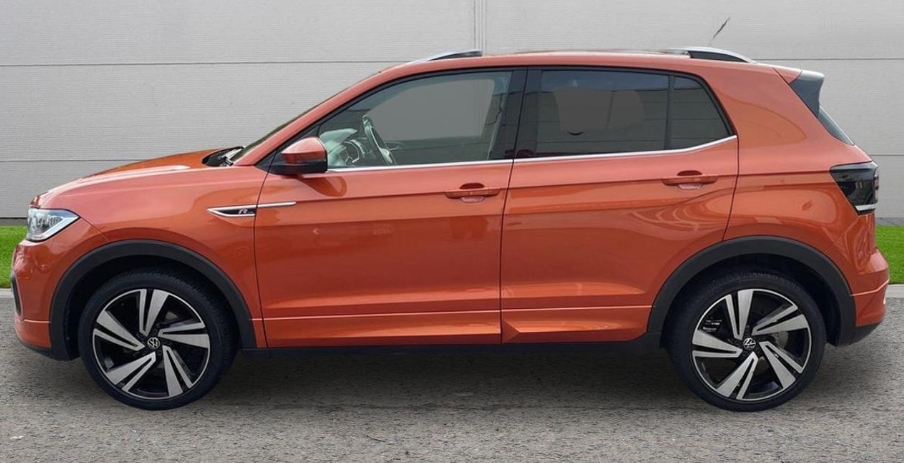
- R-Line: The range-topping, sport-styled trim. The R-Line was distinguished by its aggressive R-Line specific bumpers, unique 18-inch alloy wheels, R-Line badging, and a sportier interior with branded seats and a flat-bottomed steering wheel. It combined the flair of a performance model with the standard engine range.
Throughout this period, Volkswagen also introduced various special editions like the United and Active models, which bundled popular options from higher trims into a competitively priced package.
Global Adaptation: The T-Cross in a Different Guise
The evolution of the T-Cross is incomplete without mentioning its most significant market adaptation: its Indian counterpart. In 2021, as part of the “India 2.0” project, Volkswagen launched the Volkswagen Taigun.
While technically a different nameplate, the Taigun is fundamentally the LWB T-Cross, heavily localized for the Indian market. It shares the 2,651 mm wheelbase and MQB A0 IN platform (a variant adapted for India). However, its styling was tweaked to appeal to local tastes, featuring more prominent chrome on the grille and bumpers. The interior was also distinct, with a dashboard layout unique to the Taigun and its Skoda Kushaq cousin. The Taigun demonstrated the ultimate flexibility of the T-Cross concept—a core architecture that could be remolded, restyled, and re-engineered to succeed in a completely different automotive environment.
The Mid-Cycle Facelift: A Comprehensive Refresh (Late 2023 for 2024 Model Year)
After four successful years and over 1.2 million units sold globally, the T-Cross was due for its mid-cycle update. Unveiled in the summer of 2023 for the 2024 model year, the facelift was far more than a simple cosmetic touch-up. Volkswagen listened carefully to customer feedback and market trends to address the model’s few weaknesses, primarily concerning interior material quality.
Exterior Evolution: The updated T-Cross gained a more mature and technical appearance.
- Front: A new bumper design with a revised lower grille and standard LED headlights across the range. Higher trims gained Volkswagen’s advanced IQ.LIGHT LED matrix headlights, a feature typically reserved for more expensive models.
- Rear: The most noticeable change was the new full-width light bar incorporating a dynamic 3D LED cluster design, giving the T-Cross a more premium and modern light signature.
- Colours and Wheels: New vibrant paint options like “Grape Yellow” were introduced, along with freshly designed alloy wheels for each trim level.
Interior Revolution: This is where the most significant evolution occurred. The pre-facelift T-Cross was often criticised for its hard, scratchy plastics on the dashboard and door panels. Volkswagen rectified this comprehensively.
- Dashboard: A new, high-quality soft-touch dashboard with decorative stitching became standard, immediately lifting the cabin’s perceived quality.
- Infotainment: The integrated touchscreen was replaced by a new, tablet-style “floating” display. An 8-inch screen became standard, with a larger 9.2-inch version on higher-spec models, all running VW’s latest MIB3 software for faster responses and enhanced connectivity.
- Instrumentation: The Digital Cockpit became standard on all models, with the more advanced 10.25-inch Digital Cockpit Pro available on the upper trims.
Updated Trim Structure and Powertrains: The trim levels were simplified and renamed in many markets to align with Volkswagen’s newer models.
- T-Cross (Base): Replaced the S, now better equipped with LED headlights and the Digital Cockpit.
- Life: Remained the core model, gaining new 16-inch alloy wheels and a multifunction leather steering wheel.
- Style: Positioned as the elegant choice, it included the IQ.LIGHT matrix headlights and new 17-inch wheels.
- R-Line: Continued as the sporty flagship with its bespoke bumpers and interior detailing.
The 1.0 TSI engine received a slight power boost, with the upper version now producing 116 PS. The 1.5 TSI with 150 PS remained the top-tier engine choice. The facelifted T-Cross also saw an increase in its towbar’s maximum load, enhancing its versatility.
Conclusion: A Small SUV That Evolved to Win
The journey of the Volkswagen T-Cross from its 2019 debut to its current, extensively updated form is a case study in modern automotive strategy. It began life as a necessary and well-engineered response to a market trend, built upon the versatile and cost-effective MQB A0 platform. Its initial genius lay in the dual-wheelbase approach, allowing it to compete effectively as both a compact city crossover and a spacious small family car across different continents.
Its evolution through the 2024 facelift demonstrates Volkswagen’s ability to listen and react. The comprehensive interior overhaul addressed the model’s main critique, while the technological and stylistic updates have kept it sharp and competitive in a segment that is more crowded than ever. From a single concept, the T-Cross has evolved into a global family of vehicles—the European city-dweller, the spacious South American hauler, and the distinct Indian Taigun. It stands today not just as a smaller sibling to the T-Roc and Tiguan, but as a mature, confident, and hugely successful pillar of the Volkswagen range in its own right.