The Evolution of the Roush (Ford) Mustang: America’s Tuned Mustang Icon
For more than a quarter‑century, Roush Mustangs have stood at the pinnacle of tuned Ford Mustangs, blending factory‑level engineering with aftermarket performance enhancements and bespoke styling. Built by Roush Performance Products, these Mustangs are more than cosmetic packages — they’re coach‑built performance machines designed from birth to exceed the capabilities of standard Ford Mustangs. Over the years, the Roush Mustang lineup has continually evolved through multiple generations, powertrains, trim levels, and limited editions, cementing its legacy among enthusiasts of American muscle.
Origins: Roush Performance and the First Roush Mustangs (1995–1998)
The origins of the Roush Mustang trace back to the early 1990s. Jack Roush, a renowned engineer and motorsport figure, had been building performance parts for Ford and other manufacturers for years before turning his attention to performance Mustangs. Although Roush’s work on Mustangs can be traced to earlier aftermarket efforts, the company formally entered the Mustang market in 1995 under the banner of Roush Performance Products, located in Livonia, Michigan.
The early Roush Mustangs were based on the Ford Mustang SN‑95 generation (1994–2004) and featured a tiered package structure that would become a hallmark of the brand:
- Stage 1 – Primarily visual upgrades, including body kits, unique Roush wheels, badges, and interior trim.
- Stage 2 – Added handling and suspension enhancements to the Stage 1 foundation.
- Stage 3 – Included a ROUSHcharger supercharger and comprehensive performance upgrades.
These first Roush Mustangs offered real performance gains over the stock Mustang GT. For example, in 1995 the Stage 3 package bolstered the 5.0 L V8’s output with a bolt‑on intake, cowl induction hood, and optional Ford GT40 heads. Roush’s involvement began modestly, with much of the early work performed by dealers or third‑party shops before the company brought builds in‑house starting around 1997.
.

.
Second Generation: New Edge SN‑95 Roush Mustangs (1999–2004)
By 1999, Roush had fully taken control of its Mustang creation process, beginning a new generation of Roush Mustangs still based on the SN‑95 New Edge Mustang platform. These vehicles kept the familiar Stage 1/Stage 2/Stage 3 structure, but Roush expanded its offerings with both V6 and V8 options, and various special packages like convertibles and the base Roush Sport model.
The second‑generation Roush models brought enhanced craftsmanship and a broader range of customization options. For instance, in 2002 Roush introduced incremental Stage 3 variants such as Stage 3 Sport, Stage 3 Rally, and Stage 3 Premium, each offering varying degrees of performance and luxury enhancements.
Limited Edition highlights from this era included:
- 360R (2002) – A supercharged 4.6 L V8 Roush Mustang.
- 380R (2003–2004) – A 379 hp supercharged variant with only about 62 units in 2003 and special color options in 2004.
- 440A (2004) – A 40th‑anniversary limited edition Roush handling package boasting 400 hp.
These years solidified Roush’s reputation for blending factory reliability with performance upgrades and bespoke styling, but the real turning point was still ahead with a new generation of Mustangs.
Third Generation: S197 Roush Mustangs (2005–2014)
With the introduction of the S197 Mustang in 2005, Roush ushered in its most prolific era. Once again, the Stage hierarchy remained central:
- Stage 1 – Body styling, aero enhancements, Roush wheels and badges.
- Stage 2 – Added suspension and brake upgrades to improve handling.
- Stage 3 – Roush‑charged supercharger packages combined with aggressive tuning and hardware for substantial power increases.
The Stage 3 in particular became known for delivering performance rivaling or exceeding many specialty Mustangs and factory performance cars of the era. Power outputs climbed with incremental improvements in Roushcharger technology, often pushing well beyond 400 hp in the late 2000s.
Notable models and special editions from this generation included:
- 427R (2007–2010) – A supercharged 4.6 L V8 typically rated at 415‑435 hp, including variants with distinctive chrome Eaton M90 superchargers.
- 427R Trak Pak (2008) – Limited to about 100 units, adding advanced suspension aimed at track performance.
- 428R (2008) – Similar level performance with visual and equipment enhancements.
- P51A and limited series versions – Special editions that often celebrated performance heritage or offered unique equipment and power configurations.
This era represented Roush’s most diverse lineup of tuned Mustangs up to that point, with cars that were often as distinct visually as they were in performance capability.
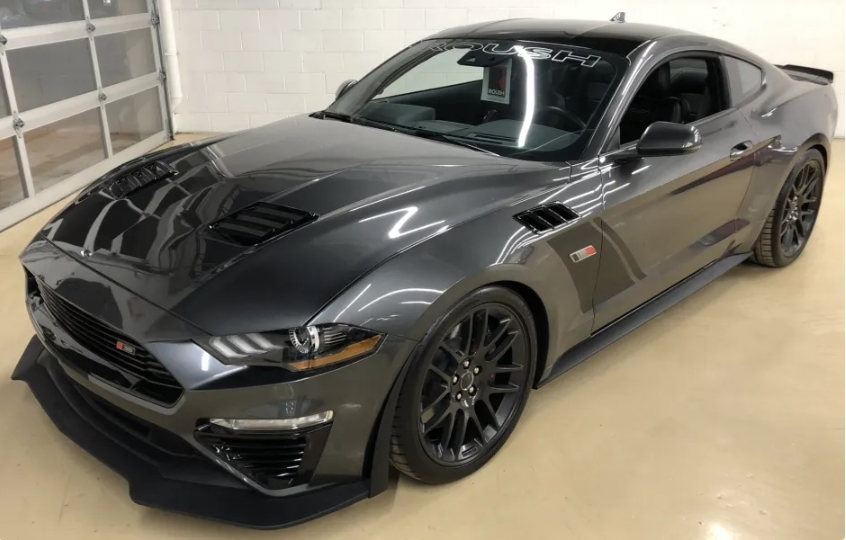
Fourth Generation: S550 and Modern Evolution (2015–Present)
With the release of the S550 Mustang in 2015, Roush began a new chapter that broadened the tuning scope even further. During this era the company expanded beyond its traditional V8‑heavy roster to include packages for the Mustang’s 2.3 L EcoBoost and 3.7 L V6 engines:
- RS / RS1 – Entry‑level Roush models focusing on styling and modest performance tweaks, often based on the V6 or EcoBoost Mustangs.
- Stage 1 – Performance styling enhancements typically with stronger wheels, aero, and moderate suspension tuning.
- Stage 2 – Included more significant suspension, brakes, and chassis upgrades.
- Stage 3 (and later Jackhammer) – Supercharged engines delivering massive power, frequently with outputs ranging from roughly 670 to over 750 hp.
For example, in 2014 the Stage 3 Roush Mustang featured the R2300 Roushcharger, producing around 575 hp, with even higher outputs in Phase 2 and Phase 3 iterations. By the late 2010s, Stage 3 and similar variants were pushing beyond 700 hp, sometimes approaching 775 hp in special editions like the Jack Roush Edition.
Modern Roush Mustangs also offer more extensive interior and cosmetic options, such as Roush‑branded leather, custom gauges, illuminated sill plates, and optional aerodynamic packages like the R9 Aero Body Kit.
Trim Levels, Special Editions, and Power
Throughout the Roush Mustang history, the company has consistently built on a straightforward philosophy: provide ample levels of performance and styling improvements that match customer desires. Trim evolution generally followed this format:
- RS / Roush Sport – Base Roush styling and modest performance improvements (more common in S550 era).
- Stage 1 – Primarily visual styling with some exhaust and minor performance tweaks.
- Stage 2 – Adds suspension, brake, and handling upgrades to Stage 1.
- Stage 3 – Full performance package including Roushcharger supercharger and tuning, high‑performance brakes, and other hardware.
- Limited Special Editions – Roush numbered or themed variants like 380R, 427R Trak Pak, P51 series, or Jack Roush Edition add exclusivity and higher power ratings.
Official Roush Mustangs are street‑legal across all 50 U.S. states, and packages are available for both manual and automatic Ford Mustangs.
Production, Popularity, and Legacy
Exact production figures for Roush Mustangs vary year to year and by model, but records show several thousand Roush‑produced Mustangs being sold annually at peak production. For example, around 616 Mustangs were built in 2011 alone, including coupés and convertibles across stages.
Over the decades, Roush Mustangs have earned a reputation for muscular performance, bold styling, and a performance pedigree rooted in motorsports — reflecting Jack Roush’s own racing background. This legacy continues to make Roush Mustangs highly desirable among enthusiasts who want more than a stock Mustang but still appreciate factory‑supported engineering.
Future Outlook
As Ford continues to evolve the Mustang platform — including electrified variants — Roush Performance has opportunities to expand its offerings into hybrid/electric‑adapted upgrades while continuing to refine traditional internal combustion packages. While demand for high‑performance gas engines remains strong among purists, Roush’s engineering prowess positions it well for future adaptation in whatever form Mustang takes in the decades ahead.
From its humble beginnings in the mid‑1990s to the high‑power monsters of the 2020s, the Roush Mustang has become synonymous with elevated Mustang performance. Across multiple generations and trim levels — from RS and Stage 1 to Stage 3 and limited‑edition variants — each Roush Mustang represents a blend of bespoke engineering, bold styling, and crowd‑pleasing power that continues to captivate enthusiasts. Whether driven on the street, shown at meets, or collected as American performance icons, the Roush Mustang legacy remains vibrant and influential in the world of tuned muscle cars.