The Evolution of the Pagani Huayra: A Hypercar Masterpiece
The Pagani Huayra is a hypercar that represents the pinnacle of automotive engineering, blending breathtaking performance, cutting-edge technology, and unparalleled craftsmanship. Introduced as the successor to the iconic Pagani Zonda, the Huayra quickly established itself as one of the most advanced and exclusive supercars of its time. Over the course of its production run, which began in 2011 and spanned more than a decade, the Huayra underwent numerous updates, with different variants, special editions, and performance enhancements introduced along the way. This article takes an in-depth look at the evolution of the Pagani Huayra, covering its history, key variants, technological advancements, and its future outlook.
The Birth of the Pagani Huayra: The Successor to the Zonda
Pagani Automobili, founded by Argentine-Italian engineer Horacio Pagani, had already made a name for itself in the automotive world with the release of the Pagani Zonda, a hypercar that redefined the boundaries of automotive performance and design. The Zonda became a symbol of innovation, craftsmanship, and extreme performance, but after over a decade in production, it was time for a successor.
In 2011, Pagani unveiled the Huayra, named after the Incan god of the wind, which would build on the Zonda’s legacy and take Pagani’s design and engineering to new heights. With the Huayra, Pagani introduced several groundbreaking technologies, including active aerodynamics, a bespoke twin-turbocharged engine, and an unparalleled level of luxury and customization. The car’s design, which combined both elegance and aggression, was a major departure from the Zonda, yet it retained the unmistakable Pagani DNA.
The Huayra marked a shift towards more modern hypercar elements, incorporating both performance and refinement. The car’s arrival in 2011 was eagerly anticipated, and it quickly earned its place among the world’s most prestigious and performance-oriented vehicles. What set the Huayra apart was its combination of extraordinary performance, cutting-edge technology, and meticulous attention to detail, making it a true masterpiece on wheels.
Pagani Huayra (2011 – 2018): The First Production Model
The Pagani Huayra was officially unveiled at the 2011 Geneva Motor Show, where it immediately captured the attention of automotive enthusiasts and critics alike. The first iteration of the Huayra came equipped with a 6.0-liter twin-turbocharged V12 engine developed by Mercedes-AMG, producing around 720 horsepower and 738 lb-ft of torque. This allowed the car to accelerate from 0 to 60 mph in just 3.0 seconds, with a top speed in excess of 230 mph (370 km/h).
One of the standout features of the Huayra was its active aerodynamics system, which included adjustable front flaps and an active rear spoiler that would adjust automatically based on the car’s speed and driving conditions. This system helped optimize downforce and stability, ensuring the car remained planted on the road, even at extremely high speeds. It was one of the first hypercars to incorporate active aerodynamics as a core element of its design.
The Huayra’s Carbon-Titanium monocoque chassis was another revolutionary design element, combining the strength of carbon fiber with the lightness of titanium. This allowed the car to be both incredibly strong and lightweight, enhancing performance while ensuring safety. The interior of the car was as meticulously crafted as its exterior, with high-quality leather, carbon fiber accents, and luxurious finishes throughout.
Key Features of the Pagani Huayra (2011 – 2018):
- Engine: 6.0L twin-turbo V12 (Mercedes-AMG)
- Power Output: 720 horsepower
- Torque: 738 lb-ft
- 0-60 mph: 3.0 seconds
- Top Speed: 230 mph (370 km/h)
- Transmission: 7-speed automated manual
- Production: 2011-2018 (Limited production)
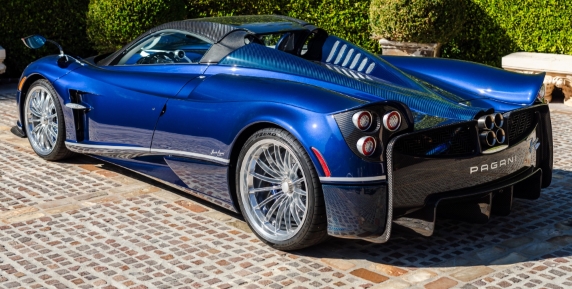
Pagani Huayra Roadster (2017 – 2020)
In 2017, Pagani introduced the Huayra Roadster, a convertible variant that offered a more visceral driving experience. The Huayra Roadster was not just about dropping the top; it also came with several performance enhancements and design revisions to make it even more dynamic than its coupe counterpart.
The Huayra Roadster was equipped with the same 6.0L twin-turbo V12 engine from Mercedes-AMG, producing 764 horsepower and 738 lb-ft of torque. However, the roadster was significantly lighter than the coupe thanks to extensive use of carbon fiber and the removal of the roof structure. The car’s performance figures were nearly identical to the coupe, with a 0-60 mph time of 3.0 seconds and a top speed of 210 mph (338 km/h). Despite the added weight of the roofless design, Pagani engineers were able to ensure that the Roadster offered a driving experience that was just as exhilarating as the coupe.
To achieve this, Pagani employed an even more advanced version of their Carbotitanium technology, which incorporated a new hybrid carbon-fiber-titanium material for the chassis. This allowed the car to retain its structural integrity while offering reduced weight. The Roadster also featured enhanced aerodynamics, including a redesigned rear spoiler and new active aerodynamics components, which helped the car maintain stability and performance in all conditions.
Inside, the Roadster offered the same level of craftsmanship and attention to detail as the coupe, with hand-stitched leather, brushed aluminum, and carbon fiber finishes. The car was highly customizable, allowing buyers to create a truly unique machine that reflected their personal style.
Key Features of the Pagani Huayra Roadster (2017 – 2020):
- Engine: 6.0L twin-turbo V12 (Mercedes-AMG)
- Power Output: 764 horsepower
- Torque: 738 lb-ft
- 0-60 mph: 3.0 seconds
- Top Speed: 210 mph (338 km/h)
- Transmission: 7-speed automated manual
- Production: 2017-2020 (Limited production)
Pagani Huayra BC (2016 – 2018): The Track-Focused Supercar
The Huayra BC was introduced in 2016 as a more performance-focused version of the original Huayra. The BC, named after Ben Chen, a Pagani enthusiast and collector, was designed to offer even more extreme handling, performance, and lightweight engineering for those who wanted a track-ready version of the Huayra.
The Huayra BC featured a significantly more powerful 6.0L twin-turbo V12 engine, now producing 750 horsepower and 738 lb-ft of torque, making it one of the most potent versions of the Huayra ever produced. In addition to the increase in power, the BC was equipped with a lighter Carbotitanium monocoque and a more aggressive aerodynamic package that included a larger rear wing, more prominent front flaps, and new underbody aerodynamics to increase downforce and improve high-speed stability.
The car’s suspension was also revised, with Pagani using a new hydraulic suspension system to improve handling and responsiveness on the track. This suspension setup allowed the BC to offer a more dynamic driving experience, particularly at high speeds. The BC also featured an increased use of lightweight materials, which helped reduce the car’s overall weight by over 200 kilograms (440 lbs) compared to the standard Huayra.
Inside, the Huayra BC was stripped of non-essential luxury features, focusing instead on providing a more track-oriented interior. The emphasis was on performance and functionality, with carbon fiber and Alcantara finishes dominating the cockpit.
Key Features of the Pagani Huayra BC (2016 – 2018):
- Engine: 6.0L twin-turbo V12 (Mercedes-AMG)
- Power Output: 750 horsepower
- Torque: 738 lb-ft
- 0-60 mph: 2.8 seconds
- Top Speed: 225 mph (362 km/h)
- Transmission: 7-speed automated manual
- Production: 2016-2018 (Limited production)
Pagani Huayra Imola (2020 – 2021)
The Huayra Imola was introduced in 2020 as one of the final iterations of the Huayra before the model’s official retirement. This special edition was designed to take everything Pagani had learned from the BC and Roadster and apply it to an even more track-oriented package. With a focus on extreme performance, the Huayra Imola was equipped with an upgraded version of the 6.0L twin-turbo V12, producing 827 horsepower and 811 lb-ft of torque. The car’s handling was further enhanced by a completely revised suspension system, updated aerodynamics, and significant weight-saving measures.
Pagani also took steps to improve the car’s performance on both the road and track by refining the active aerodynamics system, which helped maximize downforce and minimize drag at high speeds. The Imola was built with a focus on creating a hypercar that could excel both in a straight line and on a racing circuit.
Key Features of the Pagani Huayra Imola (2020 – 2021):
- Engine: 6.0L twin-turbo V12 (Mercedes-AMG)
- Power Output: 827 horsepower
- Torque: 811 lb-ft
- 0-60 mph: 2.7 seconds
- Top Speed: 238 mph (383 km/h)
- Transmission: 7-speed automated manual
- Production: 2020-2021 (Limited production)
Future Outlook: Pagani’s Next Chapter
With the end of the Huayra’s production, Pagani has shifted its focus to the Pagani Utopia, which represents the next evolution in the company’s hypercar lineage. While the Utopia introduces hybrid technologies and new design philosophies, the Huayra’s legacy continues to influence Pagani’s design language and engineering approaches.
The Pagani Huayra remains one of the most revered hypercars ever built. It pushed the boundaries of performance, luxury, and craftsmanship, and it will undoubtedly continue to be celebrated by enthusiasts and collectors for years to come. As Pagani moves toward the future, the Huayra’s influence will remain a cornerstone of the brand’s success.
Conclusion
The Pagani Huayra represents the pinnacle of engineering, performance, and artistry in the world of hypercars. From its groundbreaking active aerodynamics to its stunning design and incredible power, the Huayra has set a new benchmark for automotive excellence. As the model transitions into the history books, its impact will undoubtedly resonate for generations of automotive enthusiasts to come.