The Grand Solution: How the Toyota Grand Highlander Redefined the Family SUV
For years, a curious gap existed in the automotive market’s most competitive segment. Drivers seeking a three-row family SUV were often faced with a compromise. Vehicles like the immensely popular Toyota Highlander offered legendary reliability and efficiency but were often criticized for a third row best suited for small children and limited cargo space when all seats were occupied. On the other end of the spectrum, larger, truck-based SUVs like the Toyota Sequoia provided cavernous interiors but came with the penalties of higher fuel consumption, a less refined ride, and a significantly larger price tag. Into this void stepped the Toyota Grand Highlander, a vehicle meticulously engineered not as a mere extension of its namesake, but as a purpose-built solution to the modern family’s dilemma.
The Genesis: A Highlander with a Higher Purpose
The story of the Grand Highlander begins not with its own design, but with the market forces that demanded its creation. The fourth-generation Toyota Highlander, which debuted for the 2020 model year, was and remains a sales champion. It excels in safety, comfort, and, particularly in its hybrid form, fuel economy. However, as competitors like the Kia Telluride, Hyundai Palisade, and Honda Pilot grew in size and practicality, the Highlander’s primary weakness—its packaging—became more apparent. The third row was tight, and with it in use, the 16 cubic feet of remaining cargo space was barely enough for a weekly grocery run, let alone luggage for a family vacation.
Toyota’s product planners recognized this. They saw customers who loved the Toyota brand and the Highlander ethos but were reluctantly shopping elsewhere for the sheer space they required. The answer was not to compromise the standard Highlander, which served its own loyal customer base perfectly, nor was it to push everyone towards the larger and more rugged Sequoia. The answer was to create a new vehicle that bridged the gap, one that shared the unibody TNGA-K platform for a car-like ride but was fundamentally redesigned from the B-pillar rearward to prioritize space. The Toyota Grand Highlander was officially announced in early 2023 and went on sale later that year as a 2024 model year vehicle. It has continued into the 2025 model year with minimal changes, solidifying its place in the lineup.
.

.
Powertrain Philosophy: The Power of Three Choices
A cornerstone of the Grand Highlander’s appeal is its diverse range of powertrain options, offering a clear choice between accessible power, ultimate efficiency, and thrilling performance. This strategy ensures there is a Grand Highlander for nearly every type of three-row SUV buyer.
- The Standard Gasoline Engine: The entry point is a potent and modern 2.4-liter turbocharged four-cylinder engine. This powertrain produces a robust 265 horsepower and 310 lb-ft of torque, paired with a smooth 8-speed automatic transmission. Available in both front-wheel drive (FWD) and all-wheel drive (AWD), this engine provides confident acceleration and a respectable towing capacity of up to 5,000 pounds. It serves as the workhorse of the lineup, offering a familiar and capable driving experience for those who prioritize traditional performance.
- The High-Efficiency Hybrid: Leveraging Toyota’s decades of hybrid leadership, this option pairs a 2.5-liter four-cylinder engine with electric motors in the proven Toyota Hybrid System. The combined system output is 245 horsepower. While this is the lowest horsepower figure, the instant torque from the electric motors provides smooth, capable acceleration from a standstill. The powertrain is mated to an electronically controlled Continuously Variable Transmission (eCVT). Its primary mission is fuel economy, achieving an impressive manufacturer-estimated 36 MPG combined for the FWD version, a class-leading figure for an SUV of its size. The AWD version adds a dedicated electric motor to the rear axle for on-demand traction.
- The Performance-Oriented Hybrid MAX: The top-tier powertrain is a revelation in the segment. The Hybrid MAX system, available exclusively with AWD, combines the 2.4-liter turbocharged engine with a more powerful electric motor configuration. The result is a thrilling 362 combined horsepower and 400 lb-ft of torque. This powertrain transforms the Grand Highlander from a capable family hauler into a surprisingly quick and responsive vehicle, capable of a 0-60 mph time of just 6.3 seconds. Mated to a 6-speed automatic transmission, it delivers performance that rivals some luxury brands while still offering a respectable estimated 27 MPG combined. The 5,000-pound towing capacity is maintained, making it the ultimate do-it-all option.
Models and Trim Levels: A Clear Ladder of Progression
For its inaugural 2024 and 2025 model years, the Toyota Grand Highlander is offered in three distinct and well-equipped trim levels: XLE, Limited, and Platinum.
XLE The XLE serves as the entry point but is far from a “base” model. It establishes a high standard of features aimed directly at families.
- Powertrains: Available with the 2.4L Turbo (FWD/AWD) or the 2.5L Hybrid (FWD/AWD).
- Key Features:
- 18-inch alloy wheels.
- Seating for 7 or 8 passengers (with an optional second-row bench seat).
- SofTex®-trimmed seats with heated front seats and a 10-way power-adjustable driver’s seat.
- A massive 12.3-inch Toyota Audio Multimedia touchscreen, which is standard across the entire lineup.
- A 7-inch Multi-Information Display (MID) in the gauge cluster.
- Wireless Apple CarPlay® and Android Auto™.
- Wireless smartphone charging.
- Six USB-C ports (with a seventh available).
- A power liftgate.
- Toyota Safety Sense™ 3.0 (TSS 3.0), a comprehensive suite of active safety features.
Limited The Limited trim elevates the Grand Highlander into a near-luxury category with enhanced comfort, technology, and premium materials.
- Powertrains: Available with the 2.4L Turbo (FWD/AWD) or the 2.5L Hybrid (FWD/AWD). The performance-oriented Hybrid MAX powertrain is also available starting at the Limited trim level.
- Key Features (in addition to or replacing XLE features):
- 20-inch alloy wheels.
- Leather-trimmed seats with heated and ventilated front seats and heated second-row seats.
- A 12.3-inch fully digital instrument cluster.
- An 11-speaker JBL® Premium Audio system.
- A heated steering wheel.
- Ambient interior lighting.
- A hands-free power liftgate.
- Front and Rear Parking Assist with Automatic Braking.
- Power-folding side mirrors.
Platinum The Platinum trim represents the pinnacle of the Grand Highlander lineup, packed with every available piece of technology and luxury Toyota has to offer.
- Powertrains: Available exclusively with the 2.4L Turbo (AWD) or the top-of-the-line Hybrid MAX (AWD).
- Key Features (in addition to or replacing Limited features):
- Exclusive 20-inch two-tone alloy wheels.
- A Panoramic View Monitor (360-degree camera system).
- A 10-inch color Head-Up Display (HUD).
- A panoramic moonroof.
- A digital rearview mirror.
- Heated and ventilated second-row captain’s chairs.
- Traffic Jam Assist (with an active Drive Connect subscription).
- Two 120V household-style outlets.
Design and Dimensions: The “Grand” Difference
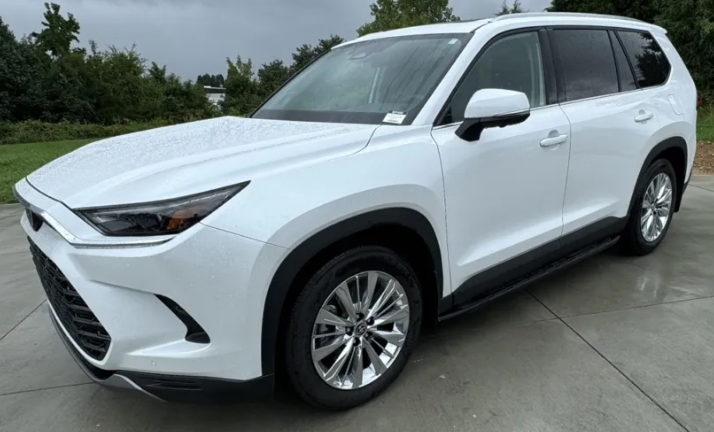
Visually, the Grand Highlander distinguishes itself from its sibling with a more upright, chiseled design. The front end features a unique trapezoidal grille, and the body sides are less sculpted, emphasizing its length and interior volume. The real story, however, is in the numbers.
Compared to the standard Highlander, the Grand Highlander is:
- 6.5 inches longer overall.
- 2.3 inches taller.
- 2.0 inches wider.
- Features a 4.0-inch longer wheelbase.
This translates directly into a cavernous interior. The third row offers 33.5 inches of legroom, a significant increase that comfortably accommodates adults. But the most crucial improvement is cargo capacity. Behind the third row, the Grand Highlander boasts 20.6 cubic feet of space, enough for multiple carry-on suitcases. With the third row folded, that expands to 57.9 cubic feet, and with all rear seats down, it opens up to a massive 97.5 cubic feet of storage. Furthermore, thoughtful touches like 13 cupholders and numerous storage cubbies underscore its family-first design.
Future Outlook and Market Position
The Toyota Grand Highlander has been an immediate success, validating Toyota’s strategy. It has effectively captured buyers who would have otherwise left the brand, without significantly cannibalizing sales of the standard Highlander, which continues to appeal to those who don’t need the extra space.
Looking ahead, the Grand Highlander’s future appears bright and stable. As a new platform, a major redesign is not expected for several years. We can anticipate minor updates in subsequent model years, such as new color options, potential software enhancements for the infotainment system, and perhaps slight adjustments to feature packaging within the trim levels. The core offering—the trio of powertrains, the three well-defined trims, and the immense interior space—is a winning formula that will likely remain unchanged for the foreseeable future.
The Grand Highlander doesn’t just compete; it sets a new benchmark. It proves that a family SUV doesn’t have to compromise. You can have a comfortable, car-like ride, class-leading hybrid efficiency, exhilarating performance, cutting-edge technology, and, finally, enough space for the whole family and everything they bring with them. It is not just a bigger Highlander; it is Toyota’s grand and definitive answer to the needs of the modern American family.