The Grand Tourer That Defined a Generation: The Enduring Legacy of the Mazda 808
In the annals of automotive history, some cars are remembered as icons of their time, while others quietly build a legacy that outlasts their production run. The Mazda 808, sold in Japan as the Mazda Grand Familia, belongs firmly in the latter category. It was a car that encapsulated a pivotal moment for Mazda, a vehicle that blended practicality with surprising performance, and laid the groundwork for the brand’s future identity as a builder of desirable, driver-focused cars.
Produced from 1971 to 1978, the 808 was more than just an entry-level sedan. It was a comprehensive family of vehicles that ranged from humble economy cars to spirited coupes and even rugged, all-terrain pioneers. Its story is one of evolution, resilience, and a commitment to engineering ingenuity, leaving a lasting impression on the automotive landscape and serving as a direct ancestor to the legendary Mazda GLC.
The Genesis: A Push for a New-Generation Familia
To understand the 808, one must first understand the car it was designed to replace: the Mazda Familia (also known as the 800). The Familia had been a success, but by the late 1960s, the automotive world was moving on. Competitors like Toyota and Datsun were expanding their offerings with more modern, larger family cars. Mazda needed a successor that could compete on a global scale, offering more space, more power, and updated styling.
The result was the Mazda Grand Familia, which debuted in Japan in July 1971. The name itself was telling—”Grand” signified a step up in size, comfort, and sophistication. When it was exported, it was marketed under a different, more familiar name in many key markets: the Mazda 808. This name, like the preceding 800, referenced the engine displacement (800cc class), though the car would soon grow to offer larger engines.
The First Generation (1971-1973): The Debute and the “Hakone”
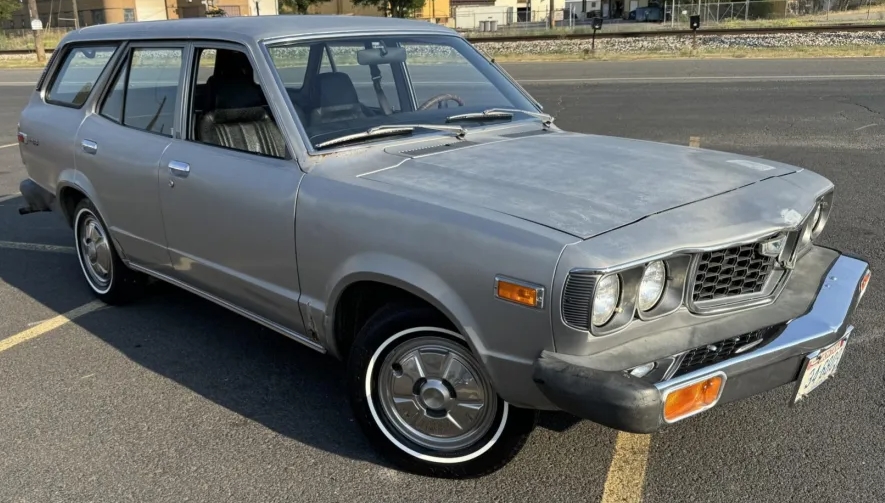
The initial Mazda 808 ( chassis code FA4) was offered in a clean, conservative four-door sedan and a five-door station wagon form. The styling was typical of the era, with crisp lines, a chrome grille, and a generally upright posture. It was an handsome but not revolutionary design.
Under the hood, the primary engine was the UA, a 1.0-liter (987cc) air-cooled, horizontally-opposed twin-cylinder engine, a direct descendant of the Familia’s powerplant. While reliable, it was underpowered for a car of this size.
Recognizing this, Mazda made a crucial update in October 1971, introducing the JA 1.3-liter (1272cc) water-cooled inline-four engine. This engine, borrowed from the Mazda Capella, transformed the 808, providing much-needed pep and drivability.
In April 1972, Mazda unveiled what would become the most iconic version of the first generation: the Mazda 808 coupe, known in Japan as the Grand Familia GT or, more famously, the “Hakone”. Named after the scenic Hakone turnpike near Mount Fuji, this model was a game-changer. It featured a sleek, pillarless hardtop design with a graceful roofline and elegant trim. The GT model was powered by a more potent version of the 1.3-liter engine (JA), producing around 78 horsepower, a significant figure for the time. It was, for all intents and purposes, a budget-friendly personal luxury coupe with genuine sporting intent.
The first-generation 808 lineup consisted of these core models:
- 4-Door Sedan: The base model, available with either the 1.0L or 1.3L engine. Trim levels in Japan included the standard “M” and the more equipped “L”.
- 5-Door Wagon: The practical family hauler, also available with both engine options.
- Grand Familia GT (Hakone) Coupe: The style and performance leader, exclusively powered by the 1.3L inline-four.
The Second Generation (1973-1978): A Facelift and a Revolutionary Addition
In September 1973, Mazda gave the 808 a significant facelift. This update marked the beginning of the second generation, which would carry the model through to the end of its life. The exterior was heavily revised with a new, more prominent grille, restyled quad headlights (on top-tier models), and new bumpers.
More importantly, this is when the 808 family truly exploded in variety. The lineup was expanded to include two new body styles that would become legendary in their own right.
The core second-generation models were:
- 4-Door Sedan & 5-Door Wagon: These continued with updated styling and improved features. Engine options now included the 1.3L and a new, larger 1.5-liter (1490cc) inline-four, codenamed “E5”. Trim levels were expanded, often designated as L, GL (Grand Luxe), and top-spec SGX or “Super Grand.”
- The Mazda 808 Coupe (2nd Gen): The beloved Hakone hardtop received the same facelift as the sedans, featuring the new front-end design. It remained the quintessential 808 for style-conscious buyers.
- The Mazda 808 Pickup: A durable and simple light-duty pickup truck was added to the lineup. It shared the sedan’s chassis and mechanicals but featured a utilitarian steel bed. It was a testament to Mazda’s ability to create versatile platforms.
- The Mazda 808 “All-Wheel Drive” (Wagon): This was the true standout. In a move of remarkable foresight, Mazda introduced an all-wheel-drive version of the 808 station wagon. Using a selectable four-wheel-drive system with a low-range transfer case, this model was a genuine off-roader. It was a direct competitor to the Subaru Leone 4WD and laid the groundwork for Mazda’s later forays into all-terrain capability with the Proceed Marvie and the B-series trucks. It is arguably the world’s first true crossover wagon.
For a brief period in 1975, a 4WD version of the pickup was also offered, further cementing Mazda’s commitment to traction. The 808 was also available in Japan with a 3-speed automatic or a 4-speed manual transmission, with a 5-speed manual available as an option on sportier models.
Performance and Trim Levels Explained
Throughout its life, the 808 was offered with three main engines:
- 1.0L (987cc) Air-Cooled UA: The initial, underpowered entry-level engine.
- 1.3L (1272cc) Water-Cooled JA: The mainstay engine, providing a solid balance of economy and performance.
- 1.5L (1490cc) Water-Cooled E5: The larger, more powerful engine introduced for the second generation, available on GL and SGX trims.
Trim levels, while varying by market, generally followed this hierarchy:
- Base/GL/L: The standard models with basic comforts like vinyl seats, manual windows, and a heater.
- SGX (Super Grand): The top-of-the-line trim. This typically included upgraded cloth or velour upholstery, power windows, a tachometer, a clock, deluxe wheel covers, and sometimes a roof spoiler on the coupe. The SGX was Mazda’s way of showing that an economy car could be genuinely upscale.
A Brief History and a Quiet Fade
The Mazda 808 was born from a need to compete and was sold during a tumultuous period in automotive history. Its production began just before the 1973 Oil Crisis, which saw gasoline prices skyrocket. The 808’s relatively small and efficient engines (especially the 1.3L) helped it weather this storm better than larger American V8s.
However, by the late 1970s, the market was changing again. The 808, while competent, was beginning to look dated. Its air-cooled roots and rear-wheel-drive platform were becoming less competitive against newer, more efficient front-wheel-drive designs. Mazda needed a successor that was truly modern.
Production of the Mazda 808 ceased in 1978. In Japan, it was directly replaced by the groundbreaking Mazda 323/Familia, a front-wheel-drive compact that would become one of the world’s best-selling cars. The 808’s role as an affordable, rear-wheel-drive platform was also filled by the Mazda 626/Capella. The 808 didn’t get a dramatic send-off; it was simply phased out as Mazda moved forward into a new era of front-wheel-drive dominance.
The Enduring Legacy and Future Outlook
Though the Mazda 808 itself is now a rare sight on the roads, its spirit lives on. Its legacy can be seen in several key areas:
- The Mazda GLC: The Global Compact (GLC), launched in 1980, was the direct descendant of the 808/Familia line. It was a hugely popular car in North America and is remembered for its durability, efficiency, and surprising fun-to-drive nature—all traits that the 808 cultivated.
- The “Zoom-Zoom” Philosophy: The 808’s existence as a family car that offered spirited performance (especially the GT coupe) was a precursor to Mazda’s modern brand identity. The company has consistently sought to build cars that are engaging to drive, from the Miata to the CX-5. The 808 was an early example of this philosophy.
- The Genesis of the Crossover: The 808 AWD Wagon is a true historical footnote as one of the very first vehicles to combine the body of a family station wagon with a legitimate four-wheel-drive system. It was the conceptual blueprint for the crossovers and SUVs that dominate today’s market.
Today, the Mazda 808 is a cherished classic for enthusiasts who appreciate its simple, honest design and its place in Mazda’s history. Clean examples, particularly the Hakone coupe and the AWD wagon, are highly sought after. They represent a time when cars were straightforward, reliable, and built with a touch of unexpected flair. The 808 was more than just a stepping stone; it was a car that helped define Mazda as a creative, independent manufacturer capable of producing vehicles with character and a surprising amount of soul.