The Koenigsegg Jesko: A 1,600-hp Homage to a Founder and the Pursuit of 300 MPH
In the rarefied air of hypercar manufacturing, few names command as much reverence and awe as Koenigsegg. The Swedish automaker, founded by Christian von Koenigsegg, has built its reputation on a relentless pursuit of engineering purity, often defying the conventions of established automotive giants. While the Agera RS famously claimed the title of the world’s fastest production car in 2017, its successor needed to be more than just fast; it needed to be a technological leap capable of shattering the 300-mph barrier. That successor arrived in 2019, named not after a number or an aerodynamic concept, but after the company’s founder’s father: the Jesko.
A Legacy in the Name
Before the car was unveiled at the 2019 Geneva International Motor Show, Koenigsegg made a poignant announcement. The car would be named Jesko, in honor of Jesko von Koenigsegg, the founder’s father who passed away in 2020. Jesko Sr. was instrumental in the early days of the company, providing the financial backing and belief necessary to turn a teenage dream into a manufacturing reality. Naming the Agera’s successor after him was a tribute to the family roots that anchor the hypercar manufacturer.
The Jesko was designed to be the ultimate evolution of the Agera platform. While it retained the brand’s recognizable silhouette, every single component was re-engineered. The goal was twofold: to create a car that could dominate on the track with unprecedented agility and to build a machine capable of exceeding 300 mph (482 km/h) on a closed road, a feat no production car had officially achieved at the time.
The Heart of the Beast: The V8 Powertrain
At the core of the Jesko lies a heavily modified version of the familiar 5.0-liter twin-turbocharged V8 found in the Agera RS. However, calling it a mere evolution is an understatement. Koenigsegg stripped the engine down and rebuilt it with a new flat-plane crankshaft, new cylinder heads, and upgraded turbochargers.
The result is an engine that revs to a screaming 8,500 rpm and produces a staggering 1,280 horsepower on standard 91 octane pump gas. Switch to E85 biofuel, and the numbers climb even higher, unleashing 1,600 horsepower and 1,106 lb-ft of torque. This power is managed not by a traditional automatic transmission, but by Koenigsegg’s proprietary 9-speed Light Speed Transmission (LST). Unlike conventional gearboxes, the LST uses multiple clutches to allow for near-instantaneous shifts across a wide ratio spread, eliminating the need for a heavy dual-clutch system while maintaining seamless power delivery.
.

.
Aerodynamics: The “Aircore” Revolution
A hypercar with 1,600 horsepower is useless without the aerodynamic downforce to harness it. The Jesko features a new double-wishbone suspension setup and a proactive aerodynamic system that is as functional as it is striking.
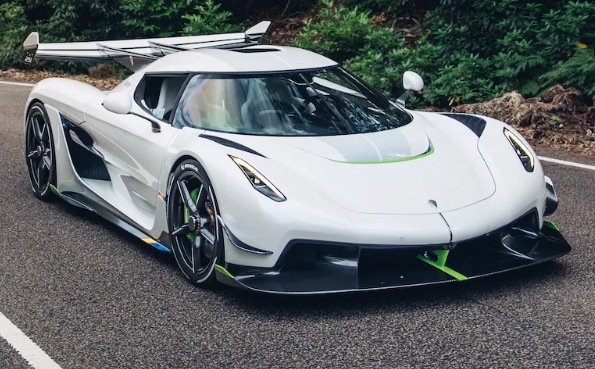
The most visually arresting innovation is the use of “Aircore” carbon fiber wheels. These hollow, carbon-fiber spokes replace traditional alloy rims, drastically reducing unsprung mass and gyroscopic forces. This allows for sharper turn-in response and improved handling dynamics. Furthermore, the wheels themselves act as fans, extracting air from the wheel wells to reduce pressure and turbulence.
The Jesko’s active rear wing is the centerpiece of its aerodynamic profile. At low speeds, it sits flush with the bodywork to minimize drag. Under braking or during high-speed cornering, it rises to generate significant downforce—up to 1,000 kg (2,200 lbs) at 250 km/h. The front active wing works in concert with the rear, adjusting its angle of attack to balance the car perfectly through corners.
The Models and Trim Levels
Unlike mass-market manufacturers who offer a dizzying array of trim levels and option packages, Koenigsegg operates on a bespoke basis. However, the Jesko lineup has evolved into distinct configurations based on aerodynamic philosophy and intended use.
1. The Jesko (Standard / “Clean” Design) When the car debuted in 2019, it was presented in a “clean” specification. This version prioritized a balance of low drag for top speed and downforce for track capability. It featured a large, single-element active rear wing and a relatively subtle front splitter. This is the configuration designed to chase the 300-mph title. Production of the standard Jesko is strictly limited to 125 units, all of which were sold out within days of the 2019 reveal.
2. The Jesko Absolut (Revealed 2021) In March 2021, Koenigsegg unveiled the Jesko Absolut. While based on the same chassis and powertrain as the standard Jesko, the Absolut is a completely different beast aerodynamically. It is designed with one goal: to be the fastest road-legal Koenigsegg ever built.
To achieve this, the Absolut sheds much of the aggressive downforce-generating bodywork of the track-focused Jesko. The active rear wing is replaced by a low-drag “whale tail” spoiler that integrates into the bodywork, and the front active wing is removed entirely. The side skirts are smoothed out, and the ride height is lowered. Koenigsegg claims the Absolut has a theoretical top speed of over 330 mph (531 km/h), with a drag coefficient lower than that of a Volvo SUV. Only 125 units of the Jesko Absolut will be produced.
3. The Jesko Attack (Revealed 2023) While the Absolut is the king of the drag strip, the Jesko Attack is the emperor of the circuit. Unveiled in late 2023, this variant is the ultimate track-focused iteration.
The Attack features a massive, multi-element high-downforce rear wing and a large, adjustable front splitter with dive planes. It generates significantly more downforce than the standard Jesko, prioritizing cornering speeds over top-end velocity. The car also sits on hydraulic lifters that allow for a lower ride height at speed, further enhancing ground effect aerodynamics. The Attack is designed for owners who want to extract the maximum performance on a race track, such as the Nürburgring.
Production and Delivery Timeline
The lifecycle of the Jesko has been defined by the global pandemic and the meticulous nature of Swedish manufacturing.
- 2019: The Jesko is unveiled in Geneva. All 125 units of the standard model are sold out almost immediately.
- 2020-2021: Production delays occur due to COVID-19 supply chain disruptions. Koenigsegg pivots to focus on the development of the Jesko Absolut.
- 2022: The first production units of the Jesko (standard) are completed and delivered to customers.
- 2023: The Jesko Attack is revealed, expanding the lineup. Deliveries for the Absolut are slated to begin in 2023/2024, following the completion of the initial batch of standard Jeskos.
The Future Outlook
The Jesko represents the pinnacle of the internal combustion engine era at Koenigsegg. With the automotive industry rapidly shifting toward electrification, the Jesko may stand as one of the last great twin-turbo V8 hypercars from a boutique manufacturer.
Koenigsegg has announced plans to transition toward hybrid and fully electric powertrains in their future models (such as the Gemera). However, the Jesko’s legacy is secure. It is a celebration of mechanical purity, aerodynamic mastery, and the relentless pursuit of speed.
As of 2024, the Jesko remains the flagship of the Koenigsegg lineup. While the company has not announced a successor, the engineering lessons learned from the Jesko’s Light Speed Transmission and carbon-fiber construction will undoubtedly influence the next generation of hypercars. For the 250 owners who secured a build slot across the three variants, the Jesko is not just a car; it is a piece of automotive history, a testament to a father’s legacy, and a machine capable of rewriting the physics of speed.