The People’s Car, Perfected: The Complete Evolution of the Lada Granta
In the pantheon of automotive history, few vehicles represent a paradigm shift as stark as the Lada Granta. It was more than just a new model; it was a statement of intent, a promise of modernity, and a bridge between the utilitarian past of the Soviet-era Lada and the global ambitions of the Renault-Nissan-era AvtoVAZ. To understand the Granta is to understand the transformation of a Russian automotive giant. It is the story of how Russia’s best-selling car of the 2010s came to be, evolved, and ultimately laid the groundwork for the future.
The Genesis: A Granta of Hope (2011-2012)
By the late 2000s, AvtoVAZ, the sprawling automotive behemoth of Tolyatti, was at a crossroads. Its lineup was aging, dominated by the Lada Priora, which itself was a heavily modernized version of the 1990s Lada 110. While reliable and affordable, it lacked the refinement, safety, and design of contemporary global competitors. The venerable Lada 2107 (a Fiat 124 derivative) was still in production, a testament to both its durability and the brand’s stagnation.
Enter the Lada Granta. The project, codenamed “Project 2190,” was conceived under the leadership of then-Russian Prime Minister Vladimir Putin, who challenged AvtoVAZ to produce a high-quality, modern car for under 250,000 rubles. The goal was simple yet monumental: to create a true “people’s car” for modern Russia.
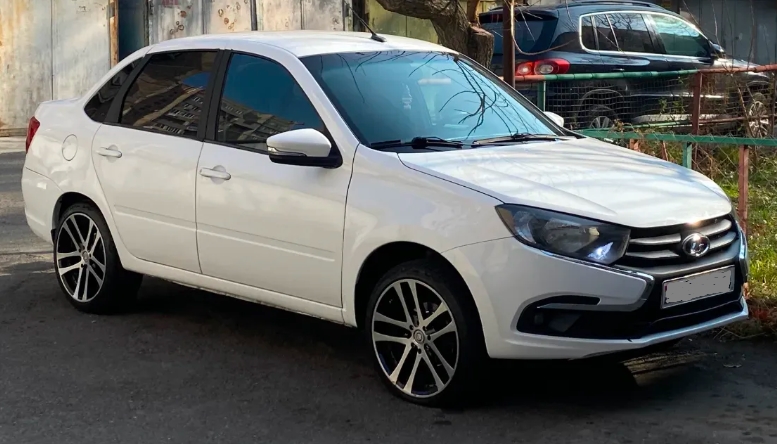
The Granta was built on the heavily modernized and elongated platform of the Lada Kalina (B-segment), effectively creating a new entry-level C-segment sedan. Its design was penned in-house at AvtoVAZ’s new design center, with oversight from Steve Mattin, the former head of design at Mercedes-Benz, who had been hired to bring international flair to the brand. The result was a clean, contemporary, and—most importantly—distinctly Lada shape. It was unpretentious but far from frumpy, with a confident stance and a much-improved interior over anything that had come before.
When the first Lada Granta sedans rolled off the assembly line in December 2011, they were offered in three distinct trim levels, each representing a clear step up in equipment:
- Standard: The absolute base model. It came with a driver’s airbag, a manual transmission, steel wheels with hubcaps, body-colored bumpers, a basic audio system with two speakers, and a rudimentary heater. Power came from the venerable 1.6-liter 8-valve engine, producing 82 horsepower.
- Norme: The mid-tier offering and the volume-seller. This trim added a passenger airbag, power steering, central locking with a remote, electric front windows, a more sophisticated audio system with four speakers, and a tachometer. The exterior was enhanced with painted bumpers and better trim.
- Luxury (Luxe): The top-of-the-line version. It included all “Norme” features and added alloy wheels, fog lights, heated front seats, a leather-wrapped steering wheel and gear knob, and a more premium-looking interior fabric. An optional “Luxury Sport” package briefly offered a leather interior and other cosmetic upgrades.
In a controversial move, the initial Granta was offered only as a sedan and with a non-collapsible steering column, a legacy of its budget-focused engineering. This was quickly rectified after public outcry, but it set the stage for the Granta’s reputation as a car that was good, but not perfect.
.
THIS might be a great place to get your new car from!
Or for those who are into the “car flipping” business, here’s an excellent resource for you!

.
The Expansion: Building a Family (2013-2016)
The Granta was an immediate, runaway success. Its combination of modern design, decent road manners, and a price point inaccessible to foreign competitors made it an instant bestseller. Capitalizing on this momentum, AvtoVAZ began a rapid expansion of the Granta family.
The first major addition arrived in 2013: the Lada Granta Liftback (Model 2192). This fastback-style version offered a much larger and more practical boot with a hatch, bridging the gap between the sedan and a small estate car. It was offered in the same Standard, Norme, and Luxe trims as the sedan, quickly becoming a favorite for families and tradespeople who needed the practicality of a hatchback without sacrificing the Granta’s affordable price tag.
The year 2013 also saw the introduction of a new transmission option: a 5-speed Automated Manual Transmission (AMT), developed by the Italian firm Magneti Marelli. Marketed as an “Agile” gearshift, it was not a traditional automatic but a robotized manual. While it drew criticism for its sometimes jerky shifts, its availability was a crucial step in making the Granta more accessible to a wider audience.
The pinnacle of Granta development in this era was the 2014 launch of the Lada Granta Sport. This was the car enthusiasts had been waiting for. Based on the liftback body style, the Sport was a true “warm hatch.” Its modifications were comprehensive:
- Engine: The 1.6-liter 16-valve engine was tuned to produce 118 horsepower.
- Suspension: A fully revised, sport-tuned suspension lowered the ride height and provided much sharper handling.
- Aesthetics: Aggressive front and rear bumpers, side skirts, a prominent rear spoiler, and 16-inch “Sling” alloy wheels gave it an assertive look.
- Interior: A signature Lada Sport steering wheel, aluminum pedals, and supportive front seats completed the package.
The Granta Sport was a revelation. It proved that AvtoVAZ could engineer a genuinely fun-to-drive car, earning praise from reviewers and immediately finding a devoted following in Russia’s motorsport scene, where it became a dominant force in rallycross and touring car championships.
In 2016, a minor but significant facelift was applied to the entire Granta line. The front bumper and grille were redesigned to look a bit more aggressive and integrated with the new Lada family face, prefiguring the design of the Lada Vesta. The interior received a redesigned center console with a new radio unit, and the steering wheel was updated. The “Off-road” trim was also introduced, featuring protective plastic cladding on the bumpers and sills, and a slightly increased ride height for those who ventured beyond the asphalt.
Refinement and the Turbocharged Apex (2017-2022)
The Granta continued its reign as Russia’s sales champion, but competition was intensifying. To keep the model fresh, AvtoVAZ continued to refine the range and introduce more specialized versions.
The Lada Granta Drive Active debuted in 2017 as an “off-road” version of the sedan and liftback. It sat higher than the standard car and featured a unique traction control system called “BRAKE ASR,” which could brake a spinning wheel to direct torque to the other, helping it crawl out of mud or snow. This trim was offered with both the standard 8-valve engine and the more powerful 16-valve unit.
A major turning point arrived in 2018 with the launch of the Lada Granta Cross. This was the successor to the “Off-road” trim, but it was much more than just an aesthetic package. The Cross was a serious crossover-inspired version with a 25 mm increase in ground clearance, protective body cladding, unique 16-inch wheels, and reinforced wheel arch liners. It was offered in both sedan and liftback forms and proved immensely popular, tapping into the global crossover trend.
The true game-changer, however, came in late 2021. AvtoVAZ finally retired the old 8-valve engine from all but the most basic models and introduced a new turbocharged 1.6-liter 16-valve engine. Co-developed with Renault, this engine was available in two states of tune:
- 90 HP: Paired with a 5-speed manual or the updated AMT, available in Norme and Luxe trims.
- 122 HP: Paired exclusively with a 5-speed manual, available in the newly renamed Granta Sport (Model 21928) and the top-spec Granta Luxe (Model 21908).
This was a monumental leap. The new turbo engine transformed the Granta. It was smoother, significantly more powerful, and more fuel-efficient. The 122 HP Sport was a true hot-hatch rival, capable of 0-100 km/h in under 9 seconds. This engine also made its way into a new, limited-run rally special, the Lada Granta Rally, a road-legal, stripped-out, 197-horsepower monster built for Group N homologation.
The Granta family was now at its most diverse: a budget sedan, a practical liftback, a sporty hot-hatch, a rugged crossover, and an AMT-equipped comfort model. It was a complete product portfolio built on a single, versatile platform.
The Unthinkable End and a Phoenix-like Future (2022-Present)
In the spring of 2022, everything changed. Following the invasion of Ukraine, international automakers fled Russia, and severe sanctions were imposed. AvtoVAZ, heavily reliant on Western components for its advanced turbo engines, modern AMT gearboxes, and even basic electronic components like airbag controllers, was forced to halt production.
The Granta line was gutted. The sophisticated turbo engines were gone, replaced by a detuned 8-valve engine running on a simplified domestic software that allowed it to run on lower-quality Russian gasoline. The AMT was discontinued indefinitely. Advanced safety features like electronic stability control (ESC) and even some airbag controllers were removed due to supply chain issues. The Lada Granta was, in essence, rolled back to a 2012-level of specification, but with a critical difference: its core chassis was still modern and safe, earning it a respectable three-star rating in updated Russian crash tests.
Yet, the Granta survived. It became the backbone of Russia’s recovering car market, its production restarting with the stripped-down components. New, quirky special editions like the “Kredo” and “Prostota” (Simplicity) appeared, celebrating the car’s newfound minimalism.
Today, the Lada Granta remains Russia’s best-selling car. Its future is one of slow, determined “import substitution.” AvtoVAZ is working to replace every sanctioned part with a domestic or friendly-nation equivalent. A new in-house-developed AMT is in the works. Research is underway to create a new Russian-made turbo engine.
The evolution of the Lada Granta is a story of adaptation. It began as a hopeful project to modernize a brand, grew into a versatile and beloved family of cars that defined a decade, and has now been forged in the crucible of geopolitics. It may have lost some of its modern amenities, but it has retained its core identity: an accessible, practical, and resilient vehicle for the people. The Granta is more than just a car; it is a reflection of the nation it serves.