The Perennial Gentleman: Charting the Noble Evolution of the Nash Ambassador
In the grand, often-brutal theater of the American automobile industry, some cars are rock stars, others are workhorses, and a precious few are statesmen. The Nash Ambassador was a statesman. For nearly three decades, it served as the flagship and standard-bearer for the Nash-Kelvinator and later, American Motors Corporation (AMC), representing a consistent philosophy of intelligent, comfortable, and forward-thinking transportation. It was a car that never screamed for attention but earned respect through its unique design, engineering integrity, and unwavering commitment to the buyer. Its evolution is a fascinating story of an independent automaker carving out a distinct identity in a sea of conformity.
The Genesis: The Birth of a Premium Name (1949-1951)
To understand the Ambassador, one must first understand its corporate parent. In 1937, George W. Mason founded the Nash Motors Company. By the 1940s, he was already envisioning a merger of independent automakers to create a company large enough to compete with the Detroit giants. That vision came to fruition in 1954 when Nash Motors merged with Hudson Motor Car Company to form the American Motors Corporation (AMC). The new company’s strategy was to consolidate resources and focus on a single, modern, and efficient product line, using the best from both companies.
However, the Ambassador name actually predates the AMC merger. It was first used in 1949 on the top-trim version of the Nash “Airflyte” series, the 600 Custom. This early “Ambassador” was not a distinct model but a premium designation, signaling the customer’s elevated status.
The true genesis of the Ambassador as we know it, however, began in 1951. That year, Nash launched its revolutionary “Airflyte 700” series. This car, designed by industry legend Pininfarina, was a stunning departure from the ornate, finned designs of its competitors. It was fluid, enclosed, and modern. The top-tier trim level was christened the Nash Ambassador. This was a full-fledged model, not just a trim package, and it came with a powerful 252 cubic-inch straight-eight engine, establishing its credentials as a premium cruiser from day one. It offered buyers a unique combination of European-inspired style and American comfort and power.
.
NO MORE dead batteries with this:

.
The Statesman with the Stance: The “Admirable” Era (1952-1957)
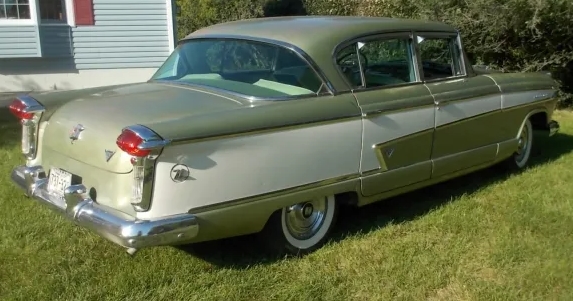
The 1952 model year solidified the Ambassador’s identity. The bodywork was updated, but the core philosophy remained. The most distinctive feature, which would become an Ambassador hallmark, was introduced: the “Dagmar” bumpers—two massive, chrome overriders mounted on the front bumper that gave the car a formidable and unique stance.
This generation of the Ambassador was offered in three body styles:
- Ambassador 4-Door Sedan
- Ambassador 2-Door Hardtop (the “V-855”)
- Ambassador 2-Door Convertible (the “V-895”)
Under the hood, the Ambassador continued with the robust Nash straight-eight until 1954. For 1955, in a nod to its new partnership with Hudson, AMC sought to use the more powerful Hudson “Hornet” inline-eight. However, a corporate decision was made to consolidate powertrains. As a result, the 1955 Nash Ambassador became the only car in its class to be offered with a V8 engine from the factory—the reliable 252 cubic-inch “Windsor” V8 from the Nash-Healey sports car. This made the Ambassador a surprisingly potent performer. Trim levels were simplified into two: the base Ambassador and the top-of-the-line Ambassador Custom, which featured a two-tone paint scheme, wheel covers, and a more luxurious interior.
In 1956, the Ambassador received a significant facelift. The front end was redesigned with a prominent split grille, and the Dagmar bumpers were enhanced with integral turn signals. The model lineup expanded to include the Ambassador Suburban, a two-door hardtop with a removable rear roof section (a precursor to the modern hatchback/sUV concept), and a new four-door hardtop sedan. This was also the first year the Ambassador could be ordered with an automatic transmission, the reliable Borg-Warner 3-speed.
For its final year in this classic form, 1957, the Ambassador adopted the流行的 “tri-tone” color schemes and more flamboyant tailfins of the era. The lineup was pruned back to the four-door sedan and the two-door hardtop.
The Forward-Looking Visionary: A Radical Transformation (1958-1960)
The late 1950s were the zenith of chrome, fins, and excess in American car design. George Romney, president of AMC, saw this as a wasteful and frivolous trend. He tasked his design chief, Chuck Jordan, to create a car that was the antithesis of this philosophy—one that was functional, efficient, and futuristic. The result was one of the most audacious and controversial cars in American history.
For 1958, the Nash Ambassador was reborn as the Rambler Ambassador. It was now on AMC’s new, smaller “senior” platform. The car was a “three-box” design, but with a radical twist: a “loop-side” body where the front fender, door, and rear fender were stamped from a single piece of sheet metal, eliminating a major rust-prone seam. The front end featured a unique “coffin-nose” grille, and the rear “u-trunk” lid opened downwards to form a useful deck platform.
The interior was even more revolutionary. It featured fully reclining front seats that could form a near-flat bed when combined with the rear seat, a concept AMC heavily promoted for family camping. High-quality, durable upholstery replaced the heavy chrome and gimmicks of the competition. The most advanced feature was its optional “Weather-Eye” air-conditioning system, which was actually a sophisticated forced-air ventilation and heating system that could be used with the windows up or down, making the interior comfortable in any condition.
The Rambler Ambassador was offered in two primary trim levels:
- Ambassador
- Ambassador V-8 (introduced later in the year, featuring the new AMC V8 engine)
In 1959, the Ambassador received minor styling tweaks. The grille was revised, and the engine bay was now home to AMC’s new, modern “AMC V8.” The lineup was simplified to just two models: the Ambassador 4-Door Sedan and the Ambassador 2-Door Hardtop. This generation was a commercial disappointment. It was too radical for conservative buyers, who saw it as small, underwhelming, and oddly styled compared to the long, low, and flashy cars from Ford and Chevrolet. AMC’s bet on substance over style had failed to find a mass market.
The Return of the King: The Classic Full-Size “Ambie” (1961-1965)
Sales of the small Rambler Ambassador told George Romney and his successor, Roy Chapin Jr., that the market for an independent automaker was in the compact and economy segments. The Rambler Classic, not the Ambassador, was the company’s sales champion. So, after the 1960 model year, the “big” Rambler Ambassador was discontinued. But the nameplate was too prestigious to retire.
For 1961, the Ambassador name returned, but as the absolute pinnacle of the Rambler lineup. It was no longer a separate model but the top-trim Rambler Classic 4-door sedan and 4-door hardtop. These were often called “Ambies” by the public. They were built on the Rambler Classic’s wheelbase but were distinguished by a unique grille, more luxurious interior fabrics (including cloth and leather options), a plusher suspension, and more chrome trim, including a faux spare tire hump on the trunk lid.
This strategy was a massive success. From 1962 to 1964, the Rambler Ambassador was the #1 car in its price class, offering more standard features than any competitor. The trim levels evolved:
- 1962: Ambassador 4-Door Sedan and Ambassador 4-Door Hardtop. Standard features were astonishing for the price, including a clock, electric clock, foam-cushioned seats, and unique interior trim.
- 1963: A major redesign introduced a more squared-off, formal look with a new “loop” grille. The Ambassador “850” and “990” designations were introduced. The 990 was the ultimate expression, featuring a padded vinyl roof, wheel covers, and an even richer interior.
- 1964: Minor styling changes, primarily a new grille with more horizontal bars. The 850 and 990 designations continued, with the 990 convertible (introduced this year) becoming a rare and desirable collector’s item.
The engines were AMC’s reliable straight-sixes, with an optional V8 available for more power.
The “Big” Ambassador and the Final Act (1965-1974)
In 1965, AMC made its biggest move in the Ambassador’s history. The entire Rambler line was restyled on a new, wider platform. The Ambassador, now officially the Rambler Ambassador, was put on a 108-inch wheelbase—the longest in the company’s history and a true full-size car. It was now a direct competitor to the Buick LeSabre, Oldsmobile 88, and Pontiac Laurentian. Styling was handsome and conservative, with a formal roofline and a clean, “European” look.
The model lineup now consisted of the Ambassador 4-Door Sedan and the Ambassador 4-Door Hardtop. Trim levels were the 850 and the top-tier 990. The 850 was a well-equipped premium family car, while the 990 added the vinyl roof, special wheel covers, upgraded interior, and more exterior trim. The standard engine was AMC’s venerable “Torque-Command” inline-six, with a 232 cubic-inch version standard and a 290 cubic-inch V8 (in two states of tune) as a popular option.
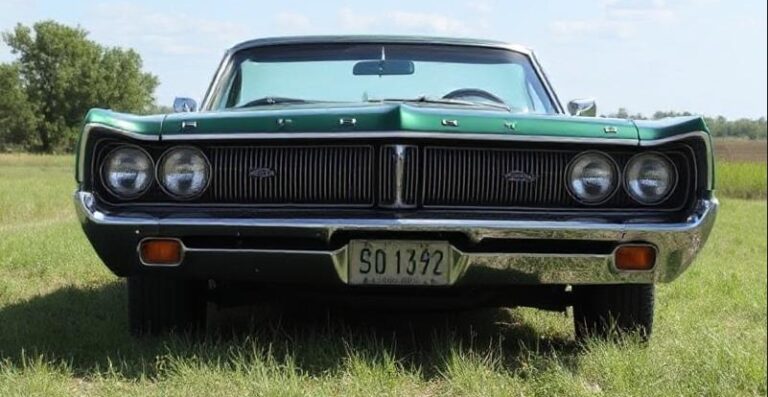
This generation lasted through 1966, after which the Rambler brand name was phased out on the Ambassador. For 1967, it became the AMC Ambassador. Styling was refreshed with a new “stacked” headlight grille. The 850 and 990 designations continued, and the AMC SST (Super Sports Touring) trim was introduced, which replaced the 850 and added sporty trim like hood scoops and special interior appointments.
The Ambassador received its final major redesign for the 1969 model year. Based on the new “fuselage” styling language of AMC’s midsize cars, it was a handsome and well-proportioned vehicle. This would be the last truly new design for the Ambassador. It was offered as a 4-door sedan, 4-door hardtop, and a new “SST” convertible for 1969 and 1970, a rare and fascinating car that put a luxury top on a family sedan chassis.
Over the next five years, the Ambassador was updated with new grilles and bumpers to meet federal safety standards, but its basic shape remained. The trim levels were eventually simplified to just one, the Ambassador, with a Brougham package available that added a padded vinyl roof, luxury interior, and wire-style wheel covers. The engine lineup grew to include a powerful 401 cubic-inch V8, making the final Ambassadors legitimate “sleepers.”
By 1974, the cost of meeting new, stricter emissions and safety regulations on an aging platform was prohibitive for a company the size of AMC. The decision was made to discontinue the Ambassador. Its final bow came at the end of the 1974 model year.
Legacy and Outlook
The Nash/AMC Ambassador never achieved the sales heights of the Big Three’s behemoths, but its legacy is profound. It was a testament to the idea that an independent automaker could thrive by offering a distinct product focused on the owner’s practical needs. It pioneered features like reclining seats-as-beds, superior ventilation, and high-end standard equipment. It proved that a car could be both conservatively styled and radically forward-thinking. Today, the Ambassador is a beloved classic, cherished by enthusiasts who appreciate its quiet dignity, clever engineering, and unique place in the annals of American automotive history—a true perennial gentleman.