The Riich M5: Chery’s Compact Sedan Experiment and the Rise of an Overlooked Subcompact
The Riich M5 is one of the lesser-known yet historically significant models produced by Chery Automobile under its short-lived premium sub-brand, Riich. Introduced during a period of rapid expansion and experimentation in China’s automotive industry, the M5 was designed as a more refined and practical alternative to the Riich M1 hatchback.
Although it never achieved major commercial success, the Riich M5 provides insight into early Chinese efforts to develop small, globally competitive passenger cars. Its evolution—from concept to discontinuation—reflects both the ambitions and challenges of its time.
Origins of the Riich Brand (2009)
The Riich M5’s story begins with the creation of the Riich brand in 2009. Chery launched Riich as part of a multi-brand strategy intended to elevate its image and compete with more established global manufacturers.
Riich was positioned above Chery’s mainstream offerings, emphasizing improved design, build quality, and features. Its initial lineup included:
- The M1 hatchback
- The M5 compact sedan (notchback)
- The X1 crossover
- Larger sedans such as the G5 and G6
Within this lineup, the M5 served as a small sedan alternative to the M1, targeting customers who wanted greater practicality without moving into a larger vehicle class.
.

.
Introduction of the Riich M5 (2010)
The Riich M5 was introduced in 2010 as a derivative of the M1.
- Years produced: 2010–2014
- Vehicle class: Subcompact sedan / notchback
- Body style: 5-door notchback (sedan-like rear with hatchback practicality)
- Platform: Shared with the Riich M1
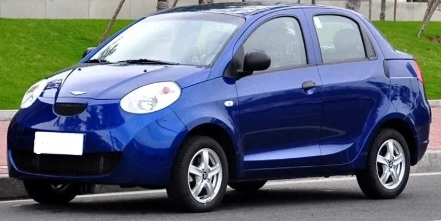
The M5 was essentially an extended version of the M1, featuring a redesigned rear section that created a more traditional sedan profile while retaining a hatchback-style tailgate.
Design and Engineering Evolution
Notchback Transformation
The most significant change from the M1 to the M5 was the addition of a notchback rear design:
- Body length increased by approximately 12 inches (30 cm)
- Overall length reached about 153.7 inches (3905 mm)
- Larger trunk capacity compared to the M1
This transformation allowed the M5 to appeal to buyers who preferred the appearance and practicality of a sedan while maintaining compact dimensions.
Exterior Styling
The M5 retained much of the M1’s front-end design:
- Rounded headlights and compact proportions
- Short hood and upright stance
- Simple, functional styling
The rear section, however, introduced:
- Extended trunk area
- More conventional sedan silhouette
- Improved cargo capacity
This hybrid design approach reflected cost-saving measures while expanding market appeal.
Interior Design
Inside, the Riich M5 was nearly identical to the M1:
- Centralized instrument cluster
- Compact dashboard layout
- Basic materials with modest upgrades over standard Chery models
While not luxurious, the interior aligned with Riich’s goal of offering a slightly more premium experience than entry-level vehicles.
Powertrain and Technical Specifications
Unlike many competitors that offered multiple engine options, the Riich M5 had a single powertrain configuration throughout its production run.
Engine
- 1.3-liter inline-4 gasoline engine (Acteco family)
- 16-valve configuration
This engine was designed for efficiency rather than performance, making the M5 suitable for city driving.
Transmission Options
- 5-speed manual transmission (standard)
- Automated manual transmission (AMT) (optional)
The availability of an automated manual gearbox provided a more convenient option for urban drivers.
Drivetrain Layout
- Front-engine, front-wheel drive
- Lightweight construction
The M5’s mechanical simplicity helped keep costs low but limited its performance capabilities.
Models and Trim Levels (2010–2014)
The Riich M5 followed a simplified trim strategy, typical of subcompact vehicles in emerging markets.
Early Trim Structure (2010–2011)
At launch, the M5 was offered in several trims that varied by equipment level rather than engine choice:
1. Base Trim
- Manual transmission
- Basic interior features
- Minimal electronic equipment
2. Standard Trim
- Additional comfort features
- Improved interior materials
- Optional AMT transmission
3. Luxury / High-End Trim
- Enhanced convenience features
- Upgraded audio system
- Additional styling elements
Exact trim names varied depending on the market, but the structure remained consistent.
Mid-Cycle Updates (2012–2014)
The Riich M5 did not receive a full redesign but underwent minor updates:
- Improved interior finishes
- Slight equipment upgrades
- Refinement of transmission options
Despite these updates, the model remained largely unchanged throughout its lifecycle.
Relationship to the Riich M1
The Riich M5 was closely related to the Riich M1, sharing:
- Platform and chassis
- Front-end design
- Interior layout
The primary difference was the M5’s extended rear section, which provided:
- Increased cargo space
- More traditional sedan styling
This strategy allowed Chery to create a new model with minimal development costs, a common approach among automakers targeting budget-conscious segments.
Market Position and Competition
The Riich M5 competed in the subcompact sedan segment, targeting buyers seeking affordability and practicality.
Key Competitors
- Domestic Chinese compact sedans
- Entry-level models from international brands
Strengths
- Affordable pricing
- Compact size ideal for urban environments
- Flexible cargo space due to hatchback-style rear
Weaknesses
- Limited engine options
- Modest performance
- Brand recognition challenges
Challenges and Decline
Despite its practical design, the Riich M5 faced several challenges:
Brand Struggles
The Riich brand itself struggled to establish a strong identity, particularly in a competitive market dominated by both domestic and international manufacturers.
Limited Differentiation
The M5’s close similarity to the M1 made it difficult to stand out, especially when larger or more powerful vehicles were available at slightly higher prices.
Market Competition
The subcompact segment was crowded, with many alternatives offering more modern features or better performance.
Discontinuation (2014)
Production of the Riich M5 ended in 2014, marking the conclusion of its lifecycle.
This discontinuation followed the broader shutdown of the Riich brand:
- 2012: Announcement of brand discontinuation
- 2013: End of Riich sales
- 2014: Final production of remaining models
The M5 was ultimately discontinued due to poor sales performance and the failure of the Riich brand to gain traction.
Post-Production and Legacy
Although the Riich M5 itself did not continue beyond 2014, its platform and design influenced later developments.
Licensing and Derivatives
- Related models were produced under different branding in some markets
- Electric variants of the M1 platform emerged in later years
These developments highlight the adaptability of the original design.
Evolution Summary
The evolution of the Riich M5 can be summarized as follows:
2010 (Launch Year)
- Introduction as a notchback version of the M1
- Single 1.3-liter engine
- Multiple trim levels introduced
2011–2012
- Expansion of trim options
- Minor equipment upgrades
2013–2014
- Decline in sales
- End of Riich brand
- Final production of the M5
Significance in Automotive History
While not a commercial success, the Riich M5 holds historical importance:
Early Attempt at Subcompact Sedans
The M5 represented an early effort by a Chinese automaker to create a globally viable small sedan.
Platform Efficiency
Its development demonstrated how manufacturers could maximize a single platform to produce multiple body styles.
Branding Experiment
The M5 was part of Chery’s broader attempt to create a premium sub-brand, providing valuable lessons for future strategies.
Future Outlook and Influence
Although the Riich M5 is no longer in production, its influence can still be seen:
Lessons for Chery
Chery has since refined its branding approach, launching more successful global sub-brands and improving product quality.
Growth of the Subcompact Segment
The market segment targeted by the M5 has expanded significantly, with modern vehicles offering far more advanced technology and features.
Electrification Trends
The platform’s later adaptation for electric vehicles reflects the broader shift toward electrification in the automotive industry.
The Riich M5 was a modest but meaningful step in the evolution of China’s automotive industry. Produced from 2010 to 2014, it represented an attempt to combine affordability, practicality, and a more refined brand image within a compact sedan format.
Key aspects of its evolution include:
- A single-generation model derived from the M1
- A simple trim structure focused on equipment levels
- A single-engine configuration emphasizing efficiency
- A short production lifespan, ending with the discontinuation of the Riich brand
While it ultimately struggled in the marketplace, the Riich M5 remains an important example of early Chinese efforts to compete on a global stage. Its legacy lies not in its sales figures, but in the lessons it provided—lessons that continue to shape the strategies of modern automakers today.