The Riich X1: Rise and Fall of Chery’s Early Urban Crossover Experiment
The Riich X1 occupies a unique place in the history of China’s automotive industry. Introduced at the end of the 2000s as part of Chery Automobile’s ambitious multi-brand strategy, the X1 was designed to elevate the company’s image through a more premium sub-brand known as Riich.
Produced during a relatively short window, the Riich X1 nevertheless reflected an important transitional moment: the rise of compact crossovers, the experimentation of Chinese automakers with branding, and the early push toward export-friendly designs. This article explores the evolution of the Riich X1, including its production years, trim levels, technical development, and long-term legacy.
Origins of the Riich Brand (2009)
To understand the Riich X1, it is necessary to examine the context in which it was created. In March 2009, Chery launched the Riich brand as part of a broader effort to move upmarket and compete with more established global manufacturers.
Riich was positioned as a more refined alternative to Chery’s mainstream lineup, offering improved build quality, design, and technology. Alongside another sub-brand, Rely, Riich was meant to redefine the perception of Chinese vehicles both domestically and internationally.
The initial Riich lineup included:
- The M1 hatchback
- The M5 small sedan
- The X1 crossover
- Later additions such as the G5 and G6 sedans
Among these, the X1 stood out as one of the earliest urban crossover vehicles produced by a Chinese manufacturer.
.

.
Introduction of the Riich X1 (2009)
The Riich X1 was officially launched in November 2009, entering production the same year.
- Years produced (Riich brand): 2009–2013
- Extended production (under related branding): until approximately 2014
- Vehicle class: Subcompact crossover / mini SUV
- Body style: Five-door wagon with crossover styling
The X1 was not developed entirely from scratch; instead, it was based heavily on the Riich M1 platform, itself derived from the Chery QQ architecture.
This meant that the X1 combined the compact dimensions of a city car with visual and functional elements inspired by SUVs.
Design and Positioning
Exterior Design
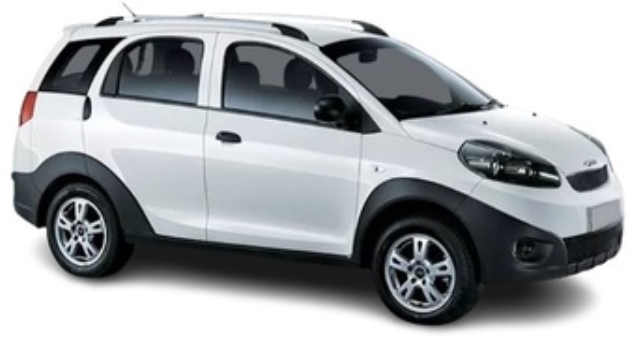
The Riich X1 adopted a distinctive design for its time:
- Wagon-like body with increased ride height
- Black plastic cladding for a rugged appearance
- Roof rails to enhance practicality
- Short overhangs for urban maneuverability
This styling approach anticipated the later explosion in popularity of small crossovers, making the X1 something of an early adopter in its segment.
Interior and Features
Inside, the X1 shared much of its layout with the M1:
- Central instrument cluster
- Simple dashboard design
- Compact seating for five passengers
While not luxurious by global standards, the interior was intended to be more refined than typical entry-level Chery models, aligning with the Riich brand’s positioning.
Powertrain and Technical Specifications
The Riich X1 utilized small-displacement gasoline engines typical of subcompact vehicles:
Engine Options
- 1.0-liter inline-4 gasoline engine
- 1.3-liter inline-4 gasoline engine
These engines were part of Chery’s Acteco family and were paired with:
- 5-speed manual transmission
- Optional automated manual transmission (on select variants)
Performance Characteristics
- Modest horsepower output (approximately 68–83 hp range)
- Front-wheel-drive layout
- Emphasis on fuel efficiency and affordability
The X1 was not designed for performance but rather for urban commuting and practicality.
Models and Trim Levels (2009–2013)
Unlike many modern vehicles, the Riich X1 featured a relatively simple trim structure, reflecting its budget-conscious origins.
Early Trim Structure (2009–2011)
At launch, the X1 was offered in several trims, typically differentiated by engine size and equipment level:
1. Base Trim (1.0L)
- 1.0-liter engine
- Manual transmission
- Basic interior features
- Minimal electronic equipment
2. Standard Trim (1.3L)
- Larger 1.3-liter engine
- Improved performance
- Additional comfort features
3. Comfort / Luxury Trim
- Enhanced interior materials
- Optional automated manual transmission
- Added convenience features such as power accessories
Exact naming conventions varied by market and documentation, but these tiers represented the typical structure.
Mid-Cycle Updates (2011–2013)
During its production run, the Riich X1 received minor updates rather than a full redesign:
- Improved interior materials
- Slight equipment upgrades
- Adjustments to engine offerings (including replacement of smaller engines in related models)
However, there was no significant facelift or second generation introduced.
Relationship to the Riich M1
The X1’s evolution is closely tied to the Riich M1, as the two vehicles shared:
- Platform
- Mechanical components
- Interior architecture
The primary difference was the X1’s crossover styling, which included:
- Raised suspension
- Protective cladding
- More rugged visual cues
This approach allowed Chery to create a new model with minimal additional development costs.
Market Performance and Challenges
Despite its innovative positioning, the Riich X1 faced several challenges:
Limited Brand Recognition
The Riich brand itself struggled to gain traction, particularly against more established domestic and international competitors.
Perceived Quality Issues
Although positioned as a premium offering, Riich vehicles were still closely associated with Chery’s budget image.
Competitive Market Segment
The compact car segment in China was highly competitive, with numerous domestic and foreign brands offering similar products.
Discontinuation of the Riich Brand (2012–2013)
By September 2012, Chery announced plans to discontinue the Riich brand due to poor sales performance.
- April 2013: Official end of Riich brand sales
- Production of Riich vehicles, including the X1, ceased shortly afterward
This decision marked the end of the X1’s primary production phase.
Post-Riich Life and Legacy
Although the Riich brand was discontinued, the underlying platform of the X1 continued to have a life beyond its original production run.
Continued Production and Rebadging
- Some models continued under the Chery brand until around 2014
- In 2017, production rights were acquired by another manufacturer
- The vehicle was later rebadged as the Shendafei 2 XEV 360, including electric variants
This extended lifecycle highlights the flexibility of the original design.
Evolution Summary
The evolution of the Riich X1 can be summarized as follows:
2009
- Launch of Riich brand
- Introduction of the X1 crossover
- Initial trims with 1.0L and 1.3L engines
2010–2011
- Expansion of trim options
- Minor feature updates
- Growing presence in domestic market
2012–2013
- Decline in sales
- Announcement of Riich brand discontinuation
- End of X1 production under Riich
2014–2017 (Post-Production Phase)
- Continued limited production under Chery branding
- Licensing and rebadging by other manufacturers
Significance in Automotive History
While not a commercial success, the Riich X1 is significant for several reasons:
Early Adoption of the Crossover Concept
The X1 was among the early examples of a subcompact crossover, a segment that would later dominate global markets.
Platform Sharing Strategy
Its development demonstrated how manufacturers could create multiple models from a single platform.
Branding Experiment
The Riich brand represented an early attempt by a Chinese automaker to establish a premium identity.
Future Outlook and Legacy
Although the Riich X1 itself is no longer in production, its influence can still be seen in modern vehicles:
Influence on Chery’s Later Models
Chery has since refined its approach to branding and product development, launching more successful global brands such as Omoda and Jaecoo.
Continued Popularity of Compact Crossovers
The segment pioneered by vehicles like the X1 has become one of the most important in the global automotive market.
Lessons Learned
The failure of the Riich brand provided valuable lessons in:
- Brand positioning
- Product differentiation
- Market strategy
The Riich X1 represents a fascinating chapter in the evolution of modern automobiles. Produced from 2009 to 2013, with extended influence beyond that period, it was an early attempt by Chery to enter the growing crossover market with a more upscale offering.
Key highlights of its evolution include:
- A single-generation model with no major redesigns
- A simple trim structure centered around engine size and equipment levels
- A platform shared with the M1, enabling cost-effective development
- A short production lifespan, ending with the discontinuation of the Riich brand
Although it ultimately fell short in the marketplace, the Riich X1 helped pave the way for future developments in compact SUVs and demonstrated the ambitions of Chinese automakers during a transformative period.
In hindsight, the Riich X1 can be seen not as a failure, but as an early experiment—one that contributed to the evolution of both Chery and the global automotive landscape.