The History of Infiniti
Forged in Fire: The Rise, Struggles, and Reinvention of Infiniti
In the early 1980s, the American automotive landscape was divided by a rigid class structure. At the top sat the luxury aristocracy: Mercedes-Benz, BMW, and Cadillac, brands that signified status and engineering prowess. Beneath them lay the reliable, utilitarian, and decidedly non-luxurious world of Japanese imports. They were economical and durable, but they were not prestigious.
Then, in 1989, two Japanese automakers decided to shatter that glass ceiling. While Toyota launched Lexus with a whisper, its corporate cousin, Nissan, launched Infiniti with a roar—or rather, the sound of rustling bamboo and flowing water. It was an audacious attempt to create a Japanese luxury marque from scratch, a gamble that would span decades of high-flying innovation, perilous financial straits, and a relentless search for an identity.
The Genesis of a New Horizon
Infiniti was founded by Nissan Motor Co., Ltd., a company that itself was on the brink of collapse in the early 1980s. Nissan was known for engineering brilliance—the Z-car, and the Skyline GT-R—but it was drowning in debt and plagued by a rigid corporate culture. A revitalization plan, led by executive chairman Yutaka Katayama (known as “Mr. K” in America), looked to the United States as a potential savior.
Katayama, a car enthusiast who had been sidelined within Nissan for decades, envisioned a premium brand that could compete with the Germans. He spearheaded “Project Horizons,” a secret initiative to develop a flagship sedan that would redefine Nissan’s image. The goal was not merely to sell a car, but to sell an experience: Omotenashi, the Japanese concept of anticipating a guest’s needs.
The Launch and the “Sensory” Marketing (1989)
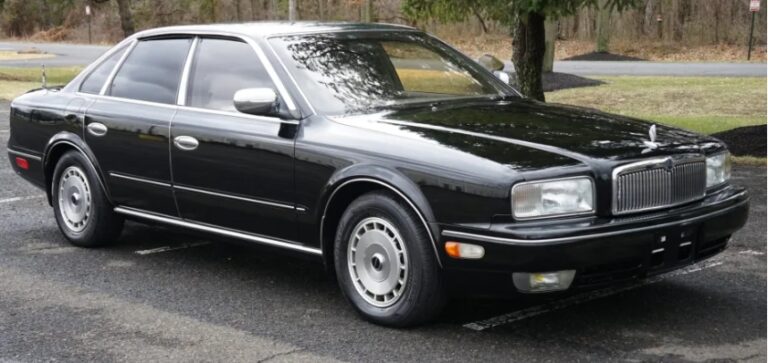
Infiniti officially launched on November 8, 1989, in the United States with a single model: the Infiniti Q45 (short for “Quarter of a Liter,” referring to its 4.5-liter V8 engine). It was unveiled alongside the slightly smaller M30 coupe.
The Q45 was a technological marvel. It featured a 278-horsepower V8, four-wheel steering, and an active suspension system called the Infinity Ellipse Suspension. It was powerful, rear-wheel drive, and built to challenge the Lexus LS400 and Mercedes S-Class.
However, Infiniti’s initial marketing strategy is perhaps the most famous example of a marketing misfire in automotive history. To emphasize the serenity of the cars, the initial television commercials featured absolutely no shots of the vehicles. Instead, viewers saw crashing waves, serene rock gardens, and rustling leaves, accompanied by the tagline, “The new luxury from Nissan.”
The strategy was meant to evoke a feeling before the product, but it backfired spectacularly. American consumers, accustomed to seeing chrome and steel, were confused. “Where is the car?” they asked. Competitors mocked Infiniti, and the brand struggled to gain traction immediately.
Hardships and the VQ Renaissance
By the early 1990s, Infiniti was facing a crisis. The Q45, while technologically advanced, was too conservative in styling and lacked the brand recognition of its rivals. Sales were sluggish, and the brand was losing money.
In 1994, the company introduced a stopgap vehicle that would inadvertently save the brand: the Infiniti G20. It was a rebadged Primera, a compact sedan sold in Japan and Europe. While it was front-wheel drive and smaller than the Q45, it was marketed as “The Driver’s Sedan” and actually won the prestigious “European Car of the Year” award (as the Primera).
While the G20 built a cult following, the true turning point came in 1996 with the introduction of the Infiniti QX4. This was essentially a Nissan Pathfinder dressed in a tuxedo. It was one of the first luxury SUVs on the market. At a time when luxury meant sedans, the QX4 was a revelation. It sold in huge numbers and gave Infiniti the revenue it needed to survive.
Simultaneously, Nissan was developing what would become its engineering crown jewel: the VQ-series V6 engine. Introduced in the 1997 Infiniti I30 (replacing the M30), the 3.0L V6 was a masterpiece of balance and sound. It was so good that it would later power almost every Nissan and Infiniti model, eventually being named to Ward’s “10 Best Engines” list for 14 consecutive years.
The Golden Era: The G35 and the “G” Legacy (2002–2010)
The true defining moment for the company occurred in 2002 with the launch of the Infiniti G35 sedan. This car was the result of a massive push led by Carlos Ghosn, the turnaround artist who took over Nissan in 1999 and saved it from bankruptcy.
The G35 was a rear-wheel-drive sport sedan powered by a 3.5L version of the VQ engine (280 hp). It was targeted directly at the BMW 3 Series and BMW 5 Series. It was stylish, affordable, and fast.
To prove its worth, Infiniti engaged in a racing program called the “G35 Challenge Cup” in 2003. They took stock G35 sedans, stripped the interiors, added roll cages, and raced them on tracks like Lime Rock Park. This proved to consumers that the G35 was a genuine sports sedan at heart.
The reception was electric. The G35 became an instant hit, winning Motor Trend‘s Car of the Year. It single-handedly established Infiniti as a brand for drivers, not just passengers.
In 2006, the coupe version, the G37, was launched, featuring a 330-hp V8 (and later a 3.7L V6) that sounded incredible. During this decade, Infiniti also expanded its lineup with the full-size QX56 SUV (2004) and the exotic FX crossover (2003), which looked like a sports car but had the ride height of an SUV.
Racing: From Challenge Cups to Formula One
Infiniti’s involvement in motorsport evolved from marketing exercises to top-tier engineering.
- The G35/G37 Challenge (2003–2008): As mentioned, this single-make series allowed customers to race their street cars, building a strong enthusiast community.
- Super GT (2006–2008): In Japan, Infiniti (badged as Nissan) fielded the GT500-class GT-R in the Super GT series, winning championships and cementing the GT-R’s legendary status.
- Formula One (2011–2015): Infiniti became the title partner of the Red Bull Racing F1 team. This was a strategic move to align the brand with Sebastian Vettel, who won two World Championships during this period. Infiniti engineers worked directly with Red Bull on aerodynamics and energy recovery systems, transferring F1 technology to road cars like the Q50.
The “Liverpool” Era and Global Expansion
In 2012, Infiniti moved its global headquarters from Japan to Hong Kong, appointing former Mercedes-Benz executive Johan de Nysschen as president. It was a bold move to decentralize the brand and make it truly global.
In 2013, Infiniti launched the Q50 to replace the G37. It was a technological leap, featuring “Direct Adaptive Steering,” a steer-by-wire system that was controversial but innovative.
The brand also attempted to capture the “millennial” market with a massive marketing campaign involving global celebrity ambassadors like Sebastian Vettel, Sofia Vergara, and Peyton Manning. Perhaps the most high-profile (and risky) strategy was a massive sponsorship deal with Liverpool Football Club (worth roughly $30 million a year), which alienated some fans in the US who didn’t follow soccer.
The Shift to Crossovers and Financial Struggles
Despite the success of the G35/G37, Infiniti has faced significant hardships in the last decade. The global shift from sedans to crossovers caught the brand off guard. While rivals Audi, BMW, and Mercedes-Benz had strong crossover lineups, Infiniti’s offerings (the QX60, QX50, QX80) often felt dated or lacked the performance flair of the brand’s “inspiration” slogan.
Furthermore, the brand suffered from leadership churn. After de Nysschen left in 2017, there was a revolving door of executives. Product development slowed, and the brand lost its way.
A major technical struggle occurred with the launch of the QX50 in 2018. It featured the world’s first production variable compression turbo (VC-Turbo) engine. While the engine was an engineering marvel, the car’s infotainment system (dual screens with confusing logic) and front-wheel-drive-based platform received lukewarm reviews from the automotive press.
The Current Status and Outlook
Today, Infiniti is a brand in the midst of a massive reinvention. Sales in the US have declined from a peak of roughly 150,000 units in 2011 to approximately 46,000 units in 2023.
However, the company is not defunct; it is undergoing a “reset.” In 2021, they announced a new strategy called “Nissan Ambition 2030.” They have committed to electrifying their entire lineup by 2030. They recently launched the QX60 Monograph concept and a redesigned QX80 for 2024, aiming to return to their roots of “powerful performance.”
Sales Figures and Notable Models
- First Vehicle Produced: The 1990 Infiniti Q45. It featured a 4.5L V8 and four-wheel steering.
- Latest Major Vehicle: The 2024 Infiniti QX80. It features a twin-turbo V6 (replacing the V8) and a massive 28.6-inch digital display.
- Most Popular Vehicle: The Infiniti G35/G37 Series (2002–2013).
- Why it was popular: It offered the performance of a BMW 3 Series for thousands of dollars less, with a more charismatic engine sound and aggressive styling. It became the unofficial car of the “tuner” scene and young professionals.
- US Sales: The G35/G37 platform sold over 500,000 units in the United States combined.
- Global Sales: Over 1 million units worldwide (including the Nissan Skyline equivalent).
What Makes Infiniti Different?
The defining characteristic of Infiniti has always been its “personality.” While Acura (Honda) often prioritized reliability and Lexus prioritized quiet comfort, Infiniti carved a niche for “performance luxury.” Their vehicles historically prioritized engine character (the V8 Q70, the V6 G37) and aggressive handling.
Additionally, Infiniti introduced a safety concept called “Shield.” This included Backup Collision Intervention (BCI) and Distance Control Assist, technology that often appeared in Infiniti vehicles years before becoming standard in competitors’ cars.
Conclusion
Infiniti’s history is a story of persistence. They started as a confusing brand with rock garden commercials, survived the brink of Nissan’s bankruptcy, peaked with the legendary G35, and then stumbled as the market shifted.
They were never able to consistently outsell the German giants, but they left a lasting impact by proving that Japanese automakers could build world-class luxury cars that were fun to drive. As of 2024, Infiniti stands at a crossroads. With a full-electric future planned and a renewed focus on the US market, the “Horizon” that Yutaka Katayama envisioned in 1989 is still being chased—only now, it’s powered by batteries rather than V8s.