A British Classic and Its Evolution: The Triumph Mayflower
The Triumph Mayflower, a small family car produced by the British Triumph Motor Company between 1949 and 1953, holds a distinctive place in British automotive history. Although it was not as widely recognized as some of its contemporaries, the Mayflower played an important role in the early post-war British automotive industry. Positioned as an affordable, compact car aimed at the working and middle classes, the Triumph Mayflower stood as a symbol of the optimism and rebuilding that followed the end of World War II. Over the course of its short production run, the Mayflower was refined and evolved in response to changing market demands, and it continues to be cherished by classic car enthusiasts today.
This article will explore the evolution of the Triumph Mayflower, its models and trim levels, its role in Triumph’s broader lineup, and its legacy in the context of British automotive history.
Background and Origins of the Triumph Mayflower
In the aftermath of World War II, Britain’s automotive industry, like many others, faced the challenge of rebuilding. The war had left much of the country’s infrastructure in tatters, and many car manufacturers were focused on producing vehicles for military use. As the 1940s progressed and Britain began to recover, the demand for small, affordable family cars grew, particularly for middle-class families who were eager to get back to a sense of normalcy and prosperity.
The Triumph Motor Company, which had historically been known for producing larger, more luxurious vehicles, sought to tap into this emerging market for affordable compact cars. In 1949, the company introduced the Triumph Mayflower, a small four-door saloon aimed at providing British families with a practical, economical option for personal transport.
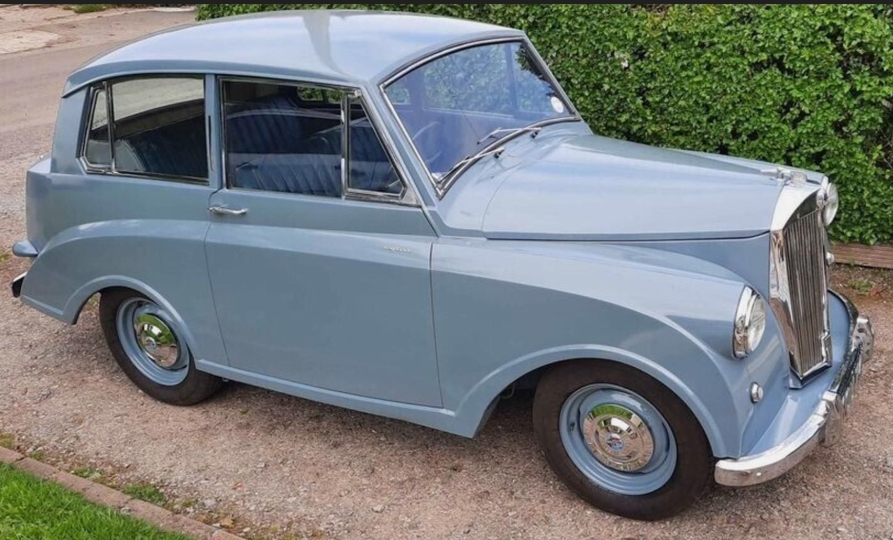
The Mayflower was designed by renowned automotive designer Edward Turner, who had previously worked on various motorcycle and automotive designs. It was produced at Triumph’s plant in Coventry, which had been heavily involved in war production. The car’s design was simple yet stylish, with its rounded body, upright rear end, and somewhat compact proportions that were typical of the post-war era. The Mayflower was marketed as a stylish, affordable car that provided decent performance for its size.
.

.
Introduction of the Triumph Mayflower (1949)
The Triumph Mayflower was first introduced in 1949 as a small, affordable car powered by a 1.0-liter four-cylinder engine. This engine produced a modest 38 horsepower, enabling the Mayflower to reach a top speed of around 60 mph (97 km/h). This was more than adequate for the needs of the post-war British market, where small, economical cars were highly sought after.
At its launch, the Triumph Mayflower was available in a single trim level, offering a simple yet functional interior with cloth upholstery, a basic dashboard, and an ample amount of cabin space for its size. The car’s small dimensions and light weight made it easy to maneuver, especially in urban environments where many British families lived. Additionally, the car featured a four-speed manual transmission, which was standard for vehicles of its class at the time.
Despite being a relatively low-cost vehicle, the Mayflower’s design was seen as stylish for its era. The rounded body shape and relatively modern front grille gave it a clean, appealing look compared to some of its competitors, which were often more utilitarian in design. In a time when many British cars were still heavily influenced by pre-war designs, the Triumph Mayflower stood out as a more modern option.
Triumph Mayflower: Refinements and Updates (1950–1952)
In the early years of production, the Mayflower was generally well-received, though it faced stiff competition from other British compact cars, such as the Morris Minor and the Austin A30. While the Morris Minor was more popular and would go on to become one of the most iconic British cars of the post-war period, the Triumph Mayflower carved out its niche in the market by emphasizing its slightly more luxurious features and refined design.
Over the next few years, Triumph made subtle updates to the Mayflower, improving its performance, comfort, and overall quality. In 1950, the Mayflower saw some minor changes to the engine and drivetrain, including slight improvements in the engine’s reliability and fuel efficiency. The small 1.0-liter engine was refined to offer smoother power delivery, although it still struggled to compete with the more powerful engines in some of its competitors.
The interior was also improved during this period, with more attention given to the materials used for the upholstery and trim. The dashboard saw updates, with a more modern design and clearer instrumentation. However, the car remained relatively simple, with only basic features like a radio and basic heating available as optional extras.
Despite these updates, the Mayflower’s performance and features were beginning to show their age by the early 1950s. As more modern small cars entered the market, including the iconic Morris Minor 1000 and the Ford Anglia, the Triumph Mayflower began to lose its edge. The car’s engine, while reliable, was not particularly powerful, and its design began to look increasingly outdated compared to newer models.
The Final Years of the Triumph Mayflower (1953)
The Triumph Mayflower continued to be produced until 1953, when it was discontinued in favor of more modern models within the Triumph lineup. By this time, the Mayflower’s sales had begun to decline as consumer preferences shifted toward cars with more advanced features and better performance. The competition from the Morris Minor and other popular small cars had made it difficult for the Mayflower to maintain its position in the market.
The final version of the Mayflower, which was produced in 1953, featured a few more updates aimed at improving its appeal. These included a slight redesign of the grille, as well as some further refinements to the car’s suspension system, which improved ride comfort. However, these changes were not enough to reverse the Mayflower’s fortunes, and production ended that same year after just over 100,000 units had been built.
Despite its relatively short production run, the Triumph Mayflower had achieved its goal of providing affordable transportation to a large number of British families. It also laid the groundwork for the future of the Triumph brand, as the company would go on to produce more successful models such as the Triumph Herald and the Triumph Spitfire in the years to come.
Legacy and Collectibility of the Triumph Mayflower
Though the Triumph Mayflower was not a major commercial success, it remains an important piece of British automotive history. The car is often considered a precursor to the more successful small cars that would follow, and it helped establish Triumph as a manufacturer capable of producing compact, affordable vehicles in addition to their more premium offerings. Its relatively simple design and accessible price point made it a popular option for families in the post-war period, even if it was ultimately overshadowed by other, more successful cars in the same class.
Today, the Triumph Mayflower is considered a classic car and is appreciated by collectors and enthusiasts for its historical significance and unique design. Its rarity—only a little over 100,000 units were produced—adds to its appeal, and well-preserved examples can fetch a premium in the classic car market. Restoration projects for the Mayflower are also common among classic car aficionados, as the car’s relatively simple design and availability of parts make it a feasible restoration project for those with a passion for vintage British cars.
The Mayflower has also gained a reputation as a “cute” and quirky classic, with its small size and charming design making it a favorite among vintage car shows and events. As with many cars from this era, the Triumph Mayflower is viewed through a lens of nostalgia, representing a simpler time in British automotive history.
The Mayflower’s Influence on Later Triumph Models
Although the Triumph Mayflower was discontinued in 1953, it played a significant role in shaping the future of the Triumph brand. The lessons learned from the Mayflower’s production were carried over into subsequent models, such as the Triumph Herald, which was introduced in 1959. The Herald, with its more modern design and improved performance, would go on to become one of Triumph’s most successful models.
Additionally, the Triumph Mayflower helped to establish Triumph’s identity as a manufacturer of accessible, affordable vehicles. This ethos would carry forward in models like the Spitfire and GT6, both of which continued to offer performance and style in smaller, more affordable packages.
Conclusion: A Symbol of Post-War Britain
The Triumph Mayflower may not have been as successful as some of its competitors, but it remains an important symbol of post-war British optimism and the growth of the British automotive industry. As one of the first compact cars to be produced by Triumph, it helped to lay the foundation for future success within the company and contributed to the evolution of affordable, practical vehicles for the British public.
Today, the Triumph Mayflower is recognized as a classic British car, and its legacy is celebrated by collectors and automotive enthusiasts who appreciate its unique design and its place in the history of British motoring. Although it may not have been the most successful car of its time, the Triumph Mayflower remains an important part of Triumph’s rich history and an enduring symbol of post-war Britain.