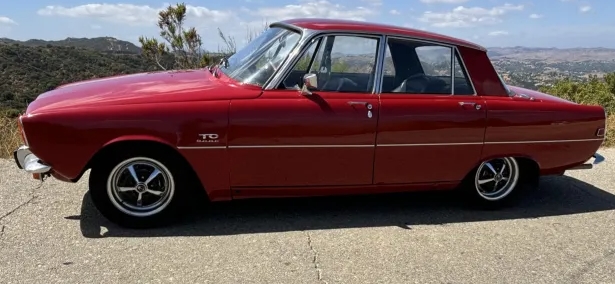
Rover 2000: The Trailblazer That Redefined British Executive Cars
The Rover 2000 marked a major turning point in the history of the Rover Company and British car design. Introduced in 1963 as part of the all-new P6 series, the Rover 2000 brought technical innovation, modern styling and dynamic engineering to the executive saloon segment. Over a production run spanning 14 years, this model evolved through several revisions, performance variants and engine upgrades, remaining competitive well into the 1970s.
Launched to replace the older P4 saloons and complement the continuing P5 range, the Rover 2000 wasn’t just a new model — it was a statement. With a fresh design philosophy and cutting-edge engineering, it became the first recipient of the European Car of the Year award in 1964, underscoring its significance in automotive history.
Design & Engineering Breakthrough (1963)
When the Rover 2000 debuted in late 1963, it was unlike anything Rover had built before. The car featured:
- Monocoque body construction — a strong steel unit with detachable aluminium panels on the bonnet and boot.
- Independent suspension all around with a sophisticated de Dion rear axle for balanced ride and handling.
- Four-wheel disc brakes — still rare for production cars at the time.
- A newly designed 2.0-litre overhead-camshaft four-cylinder engine, delivering approximately 90 bhp.
This combination of features placed the Rover 2000 in a league above many traditional British saloons: refined, comfortable and with handling closer to sports-oriented rivals.
.

.
Model Evolution & Trim Levels
Throughout its lifespan, the Rover 2000 underwent a series of important evolutions. These included engine upgrades, performance variants and cosmetic refreshes — all while maintaining the same fundamental body architecture.
2000 SC (Standard) — 1963–1966
At launch, the base version was often informally referred to as the 2000 SC (for single carburetor). It offered:
- 2.0 L straight-four engine with a single carburettor (originally around 90 bhp).
- Four-speed manual gearbox as standard, with an optional automatic available later.
- Executive-class interior trim with wood accents and ample comfort features for the period. While not fast by modern standards, it delivered balanced ride and efficiency.
This initial 2000 was celebrated for combining engineering sophistication with everyday practicality.
2000 TC — 1966–1973
In 1966, Rover introduced the 2000 TC (Twin Carburettor), a sportier version of the 2000. Highlights included:
- Twin SU carburetors and a revised cylinder head for more performance (usually around 110 bhp), improving acceleration and mid-range punch.
- A tachometer and other sporty instrumentation.
- The option of an automatic gearbox, broadening appeal among buyers seeking comfort over manual sportiness.
The 2000 TC became a desirable model for enthusiasts who still wanted the sophisticated ride quality of the P6 platform but with enhanced power.
Series II & Facelift — 1970–1973
By 1970, the P6 range — including the 2000 and 2000 TC — was showing its age, so Rover introduced a Series II refresh:
- A restyled front grille with a black honeycomb pattern and cosmetic updates to sills and trims.
- Black vinyl-covered rear roof pillars and updated wheel trims added a more contemporary visual identity.
- On TC models, circular instruments replaced the earlier linear speedometer for a more legible, modern dashboard.
These changes kept the model attractive in a competitive market and extended the 2000’s relevance into the early 1970s.
2200 SC & TC — 1973–1977
As emissions regulations tightened and performance expectations shifted, 1973 saw the 2000 replaced by the 2200:
- The 2200 SC retained single-carburetor simplicity with a larger 2.2-liter inline four engine for better low-end torque.
- The 2200 TC paralleled the twin-carb performance ethos of the earlier 2000 TC but with increased capacity.
- Aside from the engine upgrade, the 2200 models were largely visually and mechanically continuity products, reflecting the strength of the original P6 design.
The 2200 kept the P6 range in production until the series as a whole concluded in March 1977.
Variants Beyond the 2000/2200
While the focus here is the Rover 2000 and its direct evolutions, it’s worth noting the P6 platform also supported more powerful six-cylinder versions that expanded the range’s appeal:
3500 & 3500S (1968–1976)
- Starting in 1968, Rover introduced a V8-powered variant dubbed the Three Thousand Five Hundred or 3500, using an all-aluminum 3.5-litre engine.
- For several years, the 3500 was available with automatic transmission only, later joined by a manual-equipped 3500S in 1971.
- These models positioned the P6 platform as a viable contender against larger executive cars, combining performance with the class-leading ride and handling of the P6 chassis.
Although distinct from the 2000/2200 four-cylinder story, the 3500 variants underscored the versatility and longevity of the P6 platform.
Technical Legacy and Significance
The Rover 2000’s engineering was pioneering for its time, embracing:
- De Dion rear suspension, which kept the car flat in corners and improved handling relative to rivals.
- Inboard rear disc brakes, reducing unsprung weight and enhancing feel.
- A lightweight monocoque with corrosion-resistant design ideas influenced by the Citroën DS “non-stressed panels” philosophy.
These features combined robustness with comfort and competent performance — attributes that helped define the executive car segment and influenced later designs, including its eventual successor, the Rover SD1.
Production & Market Position
Across all variants of the P6 platform, including the Rover 2000, 2200 and 3500 models, over 322,000 units were produced between 1963 and 1977.
During its peak years, the Rover 2000 competed against both domestic rivals (like the Triumph 2000) and continental executive saloons (such as BMW’s 1800/2000). Its combination of innovation, safety features and driving refinement gave it a strong foothold among buyers seeking understated elegance without sacrificing modern engineering.
The 1964 Car of the Year accolade reflected this broad appeal and remains a key part of the model’s legacy.
End of Production & Future Outlook
By the late 1970s, the Rover P6 series was showing its age in the face of rising emissions standards, shifting market expectations and more modern competitors. Rover retired the P6 lineup in 1977, handing the baton to the Rover SD1, which emphasized more contemporary styling, improved aerodynamics and updated technology.
Today, the Rover 2000 and its successors are regarded as classics of British automotive design. Enthusiasts value them for:
- Historical significance as a pioneer of modern executive car design.
- Innovative engineering features that were ahead of their time.
- A compelling blend of comfort, handling and refinement rarely matched by contemporaries.
Well-preserved examples — particularly rare trims like the original 2000 TC and later 2200 TC — continue to enjoy a strong following at classic car shows and among collectors. With values appreciating and historical interest rising worldwide, the legacy of the Rover 2000 is secure as a defining British executive car of the mid-20th century.