Nissan Auster: The Evolution of a Distinctive Japanese Sedan
The Nissan Auster was a notable Japanese compact car produced by Nissan Motor Company between 1977 and 1990, sharing mechanical roots with the Nissan Violet and Stanza, but marketed uniquely within Nissan’s dealership network and with its own identity and trim structure. Positioned as a stylish, youthful competitor in the compact and mid‑size car segments, the Auster evolved through multiple generations with key updates in design, drivetrain, and trim offerings that reflected broader shifts in Nissan’s engineering focus and the global automotive landscape.
What Was the Nissan Auster?
Before diving into the generations and models, it’s important to understand what Auster stood for. The name “Auster” derives from the Latin for the south wind, symbolizing a fresh, spirited automobile designed to appeal to buyers seeking something different from Nissan’s more mainstream offerings. Originally a sister model to the Nissan Violet, it eventually became a distinct line sold through specific dealerships as part of Nissan’s multi‑channel marketing strategy in Japan (sold via Nissan Prince Store locations).
Though primarily sold in Japan, the Auster also formed the basis for related model lines in other markets under various names such as Stanza, Bluebird, and even Liberta in the Middle East.
.

.
First Generation: Auster (A10/A11; 1977–1981)
The inaugural Nissan Auster was introduced in May 1977 as part of Nissan’s second generation of the Violet family, but differentiated with distinct styling and marketing.
Design and Drivetrain
- Production: 1977–1981
- Platform: Rear‑wheel drive (shared with Nissan Violet/Stanza)
- Body types: 4‑door sedan, 3‑door hatchback coupe (“Multi‑Coupe”), 5‑door hatchback, 5‑door wagon (Japan‑unreleased), and light van variants
This generation reflected the era’s engineering norms, with front‑engine/rear‑drive layouts and a variety of inline‑four engines. It included a diverse range of trim levels and options catering to both comfort and sportiness.
Engine Options
The A10/A11 series was available with a range of inline‑4 engines:
- 1.4 L A14 — base engine in early models
- 1.6 L L16 / Z16 — mid‑range power unit for the core lineup
- 1.8 L Z18 — offered in sportier, higher‑performance trims such as 1800GT and 1800GT‑E
Trim Levels and Features
Early trim designations reflected performance and equipment tiers:
- 1600CS‑L — a mid‑range practical trim with better comfort features
- 1600CS‑E — sport‑oriented version
- 1800GT / 1800GT‑E — performance variants with larger 1.8 L engines and more aggressive equipment and styling
During its lifespan, the A10 received several updates: emissions‑related changes in 1978, minor styling updates, and expanded trim options — including performance and comfort packages tailored to buyers’ tastes.
The first‑generation Auster was appreciated for its solid driving dynamics, relatively upscale interior options, and variety of body styles at a time when Nissan was expanding its lineup aggressively.
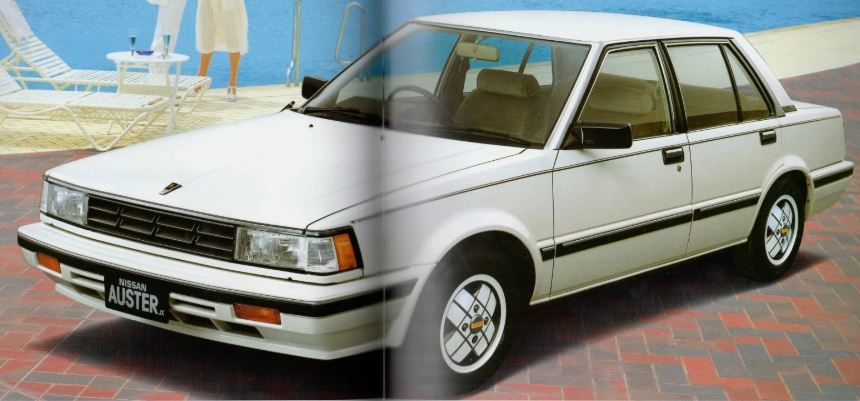
Second Generation: Auster JX (T11; 1981–1985)
By June 1981, Nissan transitioned the Auster to the T11 platform, marking a major change: front‑wheel drive (FWD).
Design and Configuration
- Production: 1981–1985
- Platform: FWD (shared with Nissan Violet FWD variants)
- Body types: 4‑door sedan and 3‑door hatchback
- Transmission: 5‑speed manual or 3‑speed automatic
The adoption of front‑wheel drive aligned the Auster with global trends toward more efficient, space‑efficient architecture that improved passenger comfort and interior volume.
Engines and Performance
Trim levels in this generation were typically denoted by engine capacity and equipment:
- 1600cc — standard engine for base and mid‑range models
- 1800cc — offered improved power and torque for higher trims
Examples of trims included:
- 1600 Mc Saloon / Vc Saloon — practical, comfort‑oriented sedans
- GT‑ES — a sportier trim with enhanced performance and styling focus
Features and Market Position
The second‑generation Auster balanced everyday usability with sportier offers like the GT‑ES. Its refined chassis and front‑wheel drive made it a competitive choice for compact sedan buyers. The hatchback variant also allowed improved practicality.
Third Generation: Auster (T12; 1985–1990)
A mid‑80s redesign brought the T12 series Auster, arguably the best‑known version among enthusiasts and the one most often associated with the nameplate.
Production and Layout
- Production: 1985–1990
- Platform: Shared with Nissan Stanza and Bluebird models
- Body types: 4‑door sedan and 5‑door Eurohatch (5‑door hatchback)
By this generation, Nissan had solidified the Auster as a modern, front‑wheel‑drive family and sport compact.
Engine Range
T12 Austers featured a broader range of engines suited to diverse markets:
- 1.6 L (1598 cc) — entry‑level engine producing around 89 hp
- 1.8 L (1809 cc) — mid‑range choice with better performance
- High‑output options — including turbocharged engines in some sport trims such as RTT Euroforma with CA18DET turbo engines producing up to ~167 hp (in enthusiast and niche trim variations)
Trim Levels and Variants
The T12 Auster lineup was more diverse than prior generations, with variations indicating equipment and performance levels:
- Mc Saloon / Vc Saloon — core comfort‑focused trims
- Vi / Xi (and equivalents) — higher‑equipment versions with additional features and comfort choices
- Eurohatch variants — hatchback versions emphasizing practicality and style
- Performance trims — rare versions like RTT Euroforma and sporty packages aimed at buyers seeking a more dynamic drive
Though Nissan did not globally market the Auster as widely as some competitors, in Japan it had a meaningful presence as a compact sedan that could blend daily usability with sportier options.
Regional and Export Identities
Outside Japan, Auster‑based models were frequently rebadged or configured to meet local market needs:
- In some regions, the closely related vehicles were sold as Nissan Stanza or Bluebird variants.
- In the Middle East, Auster/Stanza derivatives carried the Liberta nameplate.
This badge‑engineering strategy allowed Nissan to tailor the Auster and its siblings to different customer expectations without entirely bespoke platforms.
Discontinuation and Legacy
The Nissan Auster was discontinued in 1990, with its niche in Nissan’s domestic lineup taken over by the newer Nissan Primera, which offered more modern styling, better packaging, and a fresh platform targeted at the compact/mid‑size segment.
Though it never achieved the global household recognition of other Nissan models, the Auster’s legacy lives on in several ways:
- Its platform and engineering shared DNA with Stanza and Bluebird models that had global reach.
- The Auster contributed to Nissan’s understanding of front‑wheel‑drive compact and mid‑size architecture as the industry shifted away from rear‑drive layouts in the 1980s.
- Enthusiasts value later T12 Austers — especially turbocharged and sport trims — for their blend of practical design and spirited performance.
Model Overview and Trim Summary
Below is a synthesis of key Auster configurations and trims by generation:
First Generation (A10/A11; 1977–1981)
- 4‑door sedan, 3‑door hatch coupe, 5‑door hatch, wagon, light van
- Trims: 1600CS, 1600CS‑L, 1600CS‑E, 1800GT, 1800GT‑E
Second Generation (T11; 1981–1985)
- 4‑door sedan, 3‑door hatch
- Trims: 1600 Mc Saloon, 1600 Vc Saloon, GT‑ES, other sport‑focused options
Third Generation (T12; 1985–1990)
- 4‑door sedan, Eurohatch (5‑door)
- Trims: Mc Saloon, Vc Saloon, Vi, Xi; sport/RTT Euroforma turbo variants (enthusiast examples)
Across these series, transmission choices typically included 5‑speed manuals and 3‑ or 4‑speed automatics. Engines ranged from modest 1.4 L units in early years to more potent 1.8 L and turbocharged offerings late in the T12 generation.
Future Outlook and Heritage Status
Though the Nissan Auster has not seen a revival in modern Nissan lineups, its role in the development of front‑wheel‑drive compact sedans and badge‑engineered variants is part of Nissan’s broader automotive evolution. The Auster’s legacy contributed to platform strategies that informed later models like the Primera and even compact offerings under the Nissan and Infiniti brands in global markets.
Official heritage collections and enthusiast communities celebrate preserved examples of Austers — particularly third‑generation T12 models — as symbols of Nissan’s engineering and marketing diversity during the 1980s.
The Nissan Auster spanned 1977 to 1990 as a distinctive line within Nissan’s product portfolio. Through three generations — evolving from rear‑wheel drive to modern front‑engine, front‑wheel‑drive layouts — the Auster reflected both technological shifts and Nissan’s efforts to offer diverse trim levels and performances across its dealership networks. Although retired for over three decades, the Auster remains an interesting chapter in Nissan history, representing an era of dynamic automotive evolution and vibrant domestic competition.