The Evolution of the Geely Haoqing: China’s First Private-Brand Hatchback and Its Legacy
The Geely Haoqing holds a special place in the history of Chinese automotive manufacturing. As one of the earliest passenger vehicles produced by Geely Automobile, the Haoqing helped establish China’s first successful privately owned car brand. Launched in the late 1990s, the Haoqing was a subcompact hatchback that laid the foundation for Geely’s rapid growth through the 2000s and beyond. This article explores the Haoqing’s development, the various models and trim levels produced during its lifespan, its market position, and its enduring legacy.
Origins and Historical Context
Geely’s entry into automotive production began after years in the appliance and motorcycle businesses. In 1998, Geely introduced the Haoqing, sometimes referred to simply as the Geely HQ, marking the company’s first full-scale automobile product.
At the time, China’s automotive market was dominated by state-owned manufacturers. Geely was unique as a private enterprise carving out a niche in a competitive and highly regulated environment. The Haoqing’s design was based on platform technology licensed from FAW Tianjin, itself derived from the Daihatsu Charade (G100) platform, a proven and simple architecture suitable for Geely’s early vehicle ambitions.
.

.
Production Timeline (1998–2006)
The Geely Haoqing was produced from 1998 until 2006, with various model updates and derivatives appearing throughout that period. The early years of production coincided with Geely’s steep learning curve in automotive engineering, production processes, and market development.
During its production lifespan, the Haoqing was offered in multiple body styles and configurations to broaden its appeal:
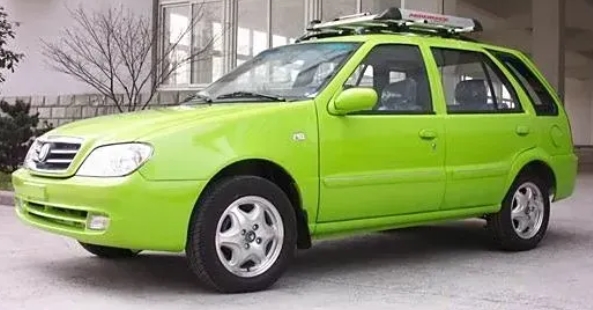
- Hatchback: The original five-door hatchback was the flagship body style at launch in 1998, featuring compact dimensions ideal for urban use.
- Station Wagon (SRV): Soon after launch, Geely added a station wagon variant commonly called the Haoqing SRV to offer greater cargo capacity and versatility.
- Liangjing Special Edition: A special five-door hatchback variant marketed under the Liangjing name was available during later years of production.
These body styles were part of Geely’s strategy to maximize the use of its basic platform by addressing different market needs without the cost of designing separate platforms.
Engine and Mechanical Options
Throughout its production run, the Haoqing was offered with a variety of small, fuel-efficient gasoline engines. These powerplants reflected both the platform’s origins and the focus on affordability:
- 0.993 L Three-Cylinder Engine: One of the initial engines available was a Chinese-built 993 cc three-cylinder unit originally developed by Daihatsu. It produced approximately 52 PS (38 kW) and was mated to a 4- or 5-speed manual transmission, depending on the model year.
- 1.342 L Inline-Four Engine: A larger 1.3 L engine producing roughly 86 PS (63 kW) was another option, providing slightly more performance for buyers seeking better highway usability.
- Later 1.5 L Options: Toward the later years of production, some models were fitted with a 1.5 L engine to provide improved performance and meet evolving customer expectations, though these were still modest by international standards.
Despite the relatively low power figures, the Haoqing’s lightweight design meant that these engines were adequate for the car’s urban and suburban roles. Transmission options were limited to manual gearboxes — primarily five-speed units — with no automatic transmissions offered on the original hatchback lineup.
Trim Levels and Variants
Documentation from parts and model listings shows that the Haoqing was marketed in several trim levels and sub-variants during its production:
- Base and Comfort Variants: Early years saw basic and comfort trims, with standard equipment focused on essential features like air conditioning, basic audio systems, and manual windows. Trim names such as 203A Basic Type and Comfort Type appear in model catalog listings from the early 2000s.
- Bright Star / Liangxing Series: In 2004–2005, Geely offered the Bright Star and Bright Star II trims, reflecting incremental feature enhancements such as improved upholstery and trim finishes.
- SRV Comfort Types: The station wagon body was also offered in comfort-oriented packages, with engine options ranging from 1.0 L to 1.5 L and both manual and later 4-speed automatic transmissions in specific SRV trims.
Because early Geely vehicles were primarily sold in China’s domestic market and many were registered in smaller cities and rural areas, detailed official trim level documentation can be sparse. However, the 17vin model listings suggest a wide variety of progressively equipped Haoqing models, reflecting Geely’s attempt to broaden appeal while keeping price points accessible.
Technological and Feature Progression
Unlike modern vehicles, the Haoqing did not feature many advanced technologies or sophisticated safety systems by today’s standards. Standard safety equipment typically included basic seatbelts and basic braking systems. Airbags, anti-lock brakes (ABS), and traction control were not widespread on early trim levels, as Chinese regulatory safety requirements were still developing in the early 2000s.
Interior technology was similarly basic. Radios, cassette players, or simple CD audio systems were common in higher trims, while lower trims focused on simplicity and cost-effective components. Despite this, the platform was mechanically straightforward and relatively easy to maintain, factors that contributed to the Haoqing’s longevity in secondary markets.
Market Position and Customer Reception
The Haoqing occupied the entry-level subcompact segment in China during the late 1990s and early 2000s. Its primary selling points were affordability, low operating costs, and a simple mechanical layout. For many first-time car buyers in China’s emerging automotive market, the Haoqing represented an accessible alternative to joint-venture or state-owned brand models.
Reviews from enthusiasts and early owners often emphasized the car’s basic and utilitarian nature. While not technologically advanced, the Haoqing was seen as dependable within its class, and many examples remained on the road in second- and third-tier cities well after official production ended.
End of Production and Transition (2006)
Production of the original Haoqing ended in 2006 as Geely shifted its focus to more modern, self-developed models such as the Merrie, Uliou, and CK/Freedom Cruiser. By this time, Geely had developed greater engineering capabilities, and Chinese consumers began demanding more advanced features, safety, and performance than basic 1990s platforms could offer.
Following the Haoqing’s discontinuation, Geely continued to produce vehicles based on derivative platforms and later introduced entirely new models under sub-brands like Emgrand and Gleagle, reflecting rapid evolution in both design and engineering.
Legacy and Future Outlook
Although the Haoqing itself has not been revived as a continuous model, its legacy persists. It was one of the first cars many Chinese customers owned, and it played a key role in Geely’s ascent to become one of China’s most prominent automotive groups. Subsequent Geely models have moved far beyond the Haoqing’s modest beginnings, now featuring advanced safety systems, electrified powertrains, and global design languages.
Today, Geely is a multinational automotive conglomerate with stakes in Volvo Cars, Lotus, and Polestar, and it continues to innovate in electrification, connectivity, and autonomous technology. While the Haoqing remains a historical footnote in this journey, its role as Geely’s foundational passenger car endures in the company’s narrative of growth and transformation.
In the context of modern automotive trends — where electrification and digital technology are paramount — the Haoqing’s simple mechanical legacy may seem distant. However, it is precisely this humble beginning that underscores how far Chinese automotive brands have evolved in less than three decades.
Conclusion
The Geely Haoqing stands as an important milestone in China’s automotive history. Manufactured from 1998 to 2006 with a variety of hatchback and station wagon models, multiple engine options, and a range of trim levels, the Haoqing helped establish Geely as a significant player in the domestic market. Its affordability and mechanical simplicity made it accessible to early Chinese car buyers, and its legacy continues to be remembered as the starting point for one of China’s most successful private-brand automakers.