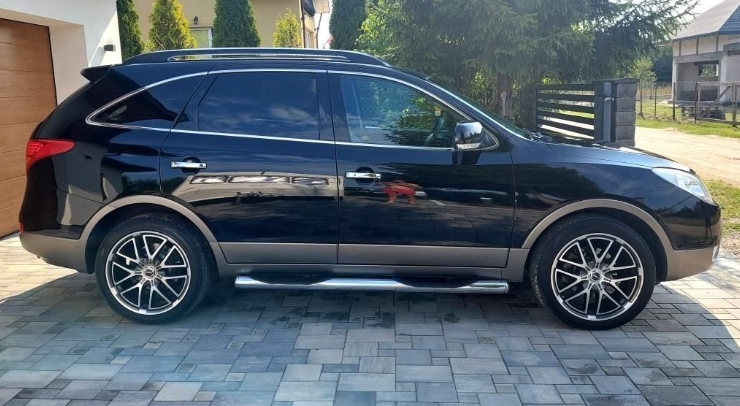
The Hyundai ix55: The Ambitious Precursor to a Premium Legacy
In the world of automotive history, some vehicles are remembered for their groundbreaking sales and cultural impact, while others, more quietly, serve as crucial stepping stones in a manufacturer’s evolution. The Hyundai ix55, known in North America as the Veracruz, falls squarely into the latter category. It was a vehicle that represented a bold declaration of intent from a brand rapidly shedding its budget-friendly image. Though its time on the global stage was relatively brief, the ix55 was a meticulously engineered and luxuriously appointed SUV that laid the essential groundwork for the premium Hyundai and Genesis models we see today. This is the story of its evolution, its models, and its understated but significant legacy.
A New Horizon: The Genesis of the Veracruz (2006-2007)
To understand the ix55, one must first look to the mid-2000s. Hyundai had spent decades building a reputation for value and reliability, exemplified by models like the Elantra and Sonata. However, the company harboured grander ambitions. It wanted to compete not just with Toyota and Honda, but with their luxury divisions, Lexus and Acura. The first tangible proof of this ambition was not a sleek sedan, but a large, three-row crossover SUV internally codenamed ‘EN’.
Launched in late 2006 in its home market of South Korea and arriving in North America for the 2007 model year, this vehicle was christened the Hyundai Veracruz. Named after a state in Mexico, the name was meant to evoke a sense of adventure and sophistication. It was built on a stretched version of the Santa Fe platform but was significantly larger, more refined, and aimed at a completely different customer. Its primary target was the undisputed king of the segment: the Lexus RX 350.
Hyundai poured an immense amount of resources into the Veracruz, focusing on characteristics that defined the luxury market: quietness, comfort, and premium features. The engineering brief was clear: create a serene and isolated cabin experience. To achieve this, Hyundai employed extensive sound-deadening materials, acoustic glass, and a sophisticated suspension setup designed to glide over imperfections rather than attack them.
Under the bonnet, the North American Veracruz was equipped with a single, powerful powertrain: the 3.8-litre Lambda V6 petrol engine. This smooth and capable engine produced 260 horsepower and 257 lb-ft of torque, channelled through a Japanese-made Aisin six-speed automatic transmission—a significant step up from the in-house five-speed units used in lesser Hyundais at the time. Buyers could choose between a standard front-wheel-drive (FWD) layout or an optional, electronically controlled all-wheel-drive (AWD) system that could proactively send power to the rear wheels when slip was detected.
.

.
The North American Campaign: Veracruz Models and Trims (2007-2012)
In the United States and Canada, the Veracruz was positioned as a premium offering from the outset, with a simplified trim structure that emphasized its high level of standard equipment.
- 2007-2008: For its initial launch, the Veracruz was offered in three distinct trim levels:
- GLS (Base): Even in its base form, the GLS was impressively equipped for the era. Standard features included 17-inch alloy wheels, rear parking sensors, a full suite of safety features (including six airbags and electronic stability control), automatic headlights, and seating for seven. The interior featured premium cloth upholstery, a six-speaker CD/MP3 audio system, and steering wheel-mounted audio controls. It was a value proposition, but a premium one.
- SE (Sport): The SE trim was a short-lived attempt to add a touch of sportiness. It primarily built upon the GLS by adding larger 18-inch alloy wheels, a power-adjustable driver’s seat, and a roof rack. However, it didn’t offer any mechanical changes and was often seen as an intermediate step to the main event, the Limited trim.
- Limited (Luxury): This was the flagship and the true Lexus-fighter. The Limited trim transformed the Veracruz into a genuine luxury vehicle. It added leather upholstery, heated front seats, a power-adjustable passenger seat, dual-zone automatic climate control, a power tilt-and-slide sunroof, and a premium Infinity surround-sound audio system with a 6-CD changer. A distinctive feature was the electroluminescent instrument cluster, which provided a crisp, high-end look. Options on the Limited included a navigation system and a rear-seat DVD entertainment package.
- 2009-2012: As the model matured, Hyundai streamlined the lineup, discontinuing the SE trim to focus on the core value and luxury propositions.
- The GLS remained the entry point, but Hyundai began adding more features as standard, such as an iPod/USB auxiliary input, enhancing its value.
- The Limited continued as the top-tier model. By 2011, features like the power liftgate became standard, and the optional navigation system was updated. The focus remained on providing a comprehensive luxury package for thousands less than its Japanese and German rivals.
Despite critical acclaim for its quiet ride, quality interior, and immense value, the Veracruz struggled to gain traction. Its styling was often described as handsome but anonymous, and its biggest hurdle was the Hyundai badge itself. In the late 2000s, many premium buyers were still hesitant to spend over $35,000 on a Hyundai, regardless of how well it was built. Consequently, sales never met Hyundai’s high expectations, and the Veracruz was discontinued in the North American market after the 2012 model year.
Crossing the Atlantic: The ix55 Identity in Europe (2009-2012)
While the Veracruz was winding down in America, it was just beginning its life under a new name in Europe. In 2009, Hyundai introduced the vehicle to the European market as the Hyundai ix55. The name change was part of a new global alphanumeric naming strategy, aligning it with models like the ix35 (Tucson) and i30.
The ix55 was positioned as the absolute flagship of the Hyundai range in Europe, a premium hauler for discerning families. While it shared its body and luxurious interior with the Veracruz, its powertrain was completely different, tailored specifically for European tastes and emissions regulations.
Gone was the thirsty 3.8-litre petrol V6. In its place was a sophisticated and powerful 3.0-litre S-Line CRDi V6 turbo-diesel engine. This engine was a powerhouse of torque, producing around 237 horsepower (240 PS) and a substantial 333 lb-ft (452 Nm) of torque. It delivered effortless cruising and strong pulling power, making it ideal for the continent’s motorways and for towing. Like the Veracruz, it was paired with the same smooth Aisin six-speed automatic transmission. In most European markets, the ix55 was offered exclusively with AWD, reinforcing its status as a capable, all-weather flagship.
The trim structure in Europe was even simpler than in North America, often consisting of just one or two highly specified models. The naming conventions varied slightly by country, but they generally followed a pattern:
- Style (or Comfort): This would serve as the entry-level model, though it was far from basic. It typically came standard with leather upholstery, heated seats, 18-inch alloy wheels, dual-zone climate control, and a comprehensive safety package. It offered the core luxury experience of the vehicle.
- Premium (or Executive): The top-tier model added every conceivable feature. This included a factory-fitted touchscreen navigation system, a premium sound system, a sunroof, xenon headlights, power-folding mirrors, and often memory settings for the driver’s seat. The ix55 Premium was a “fully loaded” vehicle with very few, if any, optional extras.
The ix55 faced similar challenges to the Veracruz. It was a technically excellent vehicle that offered tremendous refinement and space for the money, but it competed in a fiercely brand-conscious market segment against the likes of the Audi Q7, BMW X5, and Volvo XC90. While it was priced aggressively against them, the Hyundai badge still lacked the cachet of its German and Swedish rivals. Production for the European market ceased around 2012.
The End of an Era and an Enduring Legacy
The discontinuation of the Veracruz and ix55 around 2012 was not an admission of failure, but a strategic pivot. Hyundai had learned a valuable lesson: while it could build a vehicle to a near-luxury standard, the market wasn’t yet ready to accept it under the mainstream Hyundai brand.
The ix55’s role was ultimately filled by a more pragmatic solution. For the 2013 model year, Hyundai redesigned the popular Santa Fe and launched it in two wheelbase lengths. The standard five-seater Santa Fe Sport, and the new seven-seater, long-wheelbase model known simply as the Santa Fe in North America (or Grand Santa Fe in Europe). This new model offered the three-row seating of the ix55 but did so under a familiar, successful nameplate, making it a much easier sell for dealers and consumers.
However, the spirit and engineering lessons of the ix55/Veracruz did not die. They were a crucial dress rehearsal. This vehicle was Hyundai’s first serious attempt at creating a premium product, and the knowledge gained in vehicle dynamics, material quality, and luxury feature integration was directly channelled into its next, much bolder project: the Genesis sedan and, eventually, the standalone Genesis luxury brand.
When you step inside a modern Hyundai Palisade or a Genesis GV80, you are experiencing the fulfilment of the promise that the ix55 first made. The focus on a whisper-quiet cabin, the use of high-quality materials, and the generous list of standard luxury features can all trace their lineage back to this ambitious, short-lived crossover. The Hyundai ix55 may not have been a sales champion, but it was a brave and necessary pioneer, a vehicle that proved Hyundai had the engineering prowess and the ambition to play in the big leagues. It stands today as a testament to the brand’s relentless journey from a manufacturer of budget cars to a builder of world-class automobiles.