The MG RV8: The Revival Roadster — Evolution of a Classic British Sportscar
The MG RV8 holds a unique place in British automotive history as a brief but memorable revival of the classic MGB roadster, re-imagined for the early 1990s with modern performance and luxury. Built to celebrate MG heritage and invigorate the brand ahead of a new generation of sports cars, the RV8 combines traditional British open-top motoring with a powerful V8 engine and bespoke craftsmanship. Despite a short production span from 1993 to 1995, the model’s rarity and character have cemented its status as a cherished classic among enthusiasts worldwide.
Genesis: Why the RV8 Was Created
By the late 1980s, the iconic MG B — which had been produced from 1962 until 1980 — had long ceased official production, although its heritage bodyshells were being manufactured for restorations by British Motor Heritage. After seeing renewed interest in small sports cars following the success of rivals like the Mazda MX-5, Rover Group sought to reintroduce a high-end British roadster that could tap into nostalgia while appealing to modern buyers. The idea was to build a limited-run, premium MG that celebrated the marque’s tradition and pointed toward its future, helping bridge the gap before the launch of the all-new MG F in 1995.
Production Years: 1993–1995
The MG RV8 was first shown at the 1992 British International Motor Show in Birmingham as a special roadster commemorating the 30th anniversary of the original MGB. Final production began in March 1993 at Rover’s Cowley plant in Oxford following body shell manufacture by British Motor Heritage at Faringdon, Oxfordshire. Completed bodies were sent to Cowley, where skilled workers assembled each RV8 by hand.
Although officially produced from 1993 through late 1995, RV8s were built in very limited numbers — just under 2,000 units total — making them rare and highly sought after today. The vast majority were exported to Japan, where the car enjoyed considerable popularity, while only a small portion remained in the UK or other markets.
.

.
Design and Engineering Overview
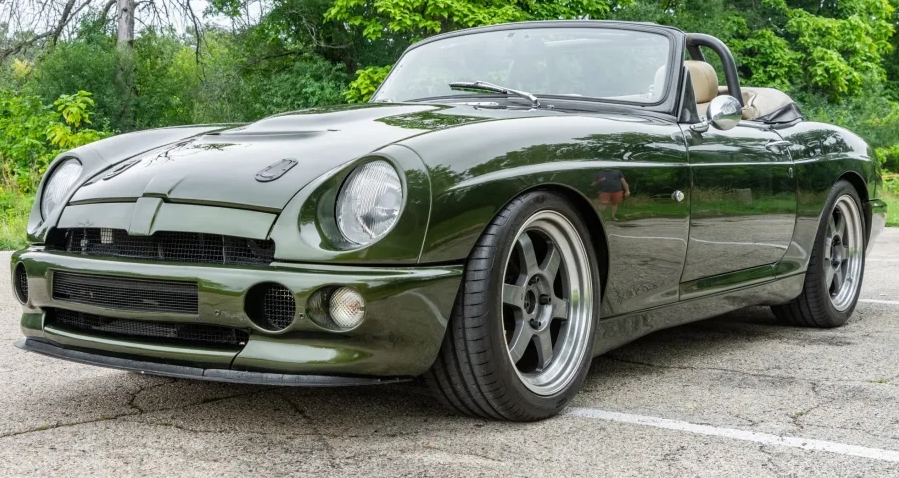
On first glance, the RV8 evokes the classic proportions of the MGB. However, its visual and mechanical differences are substantial:
- Updated bodywork: The RV8’s panels were redesigned with wider inner and outer fenders, integrated bumpers, and smoother lines, departing from the original MGB sheetmetal while retaining its classic silhouette. Porsche-style headlights and bespoke taillights gave it a modern British roadster identity.
- All-alloy V8: At its heart sat a 3.9-litre Rover V8 engine, allied to a Lucas electronic fuel-injection system producing roughly 190 bhp — a dramatic increase over the original MGB’s four-cylinder power.
- Transmission and drivetrain: Power was routed to the rear wheels via a five-speed manual gearbox and a Quaife limited-slip differential, providing engaging dynamics.
- Chassis and suspension: While the live rear axle remained from the original MGB architecture, the RV8 benefitted from wider track, upgraded suspension components, and improved brakes, enhancing its handling compared to its ancestor.
- Interior luxury: Inside, the RV8 featured premium Connolly leather seats, burr elm wood trim, and deep-pile carpeting — an upscale contrast to the MGB’s spartan interior.
These elements combined to create a car that was both nostalgically familiar and technically distinct, celebrating MG’s sporting heritage while offering a more luxurious and powerful driving experience.
Models and Trim Levels
Unlike many modern cars with broad trim hierarchies, the MG RV8 was not offered in multiple trim levels or equipment packages. It was essentially a single model — the RV8 Roadster — produced in one configuration throughout its life.
RV8 Roadster (1993–1995)
- Body style: Two-door convertible roadster.
- Engine: 3.9 litre Rover V8 petrol, ~190 bhp with Lucas multi-point fuel injection.
- Transmission: Five-speed manual.
- Performance: Around 0–60 mph in under 6 seconds and a top speed approaching 135 mph.
- Equipment: Connolly leather upholstery, burr elm veneer trim, manually-operated convertible top, bespoke alloy wheels, and luxury cues throughout.
There were no factory variants such as a coupe or hardtop; however, the rare nature of the car and the export market distribution (predominantly to Japan) meant that individual cars often had unique colour combinations or specifications — for example, different paint codes and interior trims.
Production Breakdown and Export Markets
Of the approximately 1,982 RV8s built between 1993 and 1995:
- Roughly 1,583 were exported to Japan, where demand was highest.
- Around 307 units remained in the UK.
- A small number (about 92) were sold in European markets left-hand drive.
This split underlines the RV8’s commercial niche: despite its heritage appeal, its high price and old-school rear-axle architecture limited broader uptake in its home UK market but found appreciation among Japanese enthusiasts of classic British cars.
Market Reception and Challenges
At launch, the RV8 was prized for blending classic British roadster charm with modern power and luxurious detailing. However, it also faced criticism:
- Outdated foundation: Despite modern bodywork and a V8, the car retained a live rear axle and drum brakes at the rear — features dating back decades — which some felt undermined its handling relative to contemporary rivals.
- High price: With a premium than many expected for a re-imagined classic, the RV8’s price tag limited its appeal in key markets like the UK.
- Niche positioning: More of a specialty model than a volume seller, it was built deliberately in limited quantities, emphasizing craftsmanship over mass appeal.
Still, its combination of performance, luxury interior, and evocative design ensured that RV8s quickly found favor with collectors and remain highly respected today among classic British sports cars.
Legacy and Collectibility
The RV8 did more than just celebrate the MGB’s heritage; it helped reestablish the MG marque as a maker of true sports cars. Its presence bolstered brand recognition leading up to the launch of the MG F in 1995, the next generation roadster that would significantly expand MG’s market presence.
Today, RV8s are prized by collectors for their rarity, performance, and unique place in MG history. Well-preserved examples command respectable prices at auction and are celebrated at classic car shows. Enthusiast clubs and dedicated parts suppliers support RV8 owners, reflecting the car’s strong following despite its short life.
Future Outlook
Given its limited production and devoted fanbase, the MG RV8’s status as a collector classic is secure. As time passes, its appeal among classic sports car enthusiasts continues to grow. Because of its V8 performance, retro design, and hand-built legacy, the RV8 is often compared to other rare roadsters of its era — and its values have stabilized or appreciated among serious collectors.
While there are no plans for a modern revival of the RV8 nameplate, the success of modern MG roadsters and the ongoing interest in retro-styled performance cars suggest that the RV8’s spirit lives on in enthusiast culture. Whether as inspiration for bespoke restomods or as a cherished classic, the RV8 continues to represent a bridge between MG’s storied past and its contemporary evolution.
The MG RV8 stands as an exceptional example of how a heritage sports car can be reinvented for a new era. Produced from 1993 to 1995 in limited numbers, the RV8 married classic roadster looks with a powerful 3.9-litre V8, luxurious detailing, and bespoke craftsmanship — creating a car that was both nostalgic and exciting in its own right. Though singular in its model offering and niche in appeal, its impact resonates strongly with British car collectors and MG enthusiasts alike, preserving its legacy as one of the most fascinating British sports cars of the 1990s.