The Rover 75: Evolution of a British Executive Classic
The Rover 75 stands as one of the most significant and final chapter models in the long and storied history of the British Rover marque. Introduced at the close of the 20th century and produced until the collapse of MG Rover in the early 21st, the 75 bridged traditional British design cues with contemporary engineering, offering comfort, styling and refinement that appealed to a broad marketplace. Across its production from 1999 to 2005, the Rover 75 was offered in multiple body styles, engines and trim levels that evolved over time, leaving behind a legacy honored by enthusiasts and classic-car aficionados alike.
Origins and Concept
The Rover 75 — internally known as the R40 during development — was conceived as a mid-size executive saloon intended to replace both the aging Rover 600 and 800 Series. It debuted at the 1998 Birmingham Motor Show and deliveries– for model year 1999 — began in early 1999, under the ownership of BMW, which then owned the Rover brand.
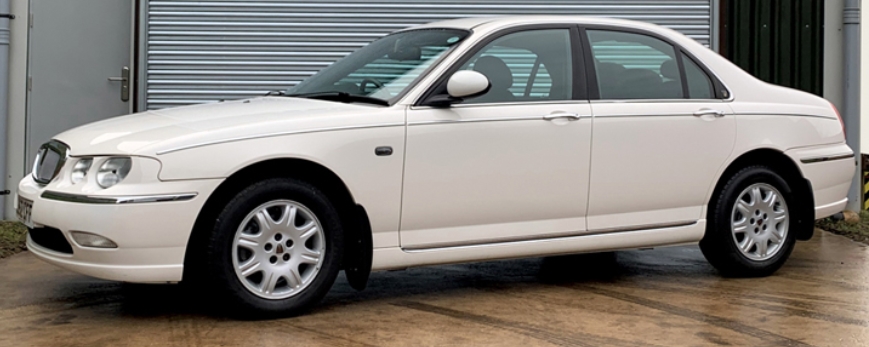
Unlike many competitors of the era, the 75’s design leaned heavily on classic British styling cues, with flowing lines, upright grille and richly trimmed interiors intended to evoke a blend of traditional elegance and modern functionality. The car’s name referenced Rover’s historical model naming tradition — echoing the classic Rover “Seventy-Five” of the mid-20th century.
Production Run: 1999–2005
The Rover 75 was produced from 1999 until 2005, when MG Rover — the successor to Rover Group after BMW’s divestment — entered administration and ceased volume car production. During this period, the 75 was manufactured in saloon and estate (Tourer) body styles, with a later facelift in 2004 that refreshed its appearance, expanded its engine choices and added special variants like a rare V8.
In total, over 200,000 examples of the Rover 75 were built before MG Rover’s collapse. The model served across private and fleet sectors, and even found use in official capacities — notably as a government car for UK ministers.
.

.
Body Styles and Variants
The Rover 75 was offered in three main body configurations:
- Saloon (4-door) – The core body style throughout production (1999–2005).
- Tourer (Estate, 5-door) – Introduced in 2001 to broaden appeal and practicality, with impressive cargo space and flexible seating.
- Long-Wheelbase Limousine – A rare stretched version used primarily for official purposes and special customers, adding 200 mm of rear floor space and luxury seating; limited numbers were built in the mid-2000s.
Engine Options and Performance
The Rover 75’s powertrain lineup evolved over its life, offering a wide range of petrol, diesel and limited-run V8 engines:
🛞 Petrol Engines
- 1.8-litre K-Series – Inline-4 petrol (around 120 PS) forming the base of the range at launch, paired with manual or automatic gearboxes.
- 1.8-litre Turbo (1.8 T) – From 2002 onward, a turbocharged version replaced the V6 2.0 in many markets, delivering ~150 PS and improved torque.
- 2.0-litre V6 – Naturally aspirated petrol V6 (~150 PS) offered in early years for smooth and refined performance.
- 2.5-litre V6 – Larger V6 (~177 PS) providing higher performance and refinement for executive buyers.
- 4.6-litre V8 – Rare and special variant (typically automatic) using Ford’s Modular V8 producing ~260 PS, added after the 2004 facelift for a limited run of around 200+ examples across saloon and Tourer.
🛞 Diesel Engines
- 2.0 litre CDT – Turbo diesel with around 116 PS, popular in Europe for economy and torque.
- 2.0 litre CDTi – Upgraded common-rail diesel (~131 PS) introduced in the early 2000s, offering strong torque and improved refinement.
Hybrid, LPG or alternative powertrains were not offered officially during the 75’s original production run, although enthusiasts frequently experiment with conversions today.
Trim Levels and Equipment Grades
From launch in 1999, Rover structured the 75 lineup around distinct trim grades to differentiate comfort, luxury and equipment levels. The following were the main tiers offered across its life (with some changes after the 2004 facelift):
🌟 Classic
Most basic trim, providing essential equipment such as ABS, electric front windows, central locking, basic radio/cassette player and standard upholstery.
🌟 Classic SE
A sub-variant adding convenience enhancements like air conditioning, upgraded sound, and minor comfort features over the base Classic.
🚘 Club
Middle-range trim adding more convenience and comfort features, such as rear electric windows, fog lamps, alloy wheels and improved interior trims.
🚘 Club SE
Enhanced Club specification with additional features including greater interior refinement and optional packs such as automatic climate control.
💼 Connoisseur
Top-end mainstream trim with leather seats, powered and heated front seats, cruise control, premium audio systems, and additional luxury touches such as wood trim and advanced instrumentation.
💎 Vanden Plas
A more premium “executive” grade introduced later in the model cycle, often featuring unique interior detailing, higher-grade leather, and soft-close doors on some variants.
After the 2004 facelift, Rover updated and renamed some trims — for example adding Contemporary and Contemporary SE grades that sat between Classic and Connoisseur levels, alongside revised Vanden Plas offerings for top-level luxury.
Facelift and Mid-Life Update (2004)
In early 2004, the Rover 75 received its most substantial refresh:
- Styling revision — revised bumpers, headlights/taillights, grilles and interior trim upgrades.
- Expanded engines — the turbo-1.8 replaced the older 2.0 V6 in many markets to improve economy; the rare V8 was added as the performance flagship.
- Refreshed trim structure — Contemporary and updated Connoisseur/Vanden Plas options refined the range, with improved standard equipment and safety features.
This facelift aimed to extend the 75’s competitive lifespan in an increasingly crowded executive market.
MG ZT and Performance Variants
Although not badged strictly as “Rover 75,” the closely related MG ZT and MG ZT-T variants — introduced by MG Rover — built on the 75’s platform to deliver a more sporting experience with stiffer suspension, sportier styling elements and performance-tuned engines, including the V8 in the ZT 260. These amplified Rover 75’s appeal to enthusiasts and added performance credibility to the family.
Market Reception and Legacy
At launch, the Rover 75 was widely praised for its comfortable ride, refined cabin, and distinct character that stood out from staid German rivals. However, it faced challenges due to tightening safety and emissions standards, increasing competition and perception issues related to Rover’s brand strength in key markets.
Despite these pressures, the 75 became popular across Europe and in export markets, especially for buyers seeking comfort and traditional design cues rather than outright performance or badge prestige. The Tourer estate, with its flexible luggage space, broadened the market appeal beyond just executive saloon buyers.
End of Production and Aftermath
MG Rover’s collapse in 2005 brought production of the 75 to an end, with no continuous successor from the brand. However, the intellectual property and tooling for the model were eventually acquired by Chinese companies — first by Nanjing Automobile, and later by SAIC Motor. Under SAIC ownership, a development of the 75 continued in China as the Roewe 750 through the mid-2010s, with updated engines and localized adaptations that kept the platform alive beyond its UK lifespan.
Future Outlook and Relevance
Today, the Rover 75 is regarded as a classic British executive saloon with growing interest among collectors due to its design, breadth of versions and significance as one of the last mainstream Rovers produced. While MG Rover no longer exists and the 75 name has not been revived, its lineage continues indirectly through Roewe and MG’s modern models that emphasise comfort, style and value, such as the current MG7 in China.
In the classic car market, well-maintained Rover 75 examples — particularly Tourers and rare V8-powered models — are increasingly appreciated for their distinct character and relative rarity, offering a snapshot of early-21st-century British automotive ambition.
The Rover 75 remains a milestone in British automotive history: a bold attempt to blend tradition with modern engineering across a versatile executive family car that spanned saloon and estate bodies, a variety of engines from economical diesels to potent V8s, and a series of thoughtful trim levels to meet diverse buyer needs. From its 1999 launch through to the end of production in 2005, it served as an elegant expression of British car design and remains a beloved classic more than two decades later.