The Saloon (Sedan) That Roared: How the Jaguar Mark 1 and Mark 2 Defined a Class
In the annals of automotive history, few cars manage to encapsulate a specific era quite like the Jaguar Mark 1 and its successor, the Mark 2. These were not merely vehicles; they were statements. They represented the zenith of the “sports saloon” concept—a genre of car that allowed the travelling businessman to enjoy the refined comfort of a luxury vehicle on the journey, yet possess the thrilling capability to devour winding country roads with the verve of a dedicated sports car. To drive a Jaguar saloon of this era was to experience a perfect duality: it was a car that looked impeccably tailored and respectable, yet hid a muscular heart that could surprise almost anything on the road. This is the story of their evolution, from the compact executive of the 1950s to the swashbuckling icon of the 1960s.
The Genesis of a Legend: The Mark 1 (1955-1959)
Following the Second World War, Jaguar, under the visionary leadership of Sir William Lyons, had established itself as a premier builder of elegant sports cars and groundbreaking grand tourers like the XK120 and the XJ13’s spiritual ancestor, the C-Type. However, Lyons had ambitions to conquer a new market: the burgeoning executive saloon segment, which was dominated by conservative offerings from Mercedes-Benz, Rover, and Humber. Jaguar’s answer was a car that combined sleek, low-slung sports car aesthetics with the practicality of a four-door saloon.
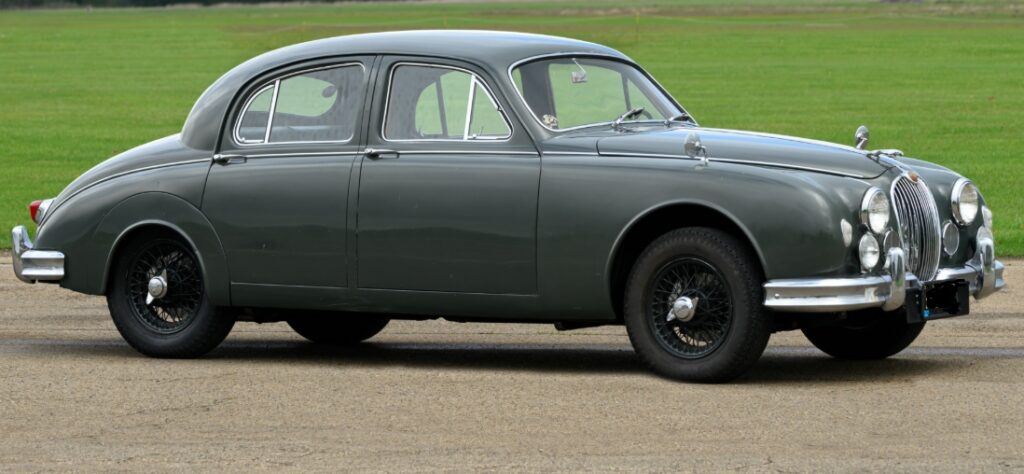
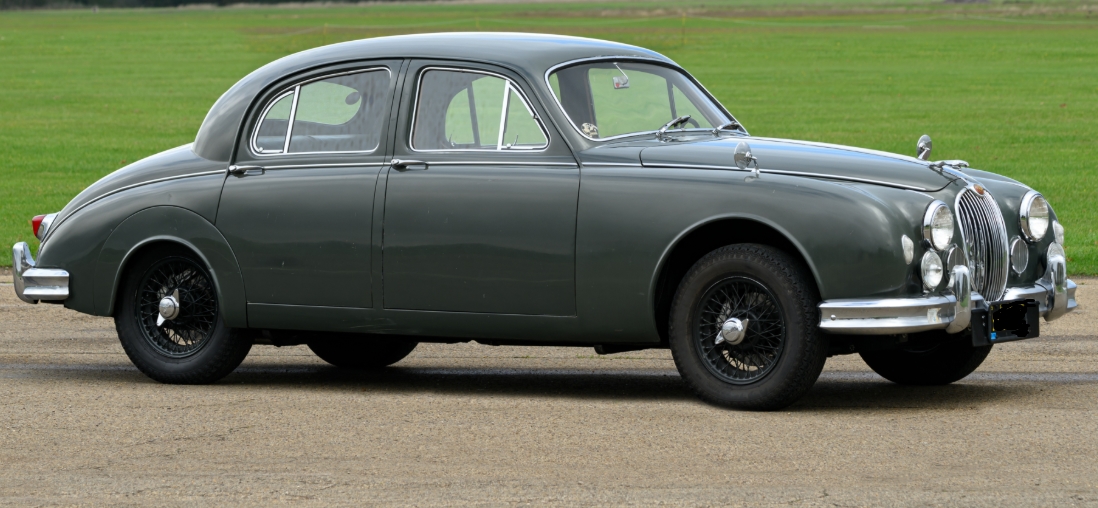
The car debuted at the London Motor Show in 1955 as the “Jaguar 2.4 Litre Saloon.” It was a revelation. The body, penned by Lyons himself, was a masterclass in style. With a sweeping waistline, a distinctive “grin” created by the placement of the headlights, and a graceful fastback-style roofline, it looked like a scaled-down XK140. The interior was pure Jaguar: a wood-veneered dashboard, Connolly leather seats, and a sense of occasion that far exceeded its price point.
At its launch, the powertrain was a 2.4-litre (2483cc) version of Jaguar’s venerable XK inline-six engine. To maintain the car’s sporting character, it featured a twin-SU carburettor setup, producing a respectable 112 bhp. While not explosively fast by modern standards, it was smooth and delivered its power with a cultured eagerness. A crucial feature for the era was the inclusion of a Borg-Warner three-speed automatic transmission as an option, alongside a standard four-speed manual gearbox (with no overdrive initially). The automatic proved immensely popular, cementing the car’s image as a relaxed and refined cruiser.
In 1957, the range was expanded with the introduction of the Jaguar 3.4 Litre Saloon. This model took the same elegant body and fitted it with the legendary 3.4-litre (3442cc) XK engine from the Mark 7m saloon and XK140 sports car. Power swelled to 210 bhp, transforming the car from a brisk executive express into a genuine high-performance saloon. The 3.4 Litre could accelerate to 60 mph in around 10 seconds and reach a top speed of over 120 mph, figures that rivaled most pure sports cars of the day. It was this model that truly established the “sports saloon” template.
By the end of production in 1959, Jaguar had built over 100,000 units of the Mark 1 range, a remarkable success. It had proven that a car could be both beautiful and brutally quick, comfortable and compact. The foundation was laid, but the best was yet to come.
.
THIS might be a great place to get your new car from!
Or for those who are into the “car flipping” business, here’s an excellent resource for you!

.
The Evolution: The Mark 2 (1959-1967)
At the 1959 London Motor Show, Jaguar unveiled the successor to its popular saloon. On the surface, the new car looked remarkably similar to the old one. However, almost every panel was new, and the changes, both cosmetic and technical, were significant enough to warrant a new name: the Jaguar Mark 2.
The most visible change was the vast expanse of glass. The A, B, and C-pillars were thinned dramatically, and the rear side windows were extended, creating a “greenhouse” effect that was not only modern but also improved visibility immensely. The rear window was also significantly larger and flatter. This “glassy” look, combined with a slightly more upright rear end, gave the Mark 2 a fresh and contemporary appearance. The front grille was subtly revised, the headlamps were now standard dual units (no longer single or “opera” lights), and the chrome trim was updated.
The engine range at launch remained the same 2.4-litre and 3.4-litre XK units, but the chassis received a major overhaul. The most important upgrade was the adoption of disc brakes on all four wheels as standard, a vital improvement for a car with such formidable speed.
The Mark 2 was initially offered in three distinct trim levels, which defined the car’s market position for the next eight years:
- Standard: This was the base model, but there was nothing “basic” about it. It came with the 2.4-litre engine (120 bhp from 1960 onwards), leather upholstery, a wood-veneered dashboard, and a comprehensive set of dials. It was the refined, sensible choice.
- De-Luxe: The De-Luxe trim added a layer of ostentatious luxury. It included front seatbelts (a forward-thinking safety feature), a heater/blower with four-speed fan, amethyst blue or grey instrumentation dials, and, most notably, real walnut door capping trim in addition to the dashboard.
- Executive: This was the top-of-the-line model, reserved for the 3.4-litre engine. It combined all the features of the De-Luxe with even plusher “Dawn” Hide leather upholstery, a wood-rimmed steering wheel, and the most opulent interior finish. The Executive was the ultimate expression of the Mark 2’s luxury credentials.
The Mark 2, particularly in 3.4-litre form, quickly became the quintessential “gangster’s car” in the UK, famously associated with figures like the Kray twins. Yet it was also the car of choice for doctors, company directors, and racing drivers. Its combination of a 125 mph top speed, a supple ride, and a luxurious cabin was unmatched.
The Racing Years and Growing Power
The Mark 2’s prowess was not confined to the road. It became a dominant force in saloon car racing. The legendary driver Stirling Moss, among others, campaigned a 3.4-litre Mark 2 to numerous victories, proving it could beat dedicated competition from Ferrari and Aston Martin on the track.
Recognising the car’s potential, Jaguar introduced more powerful versions to keep ahead of the competition:
- 3.8 Litre (1960-1967): In 1960, the 3.8-litre (3781cc) XK engine from the XK150 was fitted to the Mark 2 chassis. This engine produced 220 bhp (later 240 bhp with E-C type cams), elevating the car into the supercar league. The 3.8 Mark 2 was a true giant-killer, capable of a 0-60 mph time of under 8.5 seconds.
- 340 gtb & 340 gts (1963-1964): Briefly, for the US market, the 3.4-litre model was renamed the 340. The 340 GTB was the de-luxe trim, and the 340 GTS was the Executive trim. This was largely a marketing exercise, and the cars were mechanically identical to the 3.4-litre Mark 2.
- 2.5 Litre (1967): As the 1960s progressed, Jaguar foresaw the need to comply with emerging emissions regulations and also sought to offer a more affordable, tax-efficient model. In 1967, a new 2.5-litre (2483cc) XK engine was introduced, featuring a twin-cam head and producing 140 bhp. This was offered in Standard and De-Luxe trims and was intended to replace the older 2.4.
The Final Flourish: The 240 & 340 (1967-1969)
Despite its age, the Mark 2 platform was still highly regarded. To bridge the gap before the arrival of its eventual successor (the 420), Jaguar made one final revision to the range in late 1967, introducing the 240 and 340.
These cars were technically Mark 2s but represented a final consolidation of the model line.
- Jaguar 240: This was the entry-level model, powered by the new 140 bhp 2.5-litre XK engine. It was offered in a single, well-appointed trim level that effectively combined the features of the old Standard and De-Luxe models. It included the wood dash, improved interior fittings, and standard front disc brakes. It was the most affordable way to get into a new Jaguar sports saloon.
- Jaguar 340: This was the spiritual successor to the old 3.4-litre Executive. It used the same 210 bhp 3.4-litre XK engine but was offered in a single, high-specification trim level. It was the performance flagship of the final run, a no-compromise machine for the driver who wanted the ultimate Mark 2 experience.
Production of the 240 and 340 ended in 1969, bringing the curtain down on a production run of over 13 years and 240,000 units. The Mark 2 had evolved from a stylish compact cruiser into a multi-faceted performance icon.
Legacy and Future Outlook
The Jaguar Mark 1 and Mark 2 did not just define a class; they created it. The concept of a large, powerful, and luxurious four-door saloon that could genuinely challenge sports cars on both road and track became a blueprint that many manufacturers would follow. The BMW 3.0 CSL “Batmobile” and the later M5 models owe a philosophical debt to the Jaguar saloons of the 1950s and 60s.
Today, the Mark 1 and Mark 2 are highly prized by classic car enthusiasts. The Mark 1 is seen as the rarer, purer stylist, while the Mark 2 is the more common, more capable, and more iconic of the two. Values for pristine examples of the 3.8-litre and 3.4-litre models, especially in desirable colours and with a known history, have risen steadily. The 240 and 340 are also sought after, offering a great entry point into Mark 2 ownership.
The future for these cars remains bright. Their robust XK engine design means they can be easily maintained and even upgraded by modern specialists. The trend of “restomods,” where classic cars are fitted with modern engines, brakes, and suspension, has also embraced the Mark 2, with companies offering conversions that make them perform like contemporary super saloons while retaining their timeless looks.
More than six decades after the first 2.4 Litre saloon was unveiled, its legacy endures. The Jaguar Mark 1 and Mark 2 remain a testament to Sir William Lyons’ philosophy: “Grace, Space, and Pace.” They were, and continue to be, the perfect blend of a gentleman’s attire and a sportsman’s soul.