The Vauxhall Belmont: A Detailed History and Evolution of an Underrated British Saloon
When the Vauxhall Belmont was introduced in the mid-1980s it was a bold attempt by General Motors’ British arm to carve out a niche in the highly competitive small family car market. Positioned as a more traditional saloon alternative to hatchbacks like the Vauxhall Astra hatch, the Belmont represented an interesting chapter in Vauxhall’s history — one that was shaped by shifting market trends, badge-engineering strategies, and the evolving preferences of UK car buyers.
Origins: Creating a Saloon Distinct from the Astra
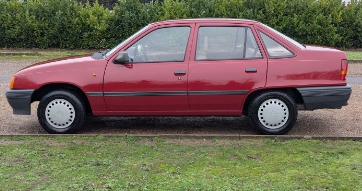
Although closely related to the second-generation Vauxhall Astra (which itself was the UK version of the Opel Kadett E), the Belmont was marketed separately in the United Kingdom. The Astra nameplate applied to hatchbacks, estates, and other body variants, but the saloon — with its traditional boot — was branded as the Vauxhall Belmont to clearly differentiate it.
First unveiled at the Frankfurt Motor Show in 1985, the saloon version went on sale in the UK in January 1986, built on the same T-platform as the Opel Kadett E and Astra Mk II. It was designed to compete directly with rivals like the Ford Orion and Volkswagen Jetta — cars that were successfully positioned above their hatchback brethren.
Production Years and Market Context (1986–1991)
Production of the Vauxhall Belmont spanned January 1986 to September 1991. During this period, the nameplate was used exclusively in the UK; elsewhere the saloon was simply known as the Opel Kadett saloon.
The decision to give the saloon a separate name was strategic: at a time when hatchbacks were rapidly gaining popularity across Europe, manufacturers hoped that distinct saloon nameplates would suggest added prestige and appeal to business customers. For the Belmont, however, this approach had mixed results — initial sales were solid but waned as hatchbacks continued to dominate the compact segment.
In September 1991, Vauxhall discontinued the Belmont name, folding all saloons back into the Astra range with the launch of the third-generation Astra. Subsequent saloon variants generally used the Astra badge until saloons were eventually dropped from the mainstream Astra line in the early 2000s.
.

.
Body Style and Architecture
Throughout its life, the Belmont was offered solely as a four-door saloon with front-wheel drive and seating for five, featuring a conventional three-box design with a prominent boot. While based on Astra/Kadett underpinnings, the extended rear ensured a larger luggage capacity — one of the Belmont’s strongest selling points.
Structurally and mechanically the car shared its core platform, suspension, and many components with the Astra Mk II, although visually it was instantly recognizable by its distinct rear profile and larger bootlid.
Engine Options Over the Years
Throughout its production run, the Belmont was offered with a range of petrol and diesel engines lifted straight from the Astra hatchback family. These provided a good balance of economy and performance for the era, particularly for those looking for practical everyday transport:
Petrol Engines
- 1.3 L (75 hp) – Early entry-level petrol engine with adequate performance for city driving.
- 1.6 L (90 hp) – A common mid-range petrol offering good all-around performance.
- 1.6 L S (82 hp) – A slightly softer-tuned version available in later years.
- 1.8 L (111 – 115 hp) – The most powerful petrol option, and the basis of sportier trims such as the SRi.
Diesel Engines
- 1.6 L Diesel (54 hp) – Efficient, economical option particularly suited to fleet buyers.
- 1.7 L Diesel (57 hp) – A small improvement in power and torque in later years.
Trim Levels and Model Variants
Trim levels for the Belmont largely mirrored those available in the wider Astra lineup, but with some British market tailoring. Typical trims included:
- L / Standard – The entry-level variant with basic features.
- GLS / GL – Mid-range models with additional comforts such as fabric upholstery and options like a sliding sunroof and electric mirrors.
- GLSi / SRi – The sportier top trims that paired the 1.8 L engine with sport suspension, alloy wheels, and other performance-oriented upgrades.
- CD – A more luxury-focused trim in some years, with upgraded interior features and trim enhancements.
In some later years, badge treatment changed slightly to “Astra Belmont” after the mid-life update in an apparent effort to unify the Astra name across all body styles.
Contemporary Reception and Legacy
When new, the Belmont was praised for its practical boot space — larger than many rivals in the same class — and its comfortable ride quality. Reviews of the era highlighted that, while it didn’t break new ground in driving dynamics, it offered solid value in terms of everyday usability and interior space.
Despite these positives, the Belmont name did not endure. By the early 1990s, the saloon body type was increasingly eclipsed by hatchbacks and emerging compact family cars with five-door layouts, leading Vauxhall to retire the separate nameplate in favor of a consolidated Astra brand approach.
Today the Belmont is rare on UK roads — tens of thousands were produced, but only a handful remain taxed and actively driven. The car has developed a modest cult following among enthusiasts, appreciated for its 1980s character and practical engineering.
The Belmont’s Place in Automotive History
The Vauxhall Belmont holds a unique place in British automotive history. It represented General Motors’ attempt to apply a European saloon marketing strategy (similar to the Ford Orion and VW Jetta) to a UK-centric model. Although it proved less enduring than rivals, the Belmont reflects a transitional era when manufacturers were experimenting with body-style differentiation to appeal to broader customer segments.
From a technical perspective, the Belmont showcased how badge engineering could be used to diversify a core platform — leveraging the popular Astra/Astra Mk II chassis while targeting a subtly different audience. It also highlighted the importance of timing in automotive marketing: as hatchbacks gained dominance, the demand for traditional three-box designs in the compact class declined sharply.