The Evolution of the Isuzu Faster: A Global Compact Pickup Pioneer
The Isuzu Faster is one of the most enduring compact pickup trucks in automotive history — a workhorse model that helped define Isuzu as a nameplate for rugged, practical utility vehicles around the world. Produced from 1972 until 2002, the Faster spanned three distinct generations and was marketed globally under a variety of names and trim configurations. While it was eventually succeeded by the Isuzu D‑Max, the legacy of the Faster remains deeply woven into international pickup culture and light commercial vehicle markets.
Origins and Market Context
The Isuzu Faster was introduced by Isuzu in 1972 as a compact pickup designed to succeed the aging Isuzu Wasp — itself a pickup derivative of the Bellett sedan. Built with a traditional ladder‑frame chassis, living rear axle with leaf springs, independent front suspension, and a variety of inline four‑cylinder engines, the Faster embodied a durable, no‑nonsense approach ideal for work and light‑utility applications.
From the outset it was built for global reach: in many export markets, Isuzu rebadged the Faster as the Isuzu KB or Isuzu Pickup, and under General Motors distribution agreements it was also sold as the Chevrolet LUV in the United States and other regions. In some markets such as Europe it appeared as the Bedford KB.
Across three generations produced between 1972 and 2002, the Faster evolved in design, capability, and market positioning — ultimately setting the stage for its successor, the globally acclaimed Isuzu D‑Max.
.

.
First Generation (1972–1980): Compact Beginnings
The first iteration of the Isuzu Faster — internally coded KB20/KB25 — debuted in 1972. With a ladder‑frame chassis, simple yet proven suspension design, and engines sourced from the Isuzu Florian sedan, this generation was intended to be both rugged and efficient.
Engine Options
The first‑generation lineup offered modest gasoline and diesel engines to suit different markets:
- 1.6‑liter gasoline (G161/G161Z) — the bread‑and‑butter engine in many regions.
- 1.8‑liter gasoline (G180Z) — a slightly larger petrol option in some export markets.
- 2.0‑liter diesel (C190) — aimed at buyers wanting economical torque and durability.
Variants and Trim Choices
Trim level designations were not as formalized as later decades of automotive marketing, but the first generation did see:
- Single‑cab short‑wheelbase — a quintessential work pickup.
- Long‑wheelbase versions — offering increased cargo space.
- Early 4×4 options (KB40) — delivered in select markets starting in the late 1970s.
In export markets, the pickup was frequently badged as Isuzu KB or Chevrolet LUV, with dealer and regional trim options such as “Deluxe” or “Standard” varying by country. The simple feature sets focused on mechanical reliability and utility.
Second Generation (1980–1988): Expanded Options and Global Reach
The second generation, introduced in 1980, brought expanded body and drivetrain options. Known in some markets simply as the Isuzu KB or P’up, this era broadened the Faster’s appeal with more cabin choices and engine variety.
Body Styles and Configurations
During this generation, customers could choose:
- Standard single cab — a basic two‑seat pick‑up.
- Space Cab — extended cab offering extra storage behind the seats.
- Crew Cab — four‑seat configuration, ideal for small teams.
Drive options included rear‑wheel drive or selectable 4×4, making the truck suitable for both commercial duty and rugged off‑road work.
Engine Lineups
A wider range of four‑cylinder engines powered second‑generation models, including:
- 1.6‑ to 2.3‑liter gasoline engines (G161Z, 4ZA1, G180Z, 4ZB1, G200Z, 4ZD1)
- Diesel offerings (C190, C223, 4JA1) — providing enhanced torque for hauling and economy.
The availability of five‑speed manual transmissions further enhanced drivability, while optional four‑wheel drive appealed to buyers needing a hardworking off‑road vehicle.
In several markets, the second‑generation Faster continued to be sold with various GM‑brand names. In North America, for example, it was offered for the early 1980s as the Chevrolet LUV and later as the Isuzu P’up, while Australian buyers knew it as the Holden Rodeo.
Third Generation (1988–2002): Global Maturity and Diverse Trims
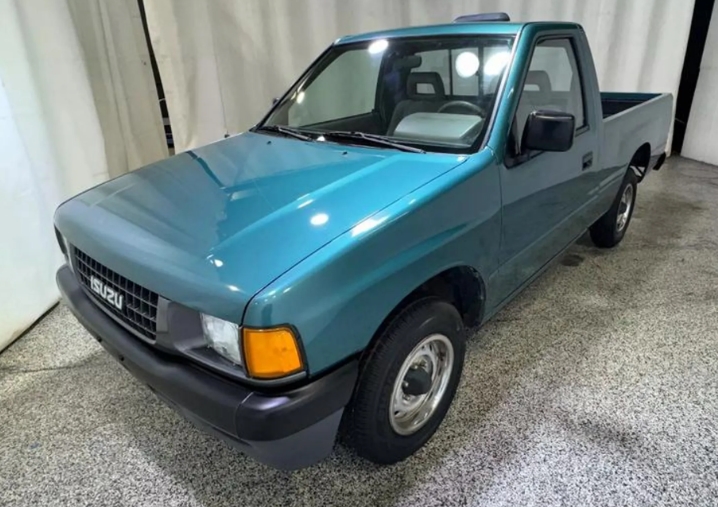
The third and longest‑running generation of the Faster — internally known as TF — was introduced in 1988 and remained in production until 2002, when it was mothballed and eventually succeeded by the Isuzu D‑Max.
Designation and Global Names
This generation’s name varied significantly by market:
- Isuzu Faster — domestic 4×2 designation in Japan.
- Isuzu Rodeo — applied to 4×4 versions in some regions.
- Isuzu Pickup — common in North America.
- Chevrolet LUV — continued in Latin America.
- Opel Campo / Vauxhall Brava — sold in parts of Europe.
- Holden Rodeo — Australian and New Zealand markets.
This proliferation of brand names and trim designations reflected the model’s versatility and popularity, adapting to a host of national automotive traditions and dealer strategies.
Trim Levels and Models
Although smaller pickups of this era did not always have formally named “trim levels” in the modern sense, the Faster TF series was offered in configurations roughly analogous to trims:
Body and Cab Configurations
- Single Cab — basic work pickup.
- Space Cab / Extended Cab — extra behind‑seat storage.
- Crew Cab — full four‑door passenger pickup.
Drivetrain and Feature Packages
- 2WD (rear‑wheel drive) — standard on base and utility models.
- 4×4 Drive — optional on Space and Crew Cabs for off‑road and commercial use.
- Manual 5‑speed and automatic 4‑speed transmissions available depending on engine and market.
Engine Options (Third Generation)
A broad array of engines powered the third generation to suit different regional needs:
Gasoline Engines
- 2.2 L I4 (C22NE/22LE) — base petrol offering.
- 2.3 L I4 (4ZD1) — mid‑range petrol.
- 2.6 L I4 (4ZE1) — stronger petrol for higher load capacity.
- Optional V6 gasoline engines (GM 3.1 L, 3.2 L V6) in some markets.
Diesel Engines
- 2.5 L turbo diesel (4JA1‑T) — rugged and economical choice.
- 2.8 L turbo diesel (4JB1‑T) — boosted diesel output.
- 3.0 L and 3.1 L diesel options (4JH1‑T, 4JG2‑T) — catering to markets valuing torque and towing potential.
As a result, Faster TF pickups could be ordered with engines tuned for economy, performance, or commercial duty, lending flexibility for both personal and business use.
Regional Naming, Market Variations, and Special Editions
The global nature of the Isuzu Faster meant that trim labels often varied by region:
North America
In the U.S., the third‑generation model was marketed primarily as the Isuzu Pickup (and briefly as the Chevrolet LUV) until it was phased out in favor of the Isuzu Hombre and later the D‑Max‑based Chevy Colorado. Engines often included the 2.6 L petrol and optional GM V6 for more power.
Australia and New Zealand
Sold as the Holden Rodeo, Faster TF trucks often came with higher‑output engines and optional comfort features not always present in base commercial models elsewhere — such as air conditioning, power accessories, and upgraded interiors.
Latin America
In Chile, Argentina, and other South American markets, the truck was widely available as the Chevrolet LUV with multiple diesel and petrol engines, sometimes assembled locally in CKD kits, with features ranging from bare‑bones “work” trims to mid‑range consumer‑oriented versions.
Legacy and Future Outlook
The Isuzu Faster’s production concluded in 2002 as part of a global shift toward more modern, safety‑focused, and emissions‑compliant pickups. It was effectively replaced by the globally successful Isuzu D‑Max, which carried forward the Faster’s ethos of durability and reliability into a more contemporary framework.
While the Faster itself remains out of production, its influence persists in classic truck circles and in markets where older models are still used for work and hobby. Many enthusiasts restore and maintain Faster and LUV variants, and parts support remains robust due to the platform’s wide historical footprint.
Looking forward, Isuzu’s commercial vehicle strategy emphasizes modern diesel engines, efficiency, and electrification where markets and regulations allow — as seen with developments in electric trucks based on more recent platforms such as the D‑Max.
Conclusion: A Pickup That Carved Global Reach
The Isuzu Faster is much more than a compact pickup — it’s a testament to how a practical, versatile work vehicle can adapt over decades and across continents. From its 1972 introduction as a replacement for the Wasp to its phase‑out in 2002 and succession by the D‑Max, the Faster embodied durability, simplicity, and adaptability.
Across its three generations, the Faster was offered in multiple cabin styles, engine options, and configurations — and sold under names like Isuzu KB, Chevrolet LUV, Isuzu Pickup, Holden Rodeo, Opel Campo, and many others, often with region‑specific trim features and powertrains.
Even today, the legacy of the Faster lives on through collectors, restorers, and in the DNA of modern Isuzu pickups — a lineage that helped define the brand’s global image and influenced the compact pickup segment for generations.