The Evolution of the Mr. Norm Dodge Dart GSS: A Muscle Car Icon
The Mr. Norm Dodge Dart GSS is one of the most intriguing and rare muscle cars to emerge from the American automotive performance boom of the 1960s. Not a factory-built model in the traditional sense, the Dart GSS is instead the product of Norm Kraus’s creativity and determination—born from his performance-obsessed Chicago dealership Grand Spaulding Dodge. This article traces the evolution of the Dart GSS, its origins, its place in both racing and street culture, the specific models and trim variations associated with its legacy, and the ongoing interest in these high-performance machines decades after their original creation.
Origins: A Dealer-Built Performance Car
The Dart GSS story did not start on an assembly line. It began with Mr. Norm’s obsession with Detroit’s compact Dodge Dart platform and his belief that it had far more performance potential than factory Dodge engineers appreciated. When the Dart’s initial introduction in the mid-1960s failed to thrill performance buyers—especially compared to Ford and Chevrolet offerings—Norm Kraus decided to do something about it. In the mid-1960s, he and his shop crew began modifying Dodge compacts at the dealership level with bigger, more potent engines and performance components. It was in these early experiments that the Dart’s transformation from grocery getter to muscle contender began.
The name GSS—short for Grand Spaulding Special—was coined by Mr. Norm to designate the performance-enhanced cars built by his team. These weren’t typical dealer-installed bolt-ons; they were comprehensive upgrades that turned a compact Dart into a serious dragstrip machine and street performer.
.

.
1967: The Prototype
Before the official GSS Darts were produced, Mr. Norm and his crew began testing the waters in 1967 by shoehorning larger Chrysler engines into the Dart’s engine bay. One of the earliest significant projects involved installing a 383 cubic-inch V8 into a Dart coupe, proving that the little A-body could handle much more power than its stock engine could deliver. This prototype proved influential, demonstrating to Dodge that more aggressive performance configurations were possible. Although not called a Dart GSS commercially that year, this effort laid the groundwork.
1968: The First True GSS Dart
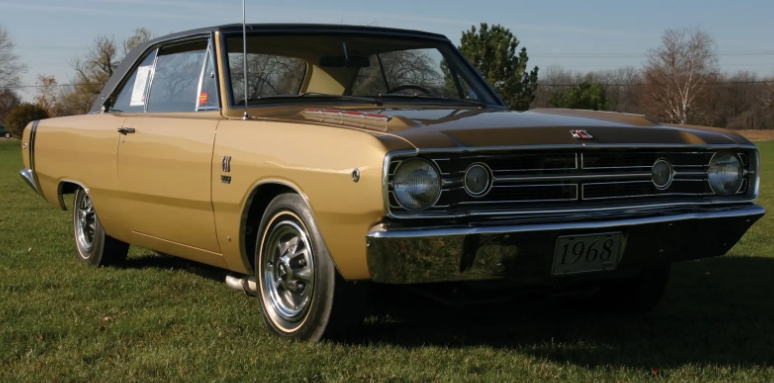
The first purposeful Dart GSS was produced in 1968 after Mr. Norm managed to convince Dodge to supply cars without engines. His team had 50 Dart body shells fitted with Chrysler’s 440 cubic-inch Magnum V8—a powerful big-block engine usually reserved for larger Mopar models at the time. These cars were converted by Hurst Performance under contract with Dodge and then delivered to Grand Spaulding Dodge, wearing the GSS badge and carrying massive performance potential.
Key Features of the 1968 Dart GSS:
- Engine: 440 CID Magnum V8, rated at approximately 375 horsepower
- Conversion: Cars were shipped from the factory without engines; Hurst installed the 440 and performance-oriented components
- Production: Around 50 examples were created for homologation and racing purposes
- Purpose: Built to compete in NHRA Super Stock drag racing and appeal to performance enthusiasts
- Badge: GSS designation instead of the stock GTS badge to highlight the upgraded performance
The 1968 GSS was more than a dealer special—it became an inflection point. It influenced the factory to introduce its own official high-performance Dart variant for the following model year.
1969: Factory Acknowledgment – The M-Code Dart GTS
Dodge took notice of the Dart GSS phenomenon. Seeing the racing success and street credibility the GSS was generating, the company decided to produce its own official performance Dart for 1969. What resulted was the M-Code Dart GTS 440, often considered the closest factory cousin to the GSS. The engine and performance package were so similar that many collectors and enthusiasts regard it as the GSS that Dodge built.
Notable Facts About the 1969 M-Code Dart GTS:
- Production: Approximately 640 hardtops were built with the 440 Magnum M-Code engine
- Engine: 440 cubic-inch V8 rated at around 375 horsepower
- Trim: Based on the Dart GTS but equipped with unique performance components (special motor mounts, exclusive exhaust manifolds, and reinforced subframe)
- Conversion: Early units were shipped as 383 equipped cars to Hurst, where they were converted to 440s
- Purpose: Designed as a factory homologation car to make the Dart competitive in NHRA Super Stock classes
- Legacy: Regarded today as one of the rarest and most desirable muscle Dart configurations ever offered
Although the 1969 M-Code was not labeled “GSS” on factory paperwork, its connection to Mr. Norm’s concept is undeniable and represents a pivotal moment where dealer innovation became corporate strategy.
Dart GSS Variants and Their Distinctions
To understand the evolution of the GSS name, it’s important to highlight the different contexts it appeared in:
1. 1967 383 Prototype
This was the experimental car that proved the concept of big-block engines in a Dart body could work, and essentially kicked off the GSS idea.
2. 1968 GSS 440 Dart
The first true GSS variant, built under Mr. Norm’s direction and served as both street performance car and race vehicle. Around 50 were produced and remain rare today.
3. 1969 M-Code Dart GTS 440
Although officially a factory model, it shares so much performance DNA with the 1968 GSS that many consider it the heir and natural evolution of the original dealer concept. Around 640 were produced.
Performance and Racing Aspirations
The primary reason the Dart GSS exists is tied directly to drag racing. Mr. Norm’s philosophy was simple: “race on Sunday, sell on Monday.” By building cars that could compete at the highest levels of NHRA’s Super Stock categories, his dealership boosted its brand visibility and demonstrated Mopar’s performance potential to a new audience.
Despite being created at a dealer level, the 1968 Dart GSS met the minimum production numbers required to qualify for competition—meaning they weren’t just show cars; they were drag racing contenders capable of serious quarter-mile times. The power-to-weight ratio of these lightweight A-bodies, when mated to a 440 big-block, made them formidable competitors.
The 1969 M-Code version continued this tradition, giving Dodge a factory-backed homologation entry that could compete with rival Ford Mustangs, Chevrolet Camaros, and Plymouth Barracudas in the Super Stock arena.
Why the GSS Matters Today
Today, the Mr. Norm Dart GSS legacy is about rarity, performance legend, and dealership ingenuity. These cars are among the rarest muscle Dart derivatives because:
- Very limited production numbers make surviving examples prized by collectors
- They represent a unique chapter where a dealer’s innovation influenced corporate muscle car strategy
- They are physical evidence of the grassroots performance culture of the late 1960s
While exact production numbers for the 1968 GSS (~50) and 1969 M-Code derivative (~640) are much smaller than mainstream muscle cars of the era, their significance is disproportionately large within the collector community.
Trim Levels and Model Years Clarified
Contrary to some misconceptions, the Mr. Norm Dart GSS was not a long-lived trim that spanned many years. The Dart platform itself continued throughout the 1960s and early 1970s, but the GSS identity is specific to the late-1960s period:
- 1967: Prototype performance Dart with big-block experimentation (not officially GSS)
- 1968: First true Dart GSS 440 (~50 units)
- 1969: Factory-influenced M-Code Dart GTS 440 (~640 units) built out of the GSS concept
No official 1970, 1971, or later Dart GSS variants were produced by Grand Spaulding Dodge. However, Mr. Norm and other performance shops did continue performance enhancements on other Mopar compacts and pony cars into the early 1970s, such as his work on the Dodge Demon GSS variants, later vehicles inspired by the original GSS philosophy.
Cultural and Collector Impact
Though not built in the numbers of factory muscle cars like the Ford Mustang or Pontiac GTO, Dart GSS cars have a passionate following among Mopar enthusiasts. They appear at major car shows, are featured in fine model kits and memorabilia, and command high prices at auction due to their scarcity and performance heritage. The narrative behind their creation—dealer ingenuity overcoming factory skepticism—only adds to their mystique.
Future Outlook and Legacy
In the 21st century, Mr. Norm’s influence extended into special commemorative packages for modern Mopar cars, including GSS-themed options on models like the Dodge Challenger and Charger, celebrating the legacy of the original GSS performance philosophy. These modern tribute packages seek to bring the spirit of performance tuning and personalized muscle car identity into contemporary production vehicles.
The original 1968 GSS cars remain centerpiece attractions in classic car circles, and the story of how a Chicago dealer’s ambition helped shape Dodge’s compact performance offerings continues to inspire enthusiasts and historians alike.
The story of the Mr. Norm Dodge Dart GSS is not just about a rare muscle car—it’s a testament to the power of automotive passion and innovation. Beginning as a bold idea by a performance-minded dealer, the Dart GSS evolved into a collector legend that influenced factory strategy, thrilled racers and drivers, and left a lasting imprint on the history of American muscle cars. Today, these limited cars are cherished symbols of an era when horsepower reigned supreme and dealers could become creators of performance icons.