The Evolution of the Foton Tunland G7: Foton’s Modern Global Pickup Truck
The Foton Tunland G7 represents an important chapter in the evolution of Chinese pickup trucks during the late 2010s and 2020s. Developed by Foton Motor as a more refined and capable successor to earlier Tunland models, the G7 combined modern styling, upgraded technology, stronger diesel and gasoline engines, and improved comfort while maintaining the rugged body-on-frame construction expected from a midsize pickup.
As Chinese automakers increasingly targeted international markets, the Tunland G7 became one of Foton’s most globally ambitious vehicles. Sold in countries across Asia, Eastern Europe, Africa, the Middle East, and Latin America, the G7 demonstrated how Chinese pickups had evolved from simple work trucks into more sophisticated lifestyle and commercial vehicles capable of competing with established rivals such as the Toyota Hilux, Ford Ranger, Nissan Navara, and Isuzu D-Max.
Origins of the Tunland Lineup
The Tunland series first entered production in 2011 as Foton’s first modern global pickup truck. Early Tunland models focused mainly on affordability and durability, using proven diesel technology and traditional body-on-frame engineering. The trucks were exported widely and gained moderate success in developing markets.
To improve competitiveness, Foton introduced major updates throughout the 2010s, including facelifted E5 and E7 variants. These updates eventually led to the development of the Tunland G7, which debuted in 2019 as a more advanced evolution of the original platform.
The G7 was designed to modernize the Tunland lineup with:
- improved styling,
- upgraded interiors,
- stronger engines,
- advanced transmissions,
- and more comprehensive safety technology.
The truck also became one of Foton’s key export products during the early 2020s.
.

.
Production Years
The Foton Tunland G7 entered production in:
- 2019
Production continues today in several international markets as of 2026.
The truck remains part of the first-generation G7 family without a full redesign, though yearly updates and regional trim changes have continued.
Development and Platform
The Tunland G7 was built on a traditional ladder-frame chassis with:
- front independent double-wishbone suspension,
- rear leaf springs,
- rear-wheel drive,
- and optional four-wheel drive.
This configuration allowed the G7 to balance:
- off-road capability,
- towing strength,
- payload capacity,
- and commercial durability.
The truck retained the rugged engineering expected from earlier Tunland models but introduced significantly improved refinement and technology.
Foton also partnered with major international suppliers for important mechanical systems. Components from:
- Cummins,
- ZF,
- BorgWarner,
- Dana,
- and Bosch
were incorporated into various Tunland models over time.
This helped improve both reliability and export-market acceptance.
Exterior Design Evolution
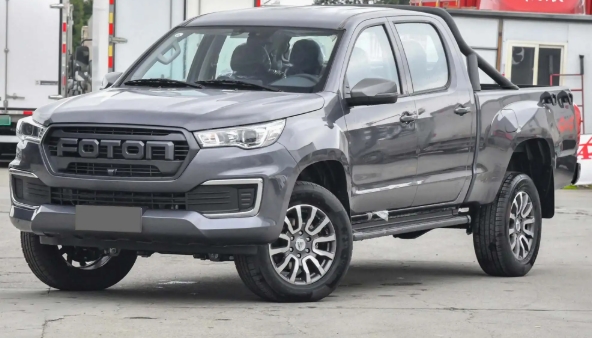
The Tunland G7 introduced much more aggressive and modern styling compared to earlier Tunland pickups.
The front fascia featured:
- a large “FOTON” grille,
- LED daytime running lights,
- sculpted bumpers,
- and squared-off body lines.
The truck’s appearance reflected global pickup design trends popularized by American and Japanese trucks.
Throughout production, the G7 was offered in:
- single-cab configurations,
- and double-cab body styles.
Dimensionally, the double-cab version measured approximately:
- 210.4 inches long,
- 77.2 inches wide,
- 73.6 inches tall,
- with a 122.4-inch wheelbase.
The larger body improved:
- rear passenger space,
- cargo bed size,
- and towing stability.
Minor styling updates during the early 2020s included:
- revised wheel designs,
- updated grilles,
- new paint colors,
- and trim-specific exterior accents.
Engines and Powertrains
One of the biggest advancements in the Tunland G7 was the availability of more modern diesel and gasoline engines.
Diesel Engines
The most common diesel configuration used:
- a 2.0-liter turbo-diesel four-cylinder engine,
- producing approximately 163 horsepower.
This engine became especially popular in:
- commercial fleets,
- export markets,
- and off-road-oriented configurations.
The diesel engine was praised for:
- strong low-end torque,
- respectable fuel economy,
- and towing capability.
Gasoline Engines
Higher-performance gasoline versions used:
- a 2.0-liter turbocharged gasoline engine,
- producing approximately 235–238 horsepower.
The gasoline model significantly improved acceleration and highway performance compared to the diesel versions.
Transmission Options
Depending on market and trim level, transmissions included:
- 6-speed manual transmission,
- 8-speed ZF automatic transmission.
The automatic transmission became increasingly important as the truck targeted more lifestyle-oriented buyers rather than purely commercial customers.
Drivetrain Layouts
Available drivetrains included:
- rear-wheel drive,
- and four-wheel drive.
Four-wheel-drive models featured:
- selectable drive modes,
- low-range gearing,
- and improved off-road capability.
Trim Levels and Models
The Tunland G7 lineup varied significantly by region, but several core trims and configurations became common throughout production.
2019 Launch Models
At launch, the G7 was commonly available in:
- Standard
- Comfort
- Luxury
- Premium
Some markets instead identified trims primarily by engine and transmission combinations.
Base and Standard Models
Entry-level trims focused on commercial and fleet use.
Features typically included:
- cloth seating,
- manual air conditioning,
- steel wheels,
- basic infotainment,
- and rear-wheel drive.
These versions often used:
- the 163-horsepower diesel engine,
- paired with a manual transmission.
Comfort and Mid-Level Trims
Mid-range models added:
- touchscreen infotainment,
- alloy wheels,
- improved interior materials,
- rear parking sensors,
- and larger digital displays.
These trims became popular among private buyers who wanted a more affordable alternative to Japanese pickups.
Luxury and Premium Trims
Higher-end versions emphasized comfort and technology.
Available features included:
- leather upholstery,
- large touchscreen multimedia systems,
- automatic climate control,
- keyless entry,
- LED lighting,
- and advanced driver-assistance systems.
Premium trims were commonly paired with:
- automatic transmission,
- four-wheel drive,
- and gasoline turbocharged engines.
Engine-Based Trim Variants
Several documented configurations included:
- 2.0 TD 163 hp 4×4 Manual
- 2.0 TD 163 hp 4×4 Automatic
- 2.0 T-GDI 235 hp Automatic
- 2.0 T-GDI 238 hp 4×4 Automatic.
These powertrain combinations remained central to the G7 lineup from 2019 through 2024.
Interior and Technology
Compared to earlier Tunland pickups, the G7 introduced a far more modern cabin.
Interior improvements included:
- larger infotainment screens,
- digital instrument clusters,
- improved dashboard materials,
- enhanced sound insulation,
- and redesigned seating.
Higher trims added:
- leather upholstery,
- panoramic cameras,
- heated seats,
- smartphone connectivity,
- and advanced multimedia systems.
Foton also emphasized comfort and lifestyle appeal, positioning the G7 as more than simply a commercial work truck.
Many reviewers noted that the cabin quality represented a substantial improvement over earlier Chinese pickups.
Safety and Driver Assistance
As export requirements became stricter, Foton expanded the G7’s safety equipment.
Features available throughout production included:
- ABS braking,
- electronic stability control,
- traction control,
- hill-start assist,
- rear parking sensors,
- reversing cameras,
- lane departure warning,
- and adaptive cruise control in some markets.
The truck’s use of Bosch electronic systems helped improve braking and stability performance.
Global Market Expansion
The Tunland G7 became one of Foton’s most important export pickups.
The truck was sold in:
- Russia,
- South Africa,
- Israel,
- the Philippines,
- Latin America,
- and various African markets.
In Russia, the G7 officially reintroduced the Tunland name after earlier Foton pickups had temporarily disappeared from the market.
Its competitive pricing and high equipment levels made it attractive in regions where buyers wanted affordable alternatives to Japanese pickups.
Reliability and Market Perception
The Tunland G7 received mixed but generally improving reviews.
Owners and reviewers often praised:
- strong equipment levels,
- comfortable interiors,
- modern styling,
- and value for money.
Online discussions frequently highlighted the truck’s use of internationally sourced components such as:
- ZF transmissions,
- Dana axles,
- BorgWarner turbochargers,
- and Cummins-related engine development.
However, some buyers remained skeptical regarding:
- long-term durability,
- resale value,
- and parts availability compared to Toyota or Ford products.
Community discussions showed divided opinions, with some owners reporting strong performance and reliability, while others criticized earlier Foton quality issues.
Future Outlook
The future of the Tunland G7 appears relatively strong as Foton continues expanding internationally.
Potential future developments may include:
- hybrid powertrains,
- plug-in hybrid systems,
- electric pickup variants,
- more advanced driver-assistance technology,
- and additional luxury trims.
The G7 already represents a major leap forward compared to earlier Chinese pickups, demonstrating how rapidly manufacturers like Foton have evolved.
By combining:
- modern styling,
- advanced transmissions,
- international supplier partnerships,
- and increasingly refined interiors,
the Tunland G7 helped establish Foton as a more serious competitor in the global pickup market.
Although the truck still faces challenges regarding brand recognition and long-term reputation, the Tunland G7 remains one of the clearest examples of China’s growing influence in the modern midsize pickup segment.