The Polestar 2: Forging a New Evolutionary Path in the Premium Electric Arena
In the rapidly electrifying automotive landscape, where legacy giants and scrappy startups vie for dominance, a unique player has emerged, distinct in its heritage and uncompromising in its vision. The Polestar 2 is more than just another electric car; it is the tangible product of a philosophy, a deft blend of Scandinavian minimalism, Volvo’s safety-centric DNA, and the blistering performance honed in the crucible of motorsport. Since its arrival, it has carved out a compelling niche, offering a compelling alternative for drivers who seek substance and design in equal measure.
A Brief History: From Racing Green to Electric Blue
To understand the Polestar 2, one must first understand the Polestar name. For over two decades, Polestar was the in-house performance arm of Volvo, much like BMW’s M or Mercedes-AMG. Founded in 1996 as Flash Engineering, it was acquired by Volvo in 2015 and rebranded as Polestar, creating highly-tuned, high-performance versions of Volvo’s models. These were cars built for enthusiasts who appreciated a sharper edge on the road and track.
The pivot to an all-electric future began in 2017. Volvo announced that Polestar would transform into a new, standalone electric performance brand, with its own design and engineering ethos. This was a bold move, positioning Polestar not as a sub-brand, but as a direct competitor to premium electric offerings like Tesla.
The first fruit of this new vision was the Polestar 1, a low-volume, plug-in hybrid grand tourer that served as a statement of intent. But the true mission statement, the car designed to bring electric performance to the masses, was the Polestar 2. Revealed in prototype form in early 2019 and beginning production in 2020, the Polestar 2 was launched as a direct challenger in the premium compact EV segment. Unlike many of its contemporaries which were sedans, Polestar chose a slightly taller “fastback” or crossover-hatchback form factor, aiming to blend the driving dynamics of a sedan with the practicality of a more versatile body style.
.
THIS could come in handy for your auto garage (and everywhere else!):

.
The Initial Arrival: 2020-2023
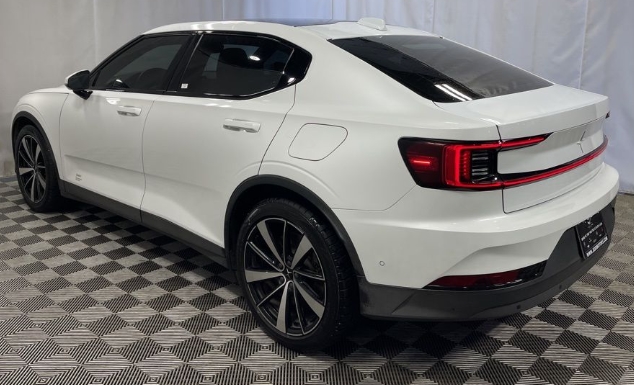
When the first-generation Polestar 2 launched, it made an immediate impact. Its design was a masterclass in restrained confidence. Built on Volvo’s CMA (Compact Modular Architecture) platform, it featured the brand’s signature “Thor’s Hammer” LED daytime running lights, a closed-off grille, and a distinctly Scandinavian clean-sheet interior dominated by a large vertical touchscreen.
However, the car faced some early criticisms. The initial single-motor, long-range model arrived later, with the first cars to market being the dual-motor Polestar 2 Long Range Dual Motor. A notable quirk of these early models was that they did not include a heat pump, a crucial component for maintaining range and charging efficiency in cold climates. This was later offered as a retrofit and became standard. A more significant design issue was the placement of the front electric motor, which meant the car did not have a traditional “frunk” (front trunk), a point of contention for some EV enthusiasts.
Despite these minor points, the Polestar 2 was lauded for its exceptional build quality, its engaging and agile handling, and its unique, understated aesthetic. It felt solid, well-engineered, and, above all, different from the often minimalist and sometimes sterile interiors of its rivals.
The Mid-Cycle Refresh: The 2024 Model Year Evolution
In late 2022, Polestar unveiled a significant update to the Polestar 2 for the 2024 model year, addressing early criticisms and elevating the car to a new level of performance and sophistication. This was not just a facelift but a substantial re-engineering, demonstrating the brand’s commitment to continuous improvement.
The most significant changes were under the skin. The entire platform received a major overhaul. The battery capacity was increased from 75 kWh to 78 kWh, but more importantly, the charging architecture was upgraded from 150 kW to a maximum of 205 kW. This dramatically reduced DC fast-charging times, allowing the battery to charge from 10% to 80% in as little as 22 minutes.
The electric motors were also completely new. The rear motor, which powers the rear wheels, is now a permanently magnetized synchronous motor (PMSM) that is more efficient and powerful. The front motor is an asynchronous motor (ASM), which can be disconnected when not needed to reduce drag, further improving efficiency. This new “rear-biased” dual-motor setup not only improved range but also enhanced the car’s handling dynamics. The new Long Range Single Motor model also introduced a more powerful motor and, for the first time, the option of rear-wheel drive (with an available Performance Pack), a significant departure from the front-wheel-drive-only setup of the pre-facelift single-motor version.
Visually, the 2024 refresh is subtle but effective. A new “Polestar 2” badge is now laser-etched into the side window glass, the front has a redesigned lower intake for better aerodynamics, and a new aero-optimized rear spoiler was added. Inside, a new, lighter weave tech material made from recycled PET bottles became standard, along with an upgraded 11.1-inch center display and a new 9-inch instrument cluster. The front motor’s new position also created a small, 31-liter front trunk, finally adding that highly anticipated feature.
A Comprehensive Guide to Models and Trim Levels
The Polestar 2 lineup has evolved, offering a clear hierarchy of performance and range. Here is a breakdown of the models offered, with a distinction between the two generations.
First Generation (Approx. 2020 – 2023):
- Polestar 2 Long Range Dual Motor: This was the launch model and the only offering for the first couple of years. It featured a 75 kWh battery and dual all-wheel-drive motors producing a combined 408 horsepower and 487 lb-ft of torque. It was capable of 0-60 mph in about 4.5 seconds.
- Polestar 2 Long Range Single Motor: Introduced later, this model was front-wheel drive, producing 231 horsepower. It utilized the same 75 kWh battery but offered a longer range due to the single motor setup.
Second Generation (Approx. 2024 – Present):
The current lineup is more powerful, efficient, and better equipped.
- Polestar 2 Long Range Single Motor (RWD): The entry point to the range, but far from basic.
- Battery: 78 kWh Long Range battery.
- Drivetrain: Rear-Wheel Drive.
- Power: 299 hp and 361 lb-ft of torque.
- 0-60 mph: 5.9 seconds.
- Range: Approximately 320 miles (EPA est.).
- Key Features: The new single motor is powerful and efficient. This model can be optioned with the Performance Pack in North America.
- Polestar 2 Long Range Dual Motor (AWD): The core of the range, offering a significant step up in performance.
- Battery: 78 kWh Long Range battery.
- Drivetrain: All-Wheel Drive (rear-biased).
- Power: 421 hp and 546 lb-ft of torque (a substantial increase over the pre-facelift version).
- 0-60 mph: 4.3 seconds.
- Range: Approximately 276 miles (EPA est.).
- Key Features: Comes standard with the Pilot Pack (adaptive cruise control, 360-degree camera, etc.) and the Plus Pack (heated front/rear seats, heated steering wheel, panoramic glass roof, etc.), making it very well-equipped.
- Polestar 2 Long Range Dual Motor with Performance Pack: This is the flagship model for driving enthusiasts.
- Power: Tuned to 455 hp and 546 lb-ft of torque.
- 0-60 mph: 4.1 seconds.
- Range: Slightly reduced to approximately 254 miles (EPA est.).
- Key Components:
- Ohlins Dual Flow Valve (DFV) Suspension: Manually adjustable, high-performance dampers for superior handling and ride control.
- Brembo Brakes: Four-piston front calipers with larger, ventilated discs for exceptional stopping power.
- 20-inch Forged Alloy Wheels: Lightweight and strong, shod with high-performance summer tires.
- Swedish Gold Seatbelts and Valve Caps: The signature aesthetic touches that signal its special status.
The Polestar Ownership Experience: Digital-First and Service-Light
Beyond the car itself, Polestar has reimagined the ownership journey. It operates on a direct-to-consumer model, with transparent, non-negotiable pricing. The “Polestar Space” is not a traditional dealership but a clean, modern showroom, often located in urban centers, where potential customers can learn about the brand and configure a car. Orders are placed online.
A key innovation is the car’s “over-the-air” (OTA) software updates. Much like a smartphone, the Polestar 2 receives regular, free updates that can add new features, refine performance, and improve the user interface without the owner ever needing to visit a service center. The Polestar app allows remote control of climate, charging, and vehicle status. For the small number of issues that do require physical attention, Polestar utilizes a “Service at your door” model, where a technician comes to you, or partners with select Volvo dealerships for more complex work.
The Future Outlook
The Polestar 2 is just the beginning. The brand has an ambitious growth plan, outlined in its “Polestar 5” business strategy. The upcoming Polestar 3, a larger electric SUV, will compete with the Tesla Model X and Audi e-tron, while the Polestar 4 will be a smaller SUV-coupe. The Polestar 5, a stunning electric grand tourer, is being developed to challenge the Porsche Taycan.
The Polestar 2 established the brand’s core identity: performance-driven, design-led, and technology-forward. It proved that an electric car could be both practical and deeply engaging to drive, without resorting to gimmicks. Its constant evolution, from addressing early shortcomings to launching a comprehensively re-engineered second generation, shows a company that listens to its customers and is relentlessly focused on improvement.
In a crowded market, the Polestar 2 stands as a testament to a different way of thinking. It is a car for those who appreciate quiet confidence over loud ostentation, substance over hype, and a design that is built to last, not just to trend. It is not merely a product of the electric revolution; it is a thoughtful and compelling leader within it.