The Evolution of the BAIC Weiwang M50F and M60: China’s Affordable Family MPV Experiment
The BAIC Group Weiwang M50F and M60 represented an important chapter in the rapid expansion of China’s multi-purpose vehicle (MPV) market during the late 2010s. Developed under BAIC’s Weiwang sub-brand, these vehicles were designed to provide affordable seven-seat transportation for growing families and commercial users in China and select export markets. Although the production run was relatively short, the M50F and M60 demonstrated how Chinese automakers were evolving from producing basic utility vans into more refined family-oriented vehicles with modern styling, improved comfort, and enhanced technology.
Origins of the Weiwang Brand
The Weiwang brand was launched by BAIC in 2011 as an entry-level division focused primarily on compact vans, MPVs, and affordable utility vehicles. The brand operated under Beiqi Yinxiang Automobile, a joint venture between BAIC and Yinxiang Motorcycle Group. Early Weiwang products emphasized affordability and practicality, competing directly against low-cost domestic Chinese brands.
By the mid-2010s, consumer expectations in China were changing rapidly. Buyers increasingly wanted MPVs that looked more stylish and offered greater comfort while still maintaining low prices. This shift created an opportunity for BAIC to introduce a more upscale people carrier positioned above the utilitarian Weiwang M20 and M30 vans.
The result was the Weiwang M50F, which debuted in late 2016.
.

.
Introduction of the Weiwang M50F (2016)
The Weiwang M50F officially launched in November 2016 as a compact front-wheel-drive MPV. Unlike earlier Weiwang models that focused heavily on commercial use, the M50F targeted family buyers who wanted a modern-looking seven-seat vehicle at a reasonable price.
The vehicle rode on a platform shared with the Huansu H3, another BAIC-affiliated model. The M50F featured a more aerodynamic body, larger dimensions, and a significantly more refined interior than earlier Weiwang products.
Production Years
- 2016–2018
Body Style
- Five-door MPV/minivan
- Seven-seat configuration with 2/2/3 seating layout
Dimensions
- Wheelbase: 108.7 inches
- Length: 186.0 inches
- Width: 70.7 inches
- Height: 67.6–69.1 inches
Engine Options
The M50F was offered with multiple gasoline engines throughout production:
- 1.5-liter naturally aspirated inline-four
- 1.3-liter turbocharged inline-four
Transmission Options
- Five-speed manual
- Six-speed manual
- CVT automatic on select variants
The naturally aspirated 1.5-liter engine primarily served entry-level trims, while the turbocharged 1.3-liter engine provided improved performance for higher-end versions.
Weiwang M50F Trim Levels
Although exact trim naming conventions varied slightly by market and model year, the M50F lineup generally included several configurations that ranged from basic family transportation to more upscale variants.
Standard/Base Trim
The entry-level M50F models typically included:
- Manual air conditioning
- Cloth seating
- Steel wheels
- Basic infotainment system
- Dual front airbags
- Rear parking sensors
These trims targeted budget-conscious buyers and fleet operators.
Comfort Trim
Mid-level variants added:
- Alloy wheels
- Improved dashboard materials
- Larger infotainment display
- Multifunction steering wheel
- Enhanced interior trim
- Additional USB connectivity
Luxury/Premium Trim
Top-level M50F trims included:
- Turbocharged engine
- CVT transmission availability
- Faux leather seating
- Chrome exterior accents
- Upgraded infotainment
- Reverse camera
- Larger touchscreen display
These upper trims attempted to compete with increasingly sophisticated domestic MPVs from brands such as Baojun and Changan.
Styling and Market Position
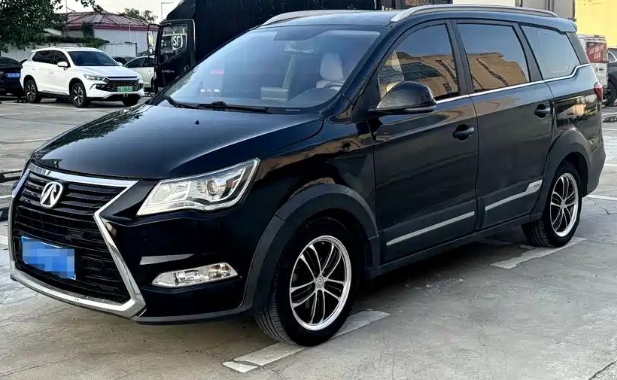
The M50F represented a significant design shift for Weiwang. Earlier models had a distinctly commercial appearance, but the M50F adopted styling cues commonly found in crossover SUVs and modern MPVs.
Notable design features included:
- Large front grille
- Swept-back headlights
- Sculpted side body lines
- SUV-inspired stance
- Higher ride height
Chinese buyers increasingly favored vehicles with crossover-inspired styling, even in MPV segments, and BAIC tailored the M50F to meet these preferences.
Pricing also played a major role in the vehicle’s appeal. The M50F entered the Chinese market at highly competitive prices, generally ranging from approximately $9,800 to $13,300 depending on trim and equipment.
Introduction of the Weiwang M60
Soon after the M50F’s launch, BAIC introduced a more premium derivative called the Weiwang M60. While mechanically related to the M50F, the M60 featured more aggressive styling and upgraded equipment intended to attract younger buyers and families wanting a more upscale appearance.
Production Years
- 2016–2018
Major Differences Between the M50F and M60
The M60 included several exterior revisions:
- Larger front grille inspired by luxury SUV designs
- More aggressive front bumper
- Plastic body cladding around wheel arches
- Redesigned rear bumper
- Wider body dimensions
The M60 measured slightly larger than the M50F:
- Length: 189.0 inches
- Width: 71.8 inches
The M60 was essentially marketed as a crossover-inspired MPV, blending family practicality with SUV styling elements.
Weiwang M60 Trim Levels
Like the M50F, the M60 was offered in multiple trims.
Base M60
Included:
- 1.5-liter naturally aspirated engine
- Manual transmission
- Cloth seats
- Standard infotainment
Mid-Level M60
Added:
- Alloy wheels
- Enhanced interior trim
- Parking camera
- Improved audio system
Turbo Premium M60
The flagship version included:
- 1.5-liter turbocharged engine
- Approximately 150 horsepower
- CVT transmission
- Leather-style interior
- Larger multimedia screen
- Premium exterior accents
The turbocharged M60 represented the highest-performing version of the entire M50F/M60 family.
Export and Rebadged Versions
One interesting aspect of the M60 was its international adaptation. BAIC exported the platform to several overseas markets under different names.
Changhe Freedom M60
Under another BAIC-owned brand, the M60 was sold as the Changhe Freedom M60.
Innoson Ikenga / IVM M20
In Nigeria, the vehicle appeared as the Innoson Ikenga or IVM M20 through Innoson Vehicle Manufacturing. This partnership demonstrated BAIC’s strategy of using regional manufacturing and rebadging agreements to enter developing markets.
Sales Performance
The M50F achieved moderate success in China during its brief production life.
Reported Chinese sales figures include:
- 2016: 13,153 units
- 2017: 28,995 units
- 2018: 5,693 units
Sales peaked in 2017 before declining sharply in 2018. The decline reflected increasing competition from newer domestic MPVs and the growing popularity of compact SUVs in China.
End of Production
Production of both the M50F and M60 ended around 2018. Several factors contributed to the relatively short lifespan:
- Rapidly changing consumer tastes
- Growing SUV demand
- Increasing competition in China’s MPV segment
- BAIC’s restructuring of the Weiwang brand
As Chinese consumers shifted toward crossovers and electric vehicles, traditional compact MPVs like the M50F became less attractive.
Legacy and Future Outlook
Although the Weiwang M50F and M60 were not long-running models, they represented an important transitional phase for Chinese automakers. These vehicles illustrated how domestic manufacturers were improving vehicle quality, styling, and technology while maintaining affordability.
The M50F and M60 also reflected broader trends in China’s automotive industry:
- Movement from commercial vans to family-oriented MPVs
- Increased emphasis on design and comfort
- Expansion into export markets
- Growing competition among domestic brands
Today, BAIC’s focus has shifted increasingly toward SUVs, electric vehicles, and intelligent mobility technologies. The Weiwang brand itself has become less prominent as BAIC reorganized its product portfolio.
However, the M50F and M60 remain noteworthy examples of China’s fast-evolving automotive industry during the late 2010s. They showcased the ambitions of Chinese manufacturers to compete not only on price, but also on styling, practicality, and modern features. For many families in China and emerging export markets, these vehicles provided affordable access to spacious seven-seat transportation during a period of dramatic growth in the global auto industry.