BAW LuBa: The Evolution of Beijing Auto Works’ Prado-Based SUV
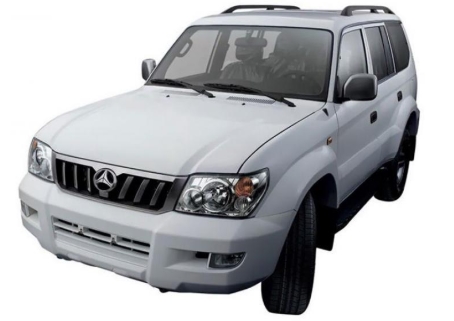
The BAW LuBa is one of the most recognizable sport utility vehicles produced by Beijing Automobile Works (BAW). Manufactured from 2001 through 2017, the LuBa occupied an important place in China’s developing SUV market during a period when demand for rugged, affordable off-road vehicles was growing rapidly. Based largely on the platform and engineering of the Toyota Land Cruiser Prado J90, the LuBa combined proven mechanical components with local production, allowing BAW to offer a capable four-wheel-drive vehicle at a lower price than many imported competitors.
Over its production life, the LuBa evolved through several mechanical updates, facelift programs, export-market variants, and related pickup-truck derivatives. Although never achieving the global recognition of the Toyota models that inspired it, the LuBa played a significant role in establishing BAW as a producer of practical utility vehicles for both domestic and international markets.
Origins of the LuBa
The LuBa was introduced in 2001, during a period when Chinese automakers were rapidly expanding their sport utility vehicle offerings. The vehicle was based on the Toyota Land Cruiser Prado J90 platform, a well-regarded off-road SUV originally produced between 1996 and 2002. Following the end of J90 production, BAW gained access to the platform and adapted it for Chinese production.
The resulting vehicle retained much of the Prado’s basic architecture, including:
- Body-on-frame construction
- Front-engine layout
- Four-wheel-drive system
- Off-road-oriented suspension
- Five-door SUV body style
These features gave the LuBa genuine off-road capability at a time when many competitors were increasingly moving toward car-based crossover designs.
.
MANY auto lovers not only spend time in their garages to tinker on their autos, but have other projects going on in there as well. Wood working is a popular pastime for the creative type of individual. Not sure what to make next? Or thinking about getting into this kind of hobby? There’s lots of possibilities… Here’s some of them…

.
First Generation Launch (2001–2005)
The earliest LuBa models entered production in 2001 and were marketed as durable utility vehicles suitable for both urban and rural use.
Initial versions were powered by an imported Toyota-derived 3.4-liter V6 engine similar to the Toyota 5VZ-FE. This engine provided respectable performance and reliability, helping establish the LuBa’s reputation during its early years. Production volumes gradually increased as demand for sport utility vehicles expanded throughout China.
During this period, the vehicle was commonly identified by its factory designation BJ2032 in addition to the LuBa name.
Expansion and Market Growth (2005–2009)
By the mid-2000s, the LuBa had become one of BAW’s most important passenger vehicles. Sales peaked during the late 2000s, with annual production reaching several thousand units. The vehicle appealed to buyers seeking a rugged SUV without the higher cost associated with imported Japanese models.
Throughout this period, the LuBa continued to use its proven body-on-frame design and manual transmission. The SUV’s dimensions remained largely unchanged:
- Wheelbase: 105.3 inches
- Length: 188.8 inches
- Width: 72.2 inches
- Height: 75.8 inches
These measurements placed it firmly within the full-size SUV category in China.
The LuBa S100 and Export Expansion (2009)
A significant development occurred in 2009 with the introduction of the LuBa S100.
The S100 designation was used for updated versions intended to keep the model competitive as newer SUVs entered the marketplace. Around the same time, BAW expanded exports to international markets. In Russia, the vehicle was marketed under the name “Land King,” while other regions received localized branding and specifications.
The export strategy allowed BAW to leverage the LuBa’s rugged design in regions where durability and off-road capability remained highly valued.
Engine Evolution (2010–2012)
One of the most important phases in the LuBa’s development occurred between 2010 and 2012, when BAW revised the engine lineup.
Earlier Toyota-derived V6 engines were gradually replaced by locally sourced four-cylinder powerplants. Available engines during this period included:
2.4-Liter Gasoline Engine
- Approximately 150 horsepower
- Approximately 160 lb-ft of torque
2.7-Liter Gasoline Engine
- Approximately 143 horsepower
- Approximately 173 lb-ft of torque
Both engines were paired with a five-speed manual transmission. These newer engines reduced production costs while maintaining acceptable performance for the vehicle’s target market.
Models and Trim Levels
Unlike many modern SUVs, the LuBa was not marketed with a highly detailed trim hierarchy. Instead, the lineup was largely organized around engine options and market-specific configurations.
Documented variants include:
| Model | Years Produced | Notes |
|---|---|---|
| LuBa BJ2032 | 2001–2017 | Standard SUV |
| LuBa S100 | 2009–2017 | Updated SUV version |
| Land King | 2009–2017 | Russian-market version |
| Youxian | Various years | Alternate domestic branding |
Available powertrain configurations generally included:
| Engine | Years Available |
| 3.4L V6 | 2001–approximately 2010 |
| 2.4L I4 | 2010–2017 |
| 2.7L I4 | 2010–2017 |
Public records do not identify trim names equivalent to LX, EX, Limited, Touring, or Premium grades. Most differentiation occurred through engine selection and regional equipment packages.
The Yueling Pickup Derivative
One of the most important developments in the LuBa’s evolution was the creation of the BAW Yueling pickup.
Introduced in 2009, the Yueling utilized the LuBa platform but replaced the SUV body with a pickup-truck cargo bed. The Yueling was offered in both standard-wheelbase and long-wheelbase versions. Available engines included:
- 2.2-liter gasoline four-cylinder
- 2.8-liter turbo-diesel four-cylinder
The pickup broadened the usefulness of the LuBa platform and helped BAW compete in China’s growing light-truck market.
Final Years and Facelift (2017)
Despite declining sales during the 2010s, BAW continued updating the LuBa.
In 2017, spy photographs and industry reports revealed a revised front-end design intended to modernize the vehicle’s appearance. The updated styling aligned the SUV more closely with newer BAW products. However, by this time, the platform was showing its age compared with modern competitors.
Production ended during 2017 after approximately sixteen years on the market. The LuBa was eventually replaced by newer BAW SUVs better suited to changing consumer preferences.
Production Timeline
| Year | Development |
| 2001 | LuBa introduced |
| 2002 | Full commercial sales begin |
| 2005 | Expanded production |
| 2009 | LuBa S100 introduced |
| 2009 | Yueling pickup launched |
| 2010 | New 2.4L and 2.7L engines added |
| 2017 | Final facelift revealed |
| 2017 | Production ends |
Legacy and Future Outlook
Although the LuBa is no longer in production, it remains one of the most significant SUVs in BAW’s history. The vehicle helped establish BAW’s reputation in the utility-vehicle market and provided the foundation for later SUV and pickup-truck programs.
Today, BAW’s focus has shifted toward newer products such as electric vehicles, commercial vans, and modern utility vehicles. As a result, a direct successor to the LuBa has never emerged. Nevertheless, the vehicle remains noteworthy as one of China’s longest-running body-on-frame SUVs and as an example of the country’s early efforts to develop a competitive domestic SUV industry.
Produced from 2001 to 2017, the BAW LuBa played an important role in the development of China’s SUV market. Built on the proven Toyota Land Cruiser Prado J90 platform, it offered rugged construction, four-wheel-drive capability, and practical utility at an accessible price. Through multiple engine revisions, export-market expansions, and the addition of the Yueling pickup derivative, the LuBa evolved into a versatile vehicle family that served a wide range of customers. Although production ended in 2017, its legacy continues as one of BAW’s most influential and recognizable vehicles.