JMC Carrying: The Evolution of Jiangling Motors’ Versatile Light Truck Family
The JMC Carrying is one of the longest-running and most successful commercial vehicle lines produced by Jiangling Motors Corporation (JMC). Designed primarily as a light-duty truck for urban delivery, logistics, construction, and small business applications, the Carrying has become a familiar sight in many markets throughout Asia, South America, Africa, and parts of Eastern Europe. Over the years, the model has evolved from a simple Isuzu-derived work truck into a modern commercial vehicle family offered in numerous configurations, payload ratings, and body styles. Its reputation for durability, affordability, and practicality has helped make it one of JMC’s most important commercial products.
Origins of the JMC Carrying
The roots of the Carrying can be traced to JMC’s partnership with Isuzu during the 1980s. As Jiangling Motors expanded its commercial vehicle business, the company adopted and adapted several Isuzu truck technologies for the Chinese market. JMC launched its first light-truck products based on this engineering foundation, eventually creating the Carrying series as a dedicated light commercial vehicle line. JMC officially began producing light trucks in the 1980s, and the Carrying name became associated with the company’s affordable cab-over commercial trucks in both domestic and export markets.
Unlike larger medium-duty trucks, the Carrying was designed for operators who needed a compact vehicle capable of transporting significant payloads while remaining easy to maneuver in crowded cities. This focus helped the model gain popularity among delivery companies, tradespeople, municipal agencies, and small businesses.
First Generation (Late 1990s–Mid-2000s)
The first-generation Carrying emerged during the late 1990s as JMC expanded its commercial vehicle offerings. These trucks were heavily influenced by Isuzu light-truck designs and featured a traditional cab-over-engine layout.
Key characteristics included:
- Steel ladder-frame chassis
- Rear-wheel drive
- Diesel-powered engines
- Manual transmissions
- Simple, durable interiors
- Compact dimensions for urban operation
The emphasis was on reliability and low operating costs rather than comfort or advanced technology. Most vehicles were sold to commercial operators who valued payload capacity and ease of maintenance above all else.
Models Offered
Early Carrying models were generally available as:
- Chassis-cab
- Flatbed truck
- Stake-bed truck
- Box truck conversion
- Specialized municipal variants
Trim levels were minimal, with customers primarily choosing payload ratings and body styles rather than equipment packages.
.
We LOVE cars & cruising around, but sometimes day trips to explore new cities are required (with family or friends) for a spice of variety in your life!
So GO explore!
Cruises & Day/Night USA City Tours to: Baltimore, Boston, Chicago, Marina Del Ray, New York, Niagara, Philadelphia, San Diego, San Francisco, Toronto, Washington DC, etc.:

.
Second Generation (Mid-2000s–2012)
As China’s logistics industry expanded rapidly during the 2000s, JMC updated the Carrying line to improve performance, safety, and driver comfort.
Major changes included:
- Redesigned cab structure
- Improved visibility
- Updated diesel engines
- Better suspension tuning
- Enhanced payload capability
- Improved corrosion protection
The second-generation models also began incorporating features that were previously uncommon in entry-level commercial vehicles, including optional air conditioning and power steering.
Payload Variants
During this period, JMC marketed several Carrying versions based on gross vehicle weight ratings.
Common variants included:
- Carrying 2.5T
- Carrying 3.0T
- Carrying 3.5T
- Carrying 5.0T
The numbers generally referred to the truck’s gross vehicle weight class and intended application. Different wheelbases and cargo-body lengths were available depending on customer requirements.
Trim Levels
Depending on market and year, trim offerings typically included:
- Standard
- Deluxe
- Fleet Specification
- Commercial Package
Equipment levels remained practical, focusing on features useful to commercial operators.
Third Generation (2012–2020)
The third-generation Carrying represented one of the most significant updates in the model’s history. JMC modernized both the exterior and interior while improving efficiency and safety.
Key improvements included:
- New front-end styling
- Larger cabin
- Improved ergonomics
- More powerful diesel engines
- Enhanced fuel economy
- Improved braking systems
- Better noise insulation
The truck benefited from JMC’s growing technical experience and increasing cooperation with international automotive partners. These improvements allowed the Carrying to compete more effectively with rival light trucks from Isuzu, Foton, JAC, and Dongfeng.
Major Models
The lineup expanded to include:
Carrying 2.8T
- Entry-level urban delivery truck
- Lower operating costs
Carrying 3.5T
- Most popular model in many export markets
- Balanced payload and maneuverability
Carrying 5.0T
- Heavier-duty version
- Increased cargo capacity
Mobile Truck
- Passenger and cargo combination vehicle
- Capable of carrying multiple passengers while retaining significant cargo capacity
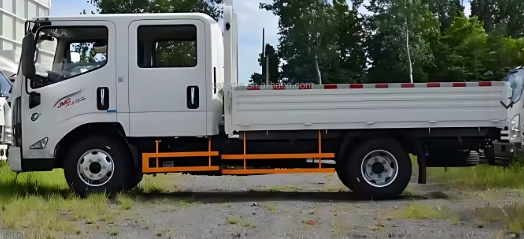
In markets such as Chile, the Carrying 3.5T became one of the segment leaders. Available configurations included chassis-cab, single-cab pickup, cargo-body truck, double-cab pickup, and the Mobile Truck variant.
Body Styles
Customers could select:
- Chassis-cab
- Flatbed
- Cargo box
- Refrigerated truck
- Double-cab truck
- Passenger/cargo hybrid versions
These options helped broaden the vehicle’s appeal across multiple industries.
Fourth Generation (2020–Present)
The current generation of the Carrying family reflects JMC’s efforts to modernize its commercial vehicle lineup while retaining affordability.
Key features include:
- Updated exterior styling
- Improved aerodynamic design
- Modernized dashboard
- Better driver ergonomics
- Enhanced emissions compliance
- Advanced diesel powertrains
- Improved safety systems
The Carrying remains focused on practical commercial transportation but now offers features that were once reserved for higher-end trucks.
Current Models
Current Carrying models generally include:
Carrying 3.5T
- Urban and regional logistics
Carrying 5T
- Medium-capacity commercial transportation
Carrying Chassis-Cab
- Suitable for specialized body conversions
Cargo Box Variants
- General freight transportation
Flatbed Variants
- Construction and equipment transport
Double-Cab Variants
- Crew transportation and worksite applications
In some export markets, the Carrying is offered with a 2.8-liter turbocharged diesel engine producing approximately 109 horsepower and designed to balance performance with fuel economy.
Trim Levels
Modern Carrying trim levels vary by market but generally include:
- Base Commercial
- Standard
- Comfort
- Premium Fleet
Higher trims may offer:
- Air conditioning
- Power windows
- Improved seating
- Touchscreen infotainment systems
- Enhanced driver-information displays
Global Market Success
One reason for the Carrying’s longevity is its strong export performance. JMC began expanding into international markets during the 1990s, and commercial vehicles such as the Carrying became important products in Latin America, the Middle East, Africa, and Eastern Europe.
The truck’s success has been built on several key advantages:
- Competitive pricing
- Proven diesel engines
- Easy maintenance
- High payload capacity
- Broad availability of configurations
These qualities have made it attractive to fleet operators and independent business owners alike.
Relationship to Other JMC Trucks
The Carrying occupies an important position within JMC’s commercial vehicle portfolio.
Related models include:
- JMC Shunda
- JMC Kaiyun
- JMC Kairui
While the Carrying traditionally focuses on entry-level and mid-range light-duty applications, these related models serve different payload classes and customer needs.
Future Outlook
The future of the JMC Carrying will likely be shaped by increasingly strict emissions regulations and the ongoing electrification of commercial transportation. JMC has already begun introducing electric commercial vehicles across several product categories, suggesting that electric versions of Carrying-based trucks could become more common in the future.
Expected developments include:
- Battery-electric variants
- Improved diesel efficiency
- Advanced safety systems
- Fleet-management connectivity
- Enhanced driver-assistance technologies
- Expanded export-market availability
As urban delivery and e-commerce logistics continue growing worldwide, demand for compact and efficient commercial trucks remains strong.
The JMC Carrying has evolved from a simple Isuzu-influenced light truck into a versatile family of commercial vehicles serving businesses around the world. Produced since the late 1990s, the Carrying has been offered in numerous payload classes, body styles, and equipment levels, ranging from basic chassis-cab models to specialized cargo and passenger configurations. Its combination of durability, affordability, and adaptability has made it one of JMC’s most successful commercial vehicle lines. As the commercial transportation sector moves toward greater efficiency and electrification, the Carrying appears well positioned to continue playing an important role in JMC’s global lineup for years to come.