The Evolution of the Caterham Seven: Five Decades of Lightweight Performance
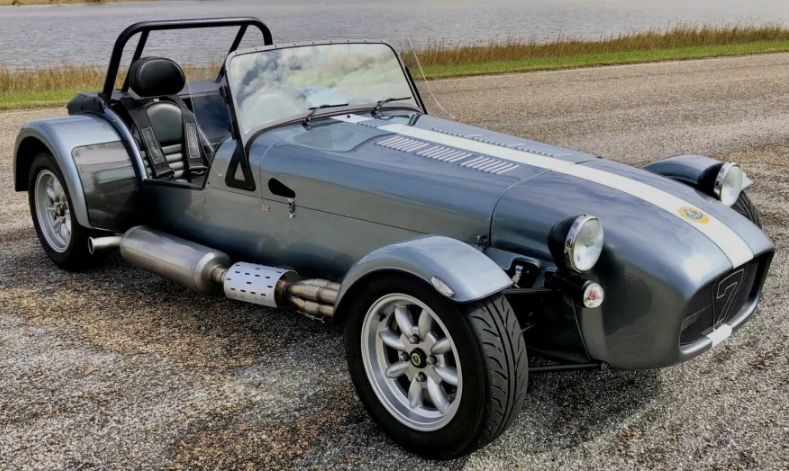
Few sports cars have remained as visually recognizable and mechanically faithful to their original design as the Caterham Seven. Since 1973, this minimalist roadster has evolved through numerous engines, trim levels, and performance packages while maintaining the core philosophy first established by Colin Chapman: “Simplify, then add lightness.”
Although the Seven’s story begins with the Lotus Seven, the car’s modern development belongs to Caterham Cars. Over more than fifty years, the company has refined the platform into one of the purest driver-focused sports cars ever produced. This article explores the evolution of all Caterham Seven models and trims, from the early 1970s to the modern era.
Origins of the Caterham Seven (1973)
In 1973, Caterham Cars purchased the production rights and tooling for the Lotus Seven from Lotus Cars after Lotus discontinued the model.
Caterham was originally a Lotus dealership based in Caterham, Surrey. When Lotus decided to move toward more refined road cars, Caterham acquired the rights to continue building the minimalist Seven.
The earliest Caterham models were essentially continuations of the Lotus Series 3 Seven. From that foundation, Caterham gradually introduced new engines, chassis upgrades, and performance trims.
.

.
Early Caterham Seven Models (1973–1980s)
Series 4 and Series 3 Continuation (1973–1974)
The first Caterham-built cars were leftover Series 4 Lotus Sevens, with approximately 38 units sold between 1973 and 1974.
However, enthusiasts preferred the earlier Series 3 design. Caterham quickly switched production back to a Series-3-style chassis, which remains the basis of the Seven today.
Early Variants
- Series 3 Twin Cam (1974–1983)
- Engine: Lotus-Ford Twin Cam
- Approximately 313 produced
- 1300GT (1975)
- Engine: Ford Kent Crossflow
- Very limited production
- 1600GT (1975–1992)
- Engine: Ford Kent Crossflow
- One of the longest-running early trims.
These early Caterhams closely resembled the original Lotus cars, retaining the aluminum body panels, exposed wheels, and extremely lightweight construction.
Expanding Performance Models (1980s)
During the 1980s, Caterham began introducing more powerful engines and performance-oriented trims.
Supersprint and Special Editions
1600 Sprint (1980–1992)
- Engine: Caterham-tuned Ford Kent
- Performance upgrade over the GT models.
1700 Supersprint (1982 onward)
- Engine: 1.7-liter Ford Kent
- One of the most popular performance Sevens.
Silver Jubilee Edition (1981–1983)
- Special anniversary model
- Distinctive silver paint and unique trim.
VTA (1981–1985)
- Engine: Vegantune Twin Cam
- Limited-production high-performance version.
Avon A (1982–1983)
- Very rare luxury-oriented version with upgraded interior features.
These variants established Caterham’s strategy of offering the Seven in multiple trims ranging from entry-level to high-performance.
High-Performance Era (Late 1980s–1990s)
The late 1980s and 1990s saw the Seven develop into a true track-capable sports car.
Cosworth and BDR Models
1600 BDR (1983–1992)
- Engine: Cosworth BDR
- One of the first major performance upgrades.
1700 BDR (1986–1999)
- Engine: Cosworth BDR 1700
- Higher output and improved track performance.
HPC 1700 (1986–1995)
- Special high-performance variant
- Used a tuned Cosworth engine and limited-slip differential.
CVH (1986–1991)
- Engine: Ford CVH
- Produced mainly for export markets such as Switzerland.
These cars significantly increased power compared with earlier Kent-engine models.
Rover K-Series Era (1990s)
In the early 1990s, Caterham adopted Rover K-Series engines, which were lighter and more modern than the Ford Kent units.
Major Models
1.4 K-Series (1991–1996)
- Entry-level Seven with improved efficiency.
Supersport K-Series (1993–1997)
- Performance-tuned K-Series engine.
Roadsport (1996)
- Limited-production performance version
- Featured weight-reduction measures and Caterham’s six-speed gearbox.
These cars helped modernize the Seven while maintaining its lightweight ethos.
Special Editions and Trim Packages
Throughout the 1990s, Caterham also produced several special-edition packages.
The Prisoner Edition (1989–1990s)
Inspired by the classic British television series The Prisoner, this version featured themed trim and unique detailing.
35th Anniversary Edition (1992–1994)
- Lotus green and yellow paint scheme
- Commemorative dashboard plaque.
7 Classic (1992–1998)
- Simplified, lower-cost version
- Designed as an entry-level Seven.
7 GTS (1992)
- Back-to-basics model using Ford Kent engine.
Modern Chassis Development (2000s)
At the turn of the millennium, Caterham introduced its first major chassis redesign.
SV (Series Five) Chassis (2000–present)
Introduced around 2000–2001, the SV chassis is wider and longer than the traditional Series 3 frame.
This allowed:
- More interior space
- Improved comfort for taller drivers
- Larger engines.
CSR Generation (2005)
One of the most advanced Sevens appeared in 2005 with the CSR models.
CSR200
- Engine: 2.0-liter Ford Duratec
- Around 200 hp
CSR260
- Engine: high-performance Duratec
- Up to 260 hp
The CSR introduced several technical upgrades:
- Independent rear suspension
- Revised aerodynamics
- Improved chassis rigidity.
Performance-Focused Variants (2000s–2010s)
During the 2000s and 2010s, Caterham introduced numerous performance trims.
Superlight Series
- Reduced weight through carbon fiber and minimal equipment
- Designed for track performance.
R500 (2008–2010s)
One of the most famous modern Sevens.
- Approximately 263 hp
- Extremely low weight
- Won Top Gear Car of the Year 2008.
Modern Model Range (2010s–Present)
Caterham reorganized its lineup in the 2010s using a numeric naming system representing power levels.
Seven 160 / 165 (2013–2017)
- Small turbocharged 660cc engine
- Extremely lightweight entry-level model.
Seven 170 (2021–present)
- Successor to the 160/165
- Turbocharged Suzuki engine
- Weighs under 1,000 pounds.
Seven 270
- Mid-range performance model.
Seven 310
- Balanced road and track performance.
Seven 360
- More powerful Ford engine.
Seven 420
- Track-focused version.
Seven 420 Cup
- Road-legal racing variant.
Seven 485
- One of the most powerful naturally aspirated Sevens.
Seven 620 (2013–present)
The most powerful Seven ever produced.
- Supercharged 2.0-liter engine
- Over 300 hp
- 0–60 mph in roughly 2.8 seconds.
Kit Car Tradition
One defining characteristic of the Caterham Seven is that it can be purchased as either:
- A factory-assembled car
- A kit car for owner assembly.
This tradition dates back to Lotus, when building the car yourself reduced purchase taxes and allowed enthusiasts to customize their vehicles.
Motorsport and Racing Programs
Caterham has long supported amateur motorsport through programs such as the Caterham Academy, launched in the 1990s.
The Academy allows novice drivers to buy a race-prepared Seven and compete in a structured racing series.
Other Caterham racing categories include:
- Roadsport Championship
- Seven Championship UK
- Caterham Cup.
Future Outlook for the Caterham Seven
Despite being based on a design dating back to the 1950s, the Caterham Seven continues to evolve.
Recent developments include:
- expansion into the United States market
- increased global production capacity
- experimentation with electric powertrains.
Caterham is also developing a new electric sports car known as Project V, with a planned release around the mid-2020s.
While the company explores electrification, the Seven itself is expected to remain a lightweight internal-combustion sports car for the foreseeable future.
Legacy of the Caterham Seven
More than fifty years after Caterham took over production, the Seven remains one of the most enduring sports car designs ever created.
Key reasons for its longevity include:
- ultra-lightweight engineering
- exceptional driving feedback
- simple mechanical construction
- continuous evolution without abandoning the original concept.
From the early Series 3 continuation cars of the 1970s to the supercharged 620 models of today, the Caterham Seven has remained faithful to its founding philosophy: minimal weight, maximum driving enjoyment.
In an automotive world increasingly dominated by electronics and automation, the Caterham Seven stands as one of the last truly analog sports cars—and its enduring popularity suggests that this philosophy will continue well into the future.