Suzuki Forsa: The Brief Yet Notable Chapter in Suzuki’s International Subcompact History
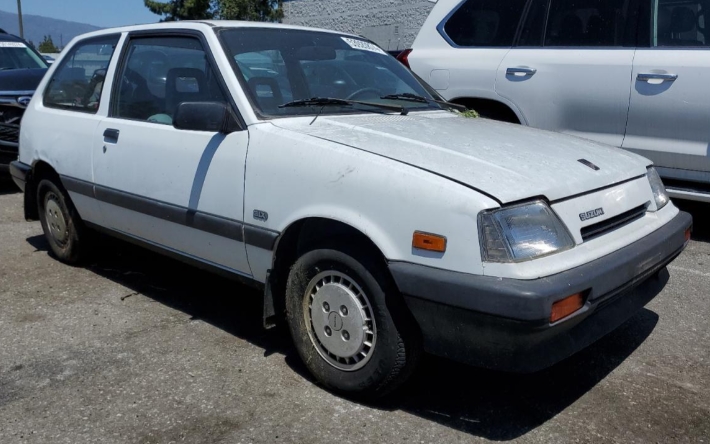
The Suzuki Forsa was a distinctive, short-lived nameplate in Suzuki’s automotive lineup — representing a specific market branding of Suzuki’s Cultus subcompact hatchback during the mid-1980s. Although the Forsa name was used only briefly and in limited regions, it represents an era when Suzuki’s small cars were marketed globally under a patchwork of names through alliances and regional strategies. This article explores the Forsa’s origin, production years, market positioning, available models and trim levels, its relationship to related vehicles, and its legacy in Suzuki’s history.
Origins: The Suzuki Cultus Platform
To understand the Suzuki Forsa, it’s essential to look at its root model — the Suzuki Cultus. The Cultus was a subcompact car produced by Suzuki beginning in 1983, intended as a compact, fuel-efficient, affordable vehicle for urban transportation and export markets.
The Cultus was part of Suzuki’s global strategy to expand its reach beyond Japan. Through a technical and marketing alliance with General Motors (GM), the Cultus platform was rebadged and sold under multiple nameplates worldwide. One of these names was Suzuki Forsa.
.
NO MORE dead batteries with this:

.
Production Years of the Suzuki Forsa
The Suzuki Forsa was not a standalone model line spanning decades — instead, it was an export nameplate used for a specific generation of the Cultus. The name “Forsa” was applied to Suzuki’s first-generation Cultus in certain export markets, mainly:
- North America (including the United States and Canada) — from 1985 to 1988
- Latin American markets (such as Ecuador and Chile) — similar approximate years
- Indonesia — where versions were sold with Suzuki Forsa badges on hatchbacks in the mid-1980s.
In essence, the Suzuki Forsa name was used only during the first generation of the Cultus, which itself was produced from 1983 to 1988 before evolving into later generations and other global nameplates.
By 1989, the Forsa name was phased out in most markets, replaced by other Suzuki branding such as Suzuki Swift or blended into other GM-related models.
Vehicle Design and Technical Overview
The Suzuki Forsa was a subcompact hatchback, typically offered only in one body style during its market life: a three-door or five-door hatchback. It was front-wheel-drive and powered by small displacement engines that prioritized fuel economy and simplicity over performance — ideal for crowded urban roads.
Engines
Depending on market and year, the Forsa shared the Cultus’s engine lineup, including:
- 1.0-liter inline-three cylinder (993 cc) — the base powerplant in many export markets, offering modest output suitable for city commuting.
- Fuel-injected or turbocharged 1.0 liter — in some markets with turbo options for slightly improved performance.
- 1.3-liter inline-four — available in certain export markets as a higher-power alternative.
These engines were paired with either a 5-speed manual or a 3-speed automatic transmission on some trims, though manual gearboxes were more common.
Market Variants and Trim Levels
Because the Suzuki Forsa was essentially a regional name for the Cultus, official “Forsa” trim level documentation is limited and often inconsistent across regions. However, available historical records and brochures provide insight into the trims and variations that were offered under the Forsa name:
Typical Trim Levels Used for Forsa (Varied by Region)
- Base / Standard — The most basic version, typically equipped with essential features such as cloth seats or vinyl upholstery, basic instrumentation, and minimal convenience options.
- GL / GLX (or Similar Mid-Tier Trim) — A higher specification offering items like upgraded interior trim, better audio options, more attractive exterior accents, and sometimes additional creature comforts (such as intermittent windshield wipers).
- Turbo Trim — In some export markets, a turbocharged version of the 1.0-liter engine was offered, giving a sportier performance edge while still maintaining efficiency. These models were usually distinguished by sportier badging and cosmetic enhancements.
Exact trim level names varied by country, with some regions offering more specific designations than others. In many cases, local dealerships’ marketing decided how variations were labeled.
Body Style and Features
For the Forsa specifically:
- Body Style: Primarily three-door and some five-door hatchback configurations were marketed depending on market.
- Seating: Typically seating for four to five passengers.
- Interior: Simple and utilitarian with optional upgrades mostly concentrated in mid-tier trims.
- Safety: Given the era, most models lacked modern safety equipment — air bags and advanced systems were not standard at this time.
Relationship to Other Rebadged Cultus Models
The Suzuki Forsa was only one of several names used to sell the Cultus globally. Other contemporaneous badges included:
- Suzuki Swift — Used in many export markets including Europe and Australasia.
- Chevrolet Sprint — GM-branded variant in parts of North America.
- Pontiac Firefly — GM-branded variant in Canada.
- Holden Barina — Badge used in Australia.
- Other regional names and configurations — Depending on market and generation.
Because of these overlapping names, the Cultus family became one of the most rebadged cars in automotive history during the late 20th century.
End of the Forsa Nameplate
By 1989, Suzuki phased out the Forsa name in favor of global consistency with the Suzuki Swift nameplate in most markets. The underlying Cultus platform continued evolving through multiple generations until production of various derivatives lasted well into the early 2000s (and in some markets, under different names even longer) — but the Forsa moniker itself was confined to the mid-1980s era.
Thus, strictly speaking, the Forsa name was produced only between roughly 1985 and 1988, making its market life notably brief compared to other Suzuki models.
The Forsa’s Legacy and Modern Outlook
The Suzuki Forsa’s legacy is more historical than technical. It represents:
- A formative era for Suzuki’s global brand expansion, where small, efficient Japanese cars entered markets outside of Japan and competed with domestic and European rivals.
- The early success of Suzuki’s partnership with General Motors, which allowed the Cultus platform to reach North American consumers through multiple GM badges.
- A collector’s niche today, as the Forsa nameplate is relatively rare in surviving examples compared to its more widely recognized Swift counterparts.
Today, the true spiritual successors to the Forsa and Cultus family are vehicles like the Suzuki Swift and compact hatchbacks such as the Suzuki Baleno and Ignis, which carry forward the philosophy of small-car efficiency and urban friendliness with much more modern technology.
The Suzuki Forsa occupies a unique footnote in Suzuki’s automotive history — a regional badge for the first-generation Cultus sold briefly in the mid-1980s. Though it had a short production lifespan (approximately 1985–1988), it played a role in establishing Suzuki’s global presence and showcased the early success of rebadged collaborations with General Motors. Over time, the Forsa name was phased out as Suzuki unified its small-car branding under the Swift name in most markets. The vehicle itself, however, lives on through its many rebadged relatives and the enduring legacy of Suzuki’s compact car segment.