Excalibur: The Rise, Evolution, and Legacy of America’s Neoclassic Automobile
When one hears Excalibur, most automotive enthusiasts immediately envision a sweeping bonnet, classic coachwork, and chrome that gleams like an heirloom. But Excalibur is more than an eye-catching “old-style” car—it is a distinctly American automotive marque that helped define the neoclassic automobile movement of the mid-20th century. Built as a blend of authentic 1920s-30s styling with modern mechanicals, the Excalibur became a cult classic among collectors, luxury car aficionados, and event hire markets like weddings and proms.
This comprehensive history explores the Excalibur’s origins, its model evolution from the 1960s through the 1990s, its various body styles and trim levels, production numbers, and lasting impact.
Origins: The Birth of an American Classic
The story of the Excalibur began in the early 1960s, when industrial designer Brooks Stevens—already respected for his work in automotive styling and industrial design—conceived a vision: a car that married the dramatic aesthetics of pre-war sports cars with the performance and reliability of contemporary American machinery. Set against the backdrop of postwar prosperity and a burgeoning collector car culture, this concept was both novel and ambitious.
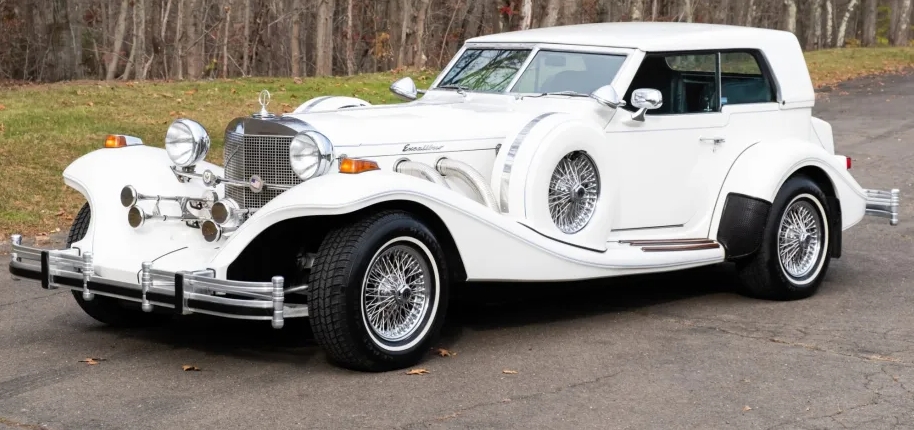
Stevens’ first prototype debuted in 1963, riding on a Studebaker Lark Convertible chassis with a Studebaker V8 engine. Its styling was overtly inspired by the 1928 Mercedes-Benz SSK, yet its underpinnings were thoroughly modern for the era. The design evoked nostalgia without sacrificing performance: long sweeping wings, a prominent vertical grille, large wire wheels, and exposed sidemount spare tires created an unmistakably classic silhouette.
Although Studebaker ceased production of its V8 engine that same year, necessitating a switch to Chevrolet powerplants, the Excalibur went into small-scale production in 1965 under the Excalibur Automobile Corporation. It was the first true neoclassic automobile—cars built to look like elegant 1930s machinery while offering reliable, modern drivetrains and suspensions.
.

.
Series I (1965–1969): The Original Excalibur
The first production Excalibur, known as the Series I, was manufactured from 1965 to 1969.
Key Features
- Body Styles:
- Roadster – A two-seat convertible with open sides and sweeping fenders.
- Phaeton – A four-seat convertible with a more substantial body.
- Engines:
- 1965: Studebaker 289ci V8 with approximately 290 hp.
- 1966–1969: Chevrolet 327ci V8 rated around 300 hp.
- Transmissions: Manual or automatic options were available.
- Chassis: Modified Studebaker Lark platform, allowing reliable on-road performance while preserving classic proportions.
The Series I cars were built in small numbers—production is often cited as a few hundred units—and quickly developed a reputation for drama and exclusivity. These early cars are now among the most sought-after by collectors, prized for their purity of design and relative rarity.
Series II (1970–1974): Refinement and Corvette Power
In 1970, Excalibur introduced the Series II, an evolution that embraced greater refinement and mechanical robustness.
What Changed
- Custom Chassis: Excalibur moved away from Studebaker platforms, introducing its own ladder-frame chassis with Corvette-derived suspension and four-wheel disc brakes.
- Engine Lineup: The standard powerplant became a Chevrolet 350ci V8, with 454ci Corvette big-block optional—boosting performance substantially.
- Body Styles: Roadster and Phaeton continued as standard offerings, and special versions like the SS Phaeton and SSK (a sportier, cycle-fendered roadster) appeared briefly.
Despite the stronger mechanical foundations and increased luxury fitment, the Series II initially struggled to find buyers. Production dipped sharply in its early years, but a design revision in 1972 helped rejuvenate interest. By 1974, the Series II had firmly cemented the Excalibur as a serious performance-luxury neoclassic.
Series III (1975–1979): Commercial Peak
The Series III marked the Excalibur’s first major commercial success. Introduced for the 1975 model year, this generation benefited from a broader production run and design tweaks that made the car more appealing to a wider audience.
Highlights
- Production Figures: Approximately 1,141 units were produced, making it the best-selling Excalibur series in history.
- Engine: Corvette-sourced 454ci V8 became standard, delivering robust torque and performance for the era.
- Body Styles: Roadster and Phaeton continued, with special trim levels and finishes becoming more common.
- Design: Subtle revisions to bumpers, fenders, and compliance features helped maintain a classic aesthetic while meeting evolving safety standards.
Although production numbers increased, critics noted that quality control suffered slightly as Excalibur grappled with higher output—a trade-off that nevertheless expanded the marque’s visibility.
Series IV (1980–1984): A New Face
As the 1980s began, Excalibur introduced the Series IV, a significant update in both style and substance.
Improvements
- Styling Evolution: While still unmistakably classic, the Series IV adopted design cues from late-1930s luxury cars like the Mercedes-Benz 500K/540K—including integrated trunks, glass side windows, refined body proportions, and power convertible tops.
- Body Options: Roadster and Phaeton remained the mainstays, but overall luxury appointments were elevated.
- Engine: Typically a 305ci (5.0L) V8 returned moderate power suited to the era’s fuel economy considerations.
- Production: Series IV numbers were smaller than Series III, but each car found a ready audience among enthusiasts seeking timeless style and more civilized manners.
Series V (1985–1990 / Extended to 1997): The Final Chapter
The Series V can be considered the final major iteration of the classic Excalibur automobile. While production under the original company effectively ceased by 1990, variants and extended models continued into the early to mid-1990s under new ownership and branding schemes such as the Limited Edition 100.
Characteristics and Variants
- Production Span: Officially 1985–1990 under Excalibur Automobile Corporation, with some Series V derivatives built until about 1997.
- Body Styles:
- Roadster – The classic two-seat convertible.
- Phaeton – Four-seat convertible with luxurious interior.
- Coupe – Closed-top variant.
- 4-Door Sedan and Pullman Limousine – Rare executive body types offered during select years.
- Engine Options: A range of Chevrolet V8 engines from 5.0L (305ci) up to 7.4L (454ci), with outputs up to ~300 hp depending on configuration.
- Limited Edition 100: A special run introduced in 1991, intended as a modernized Series III/90 homage. Only about 23 cars were ever completed, making this exceedingly rare.
Notable Subvariants of Series V
Among Series V models, collectors distinguish several versions:
- Standard Roadster & Phaeton: Traditional configurations for the line.
- Royal / Limited Editions: Higher-trim variants with upgraded interiors and finishes.
- Pullman Limousine / Touring Sedan: Extended wheelbase options for ultra-luxury use.
- Grand Models: Limited runs with larger engines and bespoke appointments.
Despite thoughtful design and variety, waning demand and financial strain led the original Excalibur company to decline by the early 1990s. Later owners briefly attempted revival, but no sustained mass production followed.
Production Numbers and Legacy
Over its production life from 1965 to roughly 1990, Excalibur automobiles were always limited in number. Series I through V collectively totaled a few thousand units—a figure that preserves rarity and desirability among collectors.
Approximate Production by Series
| Series | Years | Approx. Production |
|---|---|---|
| I | 1965–1969 | Few Hundred |
| II | 1970–1974 | Several Hundred |
| III | 1975–1979 | ~1,141+ |
| IV | 1980–1984 | Several Hundred |
| V | 1985–1990 (extended to 1997) | Several Hundred |
Precise records vary, but the likelihood is that total historical production remained below 3,500 units—a testament to Excalibur’s boutique nature.
Cultural Impact and Collectibility
Excalibur cars occupy a unique niche in automotive history: they are not restorations or replicas of original 1930s machines, nor pure kit cars—they are factory-built neoclassics with professionally engineered frames and mechanicals.
Their blend of:
- Classic aesthetics,
- American V8 power,
- Hand-built craftsmanship, and
- Low production numbers
has ensured enduring appeal among classic car collectors. Owners proudly display their Excaliburs at concours events, and the cars continue to be popular as ceremonial vehicles for weddings and other formal occasions.
Future Outlook
While Excalibur automobiles are no longer in mainstream production, the marque’s legacy persists:
- Restoration and Parts Support: Many specialist firms and enthusiast clubs maintain parts inventories, ensuring that existing Excaliburs remain roadworthy.
- Collector Market: Well-preserved examples, especially early Series I and limited variants, continue to appreciate in value.
- Neoclassic Influence: The success of Excalibur inspired similar designs and brands throughout the late 20th century, leaving a lasting imprint on automotive styling culture.
Though a full revival seems unlikely in a market increasingly focused on electrification and sustainability, the timeless romance embodied by Excalibur cars ensures they will remain cherished artifacts in automotive history.
The Excalibur automobile stands as one of the most distinctive chapters in American automotive design. From the visionary Series I of the 1960s to the eclectic body styles of the Series V and beyond, Excalibur cars married nostalgia with performance in ways few manufacturers ever have. Though confined largely to the realm of enthusiasts and collectors today, their legacy endures—an elegant nod to a bygone era, powered by the muscle and ingenuity of modern engineering.