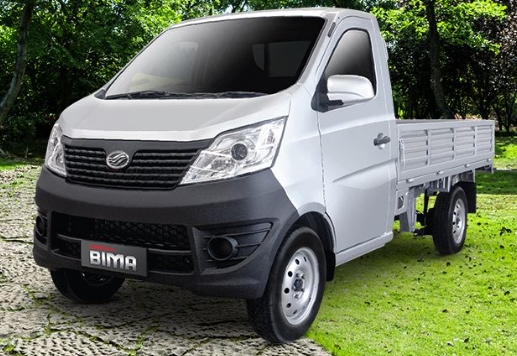
The Evolution of the Esemka Bima Line: Bima 1.2, Bima 1.3, and Bima EV
The Esemka Bima series—consisting of the Bima 1.2, Bima 1.3, and later Bima EV—represents Indonesia’s most significant attempt to establish a locally assembled light commercial vehicle family. Produced under the Esemka brand, these models are positioned as affordable pickup trucks and utility vans intended for small businesses, rural logistics, and urban delivery use.
First introduced in September 2019, the Bima lineup marked Esemka’s transition from prototype-based national car projects into limited-series production. While the vehicles are assembled in Indonesia, they are widely understood to be based on established Chinese platforms, adapted for the Indonesian market with localized branding and assembly.
Across its lifecycle, the Bima family has evolved from two gasoline-powered pickups into a broader lineup that includes a battery-electric van, reflecting both Indonesia’s industrial ambitions and the global shift toward electrification.
Historical Background: From National Project to Production Vehicle
The Esemka brand originally emerged in the late 2000s as a vocational school initiative aimed at developing domestic automotive capability in Indonesia. Early prototypes gained national attention and political support, positioning Esemka as a symbolic “national car” effort.
By the mid-2010s, Esemka transitioned into a more formal manufacturer under PT Solo Manufaktur Kreasi, establishing assembly operations in Boyolali, Central Java. After several prototype programs, the company finally launched its first mass-produced product family in 2019: the Bima pickup series.
The Bima name itself had existed in earlier prototype discussions dating back to the 2010s, but only reached production reality in 2019.
.
MANY auto lovers not only spend time in their garages to tinker on their autos, but have other projects going on in there as well. Wood working is a popular pastime for the creative type of individual. Not sure what to make next? Or thinking about getting into this kind of hobby? There’s lots of possibilities… Here’s some of them…

.
Production Overview and Timeline
The Esemka Bima series includes multiple variants that evolved over time:
Production Timeline
- September 2019 – Official launch of Bima 1.2 and Bima 1.3 pickups
- 2020–2022 – Limited production and domestic distribution in Indonesia
- February 2023 – Introduction of Bima EV at the Indonesia International Motor Show
- 2023–2026 – Continued low-volume production and EV import-based testing phase
The gasoline-powered pickups are assembled in Indonesia, while the electric variant is imported from China for evaluation and technology transfer purposes.
Platform Overview and Technical Background
The Bima family is built on light commercial vehicle platforms sourced from Chinese manufacturers:
- Bima 1.2 is based on the Chana Star 5 platform
- Bima 1.3 is based on the Jinbei T30 platform
- Bima EV is based on the SRM Shineray X30LEV platform
All versions share a similar concept: a compact pickup or van designed for cargo transport with a simple mechanical layout, rear-wheel-drive configuration (for combustion models), and a focus on durability rather than performance or luxury.
Esemka Bima 1.2: The Entry-Level Pickup
Overview
The Bima 1.2 was the first version released in 2019 and serves as the entry point into the Bima lineup. It is a compact pickup truck designed primarily for light cargo transport in urban and rural environments.
Engine and Drivetrain
- 1.2-liter inline-four gasoline engine
- Output: approximately 97 horsepower
- Five-speed manual transmission
- Rear-wheel drive layout
Dimensions (Approximate)
- Length: about 179 inches (4,560 mm)
- Wheelbase: about 114 inches (2,900 mm)
- Width: about 64.8 inches (1,645 mm)
Trim Levels
The Bima 1.2 is typically offered in a simple two-tier structure:
- Standard Trim
- Basic steel wheels
- Manual air conditioning
- Fabric seats
- Basic infotainment or radio unit
- Higher Utility Trim
- Improved interior materials
- Air conditioning standard
- Power steering
- Optional infotainment upgrades
The focus is utility and affordability rather than comfort.
Esemka Bima 1.3: Expanded Capacity and Refinement
Overview
The Bima 1.3 was introduced alongside or shortly after the 1.2 model as a slightly larger and more powerful variant. It is based on a different Chinese pickup platform and is designed for users needing more cargo capacity and improved performance.
Engine and Drivetrain
- 1.3-liter inline-four gasoline engine
- Output: approximately 84 horsepower
- Five-speed manual transmission
- Rear-wheel drive
Dimensions (Approximate)
- Length: about 194 inches (4,930 mm)
- Wheelbase: about 120 inches (3,050 mm)
- Wider and longer than the 1.2 version
Trim Levels
The trim structure is similar to the 1.2 but slightly more feature-rich in higher configurations:
- Base Utility Trim
- Steel wheels
- Manual interior controls
- Basic seating
- Minimal electronics
- Comfort-Oriented Trim
- Air conditioning
- Improved dashboard layout
- Infotainment system
- Enhanced cabin materials
The Bima 1.3 is often considered the more versatile workhorse due to its larger size.
Esemka Bima EV: The Electric Evolution
Overview
The Bima EV represents a major shift for the lineup, introducing full battery-electric capability. Unlike the combustion versions, the EV is primarily a panel van configuration designed for logistics and urban delivery use.
It was introduced in February 2023 at the Indonesia International Motor Show.
Unlike the locally assembled pickups, the Bima EV is imported from China for evaluation and technology transfer purposes.
Powertrain
- Permanent magnet synchronous electric motor
- Output: approximately 101 horsepower
- 49.1 kWh lithium battery pack
- Claimed range: about 186 miles (300 kilometers)
Trim Levels
The EV version follows a simplified structure:
- Fleet Base Model
- Cargo-focused interior
- Minimal infotainment
- Basic driver display
- Urban Logistics Trim
- Larger digital display
- Connectivity features
- Rear sensors and safety aids
- Enhanced Tech Variant
- Advanced infotainment system
- Fleet management connectivity
- Improved cabin insulation
The EV is primarily aimed at commercial fleet users rather than private buyers.
Market Position and Reception
The Esemka Bima lineup occupies a niche position in Indonesia’s commercial vehicle segment. Its main competitors include other entry-level pickups and compact vans from established Japanese and Chinese brands.
Strengths include:
- Low purchase cost
- Simple mechanical design
- Practical cargo capacity
- Local assembly for combustion models
Criticism includes:
- Heavy reliance on rebadged foreign platforms
- Limited production transparency
- Basic interior quality compared to competitors
- Small-scale availability
Despite this, the Bima line is often viewed as a politically and symbolically important project for Indonesia’s automotive industry.
Role in Indonesia’s Automotive Strategy
The Bima series is closely tied to Indonesia’s broader industrial goals, particularly:
- Increasing local automotive assembly capability
- Reducing dependence on imported commercial vehicles
- Supporting small business logistics infrastructure
- Exploring early-stage electric vehicle adoption
Even with limited scale, the project has helped develop domestic assembly experience and supplier participation.
Future Outlook
As of 2026, the future of the Bima lineup is uncertain but potentially evolving in three directions:
- Expansion of local EV production instead of imported units
- Updated combustion models with improved emissions compliance
- Greater localization of platforms and components
However, continued success depends on investment stability, supply chain development, and competition from established global automakers.
The Esemka Bima 1.2, Bima 1.3, and Bima EV form a small but symbolically important commercial vehicle family in Indonesia’s automotive landscape. Introduced in 2019 and expanded into electric mobility by 2023, the lineup reflects both national industrial ambition and the realities of relying on global platforms.
While not a high-volume global product, the Bima series remains a notable example of an emerging-market automaker attempting to build a domestic commercial vehicle identity in a highly competitive industry.