The Evolution of the Sinogold GM3: China’s Unconventional Electric MPV
The Sinogold GM3 occupies a unique place in the modern Chinese automotive industry. Introduced during the rapid expansion of China’s electric vehicle market, the GM3 represented Sinogold’s attempt to establish itself as a competitive electric vehicle manufacturer focused on practical family transportation. Although the vehicle never achieved global prominence, it became notable for its unusual styling controversy, spacious interior layout, and role as Sinogold’s first major production passenger vehicle.
Produced from 2018 through 2023, the GM3 served as the foundation of the young automaker’s lineup and reflected broader trends in China’s electric vehicle boom during the late 2010s and early 2020s.
Origins of Sinogold
Sinogold was founded in 2016 in Shandong Province, China. The company specialized in electric vehicles and emerged during a period when dozens of Chinese startups entered the rapidly growing EV sector. Sinogold partnered with Shandong Guojin Automobile Manufacturing and quickly focused on developing practical electric transportation for families and commercial users.
Before the GM3 entered production, Sinogold reportedly worked on earlier development concepts known as the K01 and K03. These projects never reached full production, but they influenced the engineering and development process that eventually led to the GM3.
The company’s first production-ready passenger vehicle was originally called the G60. During development and prior to launch, the name evolved into GM3, which became the official production designation.
.

.
Development and Launch
The Sinogold GM3 debuted publicly in 2017 and officially entered production for the 2018 model year. The vehicle was designed as a compact electric MPV, or multi-purpose vehicle, aimed primarily at Chinese families seeking spacious transportation with zero-emission capability.
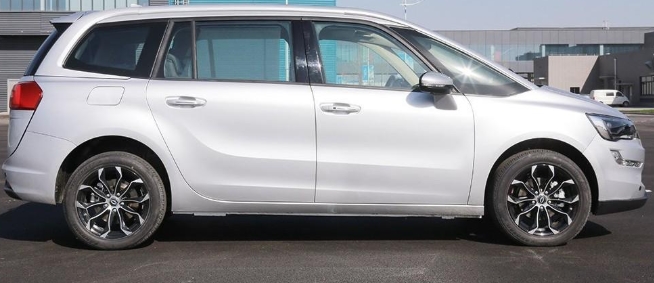
The GM3 immediately attracted attention because of its appearance. Many automotive journalists and enthusiasts observed that the vehicle closely resembled the Citroën Grand C4 Picasso. The similarities extended beyond general proportions and included body lines, window shapes, dimensions, and overall silhouette. In some early promotional materials, Sinogold reportedly used altered images of the Citroën model, which led to criticism and legal concerns.
Despite the controversy, the GM3 represented an ambitious attempt by a new Chinese EV manufacturer to enter the family transportation market. The vehicle featured a modern aerodynamic profile and a practical six-seat interior layout with a 2-2-2 seating configuration.
Production Years
The Sinogold GM3 remained in production from 2018 until 2023. During this period, it remained the company’s primary production model and the centerpiece of the Sinogold brand.
Production Timeline
| Year | Major Development |
|---|---|
| 2016 | Sinogold founded |
| 2017 | GM3 revealed publicly as G60/GM3 |
| 2018 | Full production begins |
| 2019–2021 | Minor technical updates and continued sales |
| 2022 | Sinogold expands lineup with Junxing sedan |
| 2023 | GM3 production ends |
| 2024 | Sinogold operations reportedly cease |
Dimensions and Design
The GM3 was classified as a compact MPV, although its size placed it near larger family vans sold in global markets. The vehicle measured approximately 181.7 inches long, 72.6 inches wide, and 65.2 inches high, with a wheelbase of 111.8 inches.
The design emphasized interior space and passenger comfort. Large side windows, a high roofline, and a long wheelbase created a roomy cabin intended for families and business transportation.
The front-wheel-drive electric platform allowed the GM3 to maximize passenger room while minimizing drivetrain intrusion into the cabin. The overall shape prioritized efficiency and practicality rather than sporty handling characteristics.
Powertrain and Performance
The Sinogold GM3 was powered exclusively by electric drivetrains throughout its production run. The vehicle used a front-mounted electric motor producing approximately 161 to 163 horsepower and 184 pound-feet of torque.
Two primary battery configurations were offered during production:
- 55 kWh battery pack
- 66 kWh battery pack
Range estimates varied depending on battery size and testing standards. Under China’s NEDC testing cycle, the 55 kWh version offered roughly 186 miles of range, while the larger 66 kWh battery increased range to approximately 252 miles.
Sinogold claimed that slower city driving could further extend driving range under ideal conditions. Charging times were competitive for the era, with standard charging requiring approximately eight hours and fast charging reaching 80 percent capacity in roughly 40 minutes.
Top speed was rated at approximately 93 miles per hour, making the GM3 suitable for highway travel as well as urban commuting.
Models and Trim Levels
Unlike larger global automakers that offered numerous trim levels, the Sinogold GM3 maintained a relatively simple lineup throughout its production life. Detailed official trim-level documentation is limited, but available information indicates that the GM3 was primarily sold in variations distinguished by battery size, range capability, and equipment packages rather than dramatically different model names.
Main GM3 Variants
| Model/Variant | Years Offered | Key Features |
|---|---|---|
| GM3 Standard Range | 2018–2023 | 55 kWh battery, lower-cost configuration |
| GM3 Long Range | 2018–2023 | 66 kWh battery, increased range |
| GM3 Executive/High Equipment Versions | Limited availability | Additional comfort and technology equipment |
The vehicle generally included features expected in modern Chinese EVs during the late 2010s, such as:
- Large infotainment displays
- Digital instrumentation
- Climate control systems
- Smartphone integration
- Navigation systems
- Fast-charging capability
- Multiple seating configurations
Higher-equipment versions reportedly included upgraded interior materials and enhanced multimedia systems.
Market Position and Reception
The GM3 entered the Chinese market during an explosive growth period for electric vehicles. Government incentives and environmental policies encouraged EV adoption, creating opportunities for startup manufacturers like Sinogold.
However, the GM3 faced several challenges:
- Strong competition from larger Chinese EV manufacturers
- Limited brand recognition
- Styling controversy surrounding its resemblance to the Citroën Grand C4 Picasso
- Rapid technological changes in the EV market
Even so, the GM3 gained attention for offering substantial interior space and relatively affordable electric transportation for larger families. It also reflected China’s increasing focus on electric MPVs, a segment that became more popular during the late 2010s.
Among automotive enthusiasts online, the vehicle became widely recognized as an unusual imitation of the Citroën design. Discussions on automotive forums and social media frequently referenced the similarity between the two vehicles.
The End of Production
Production of the GM3 ended in 2023. By this time, China’s EV market had become significantly more competitive, with dominant manufacturers such as BYD, NIO, XPeng, and Tesla exerting pressure on smaller startups.
Sinogold attempted to expand its lineup by introducing additional vehicles, including the Junxing sedan developed in cooperation with Chery Automobile. However, the company struggled to establish a lasting market presence. Reports indicate that Sinogold ceased operations in 2024.
Future Outlook and Legacy
Although the Sinogold GM3 was never a high-volume global success, it remains an interesting example of China’s early EV startup era. The vehicle demonstrated how quickly new manufacturers emerged during the electric vehicle boom and how aggressively companies attempted to compete in the growing EV marketplace.
The GM3’s legacy is tied to several broader automotive trends:
- The rapid expansion of Chinese electric vehicles
- Increasing popularity of electric MPVs
- The rise and fall of EV startup manufacturers
- Design controversies involving vehicle similarities
Today, the GM3 stands as a reminder of the experimental and highly competitive nature of China’s EV industry during the late 2010s and early 2020s. While Sinogold itself may no longer exist, the GM3 remains part of the larger story of how China became one of the world’s leading electric vehicle markets.