The Evolution of the Changhe Q25: BAIC’s Urban Crossover Experiment
The Changhe Q25 was one of the most important modern vehicles produced by the Chinese automaker Changhe during the late 2010s. Introduced as a compact urban crossover aimed at younger buyers, the Q25 represented Changhe’s transition into the growing sport utility vehicle market after the company became part of the BAIC Group. Although the model had a relatively short production life, it played an important role in the company’s attempt to modernize its lineup and compete with a rapidly expanding field of affordable Chinese crossover vehicles.
Origins of Changhe and the Q-Series
Changhe was founded in 1970 in Jiangxi Province, China, and originally specialized in compact commercial vehicles and microvans. During the 1980s and 1990s, the company became closely associated with Suzuki through joint ventures that produced small passenger vehicles for the Chinese market. In 2013, the company came under the control of BAIC Group, one of China’s major state-owned automotive manufacturers.
Following the BAIC acquisition, Changhe began repositioning itself with a more modern range of crossovers and passenger vehicles. The Q25 became one of the first major products developed during this new era. It was also among the earliest examples of BAIC’s strategy of sharing platforms and engineering resources across multiple brands. The Q25 shared much of its structure and engineering with the Senova X25, another small crossover sold under BAIC’s Senova division.
.

.
Development and Debut
The Changhe Q25 was first shown publicly during the 2015 Guangzhou Auto Show in China. Production began shortly afterward, with sales officially launching in early 2016 for the 2016 model year.
At the time of its introduction, compact crossover SUVs were becoming extremely popular in China. Domestic manufacturers such as Changan, Great Wall, Chery, and BAIC were all introducing affordable crossovers designed for city driving. The Q25 entered this competitive market with youthful styling, compact dimensions, and relatively inexpensive pricing.
The vehicle was marketed primarily toward first-time car buyers and younger urban customers. Pricing reportedly ranged from approximately 55,900 yuan to 76,900 yuan, depending on trim level and equipment.
Production Years
The Changhe Q25 was produced from 2015 through 2019, although it was sold mainly as a 2016–2019 model-year vehicle. Production officially ended in 2019 as Changhe began reducing and restructuring its passenger vehicle operations.
Production Timeline
- 2015: Prototype and launch preparation
- 2016: Full market launch in China
- 2017: Continued sales and trim expansion
- 2018: Sales decline amid growing competition
- 2019: Final production year and discontinuation
Design and Styling Evolution
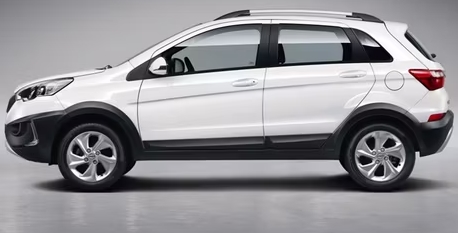
The Q25 featured a modern crossover appearance that aligned with Chinese automotive design trends during the mid-2010s. The front fascia included a chrome-accented grille, large headlamps, and skid-plate-inspired bumper styling. Roof rails and alloy wheels emphasized its sporty image.
Inside, the Q25 used colorful trim pieces and youthful interior accents intended to attract younger drivers. The dashboard design included a freestanding infotainment screen, circular air vents, and a relatively simple control layout. Some interior color combinations matched the exterior paint, a feature uncommon in many low-cost crossovers at the time.
Dimensionally, the Q25 was classified as a subcompact crossover SUV. The vehicle measured approximately 161 inches long with a wheelbase of about 99 inches, making it suitable for crowded urban streets while still offering seating for five passengers.
Unlike some competitors that emphasized rugged off-road capability, the Q25 was designed primarily as a city-oriented vehicle with front-wheel drive only.
Engines and Mechanical Specifications
Throughout its production run, the Changhe Q25 remained mechanically simple. The vehicle used naturally aspirated four-cylinder gasoline engines paired with either manual or automatic transmissions.
Engines Offered
- 1.3-liter inline-four
- 1.5-liter inline-four
Most markets and production versions primarily used the 1.5-liter gasoline engine producing approximately 116 horsepower and 148 Nm of torque.
Transmissions
- 5-speed manual transmission
- 5-speed automatic transmission
Some sources associated with the related Senova X25 mention a 4-speed automatic, although the Q25 itself was commonly described as using a 5-speed automatic in official summaries.
The Q25 used a front-engine, front-wheel-drive layout. Fuel economy and maintenance costs were considered relatively affordable by Chinese market standards.
Models and Trim Levels
Public English-language documentation regarding every Changhe Q25 trim level is somewhat limited, but several known trims and configurations were offered during the vehicle’s production run.
Known Trim Levels and Configurations
- Le Shang Version
- Lehui Version
- Manual transmission variants
- Automatic transmission variants
- Two-wheel-drive models
Documentation from Chinese VIN databases confirms the existence of at least the “Le Shang” and “Lehui” trim versions during the 2017 model year.
Lower trims generally focused on affordability and basic transportation, while higher trims added features such as:
- Alloy wheels
- Larger infotainment screens
- Bluetooth connectivity
- Roof rails
- Improved interior materials
- Additional exterior chrome accents
Because Changhe primarily sold the Q25 in the domestic Chinese market, trim naming conventions were not always translated consistently into English-language automotive media.
Sales Performance
The Changhe Q25 experienced its strongest sales during its first full production years. In 2016, the model reportedly sold more than 16,000 units in China, making it one of Changhe’s more successful modern passenger vehicles.
However, the vehicle’s momentum slowed significantly after 2017. Competition in China’s compact crossover market became increasingly intense as dozens of manufacturers launched newer and more advanced SUVs. Sales dropped sharply between 2017 and 2019.
Several factors contributed to the decline:
- Heavy competition from domestic rivals
- Rapid advances in infotainment technology
- Growing consumer demand for larger SUVs
- Increased popularity of electrified vehicles
- Changhe’s weakening passenger vehicle presence
By 2019, sales volumes had become very low, and the model was discontinued.
Relationship to the Senova X25
One of the most important aspects of the Q25’s history was its relationship to the Senova X25. The two vehicles shared platforms, engineering components, and many styling elements.
This platform-sharing strategy allowed BAIC to reduce development costs while quickly expanding multiple brands. The Q25 was essentially Changhe’s interpretation of the Senova X25, with revised styling details and branding differences intended to target slightly different customer groups.
This strategy was common among Chinese automakers during the 2010s as companies attempted to grow rapidly in the crossover segment.
Discontinuation and Brand Decline
The discontinuation of the Q25 reflected broader challenges facing Changhe itself. Although the company had once been an important Chinese manufacturer, its passenger car operations struggled to remain competitive in an increasingly crowded domestic market.
By the early 2020s, many Changhe-branded passenger vehicles had disappeared from production. Reports indicate that the company’s official operations and website effectively ceased by 2022.
As a result, the Q25 became one of the final notable crossover models associated with the Changhe brand.
Legacy and Future Outlook
The Changhe Q25 may not have achieved international recognition, but it remains an interesting example of the rapid development of China’s automotive industry during the 2010s. The vehicle demonstrated how Chinese manufacturers adapted to changing consumer preferences by shifting from compact sedans and microvans toward affordable crossover SUVs.
Today, the Q25 survives mainly as a used vehicle in China and a reminder of BAIC’s efforts to modernize the Changhe brand. While there are no confirmed plans for a direct successor, the ideas behind the Q25 — compact size, low cost, urban practicality, and crossover styling — continue to influence many modern Chinese SUVs.
In retrospect, the Changhe Q25 represented a transitional moment in Chinese automotive history. It combined older Changhe manufacturing traditions with newer BAIC engineering and contemporary crossover design trends. Although its production run lasted only a few years, the Q25 remains a noteworthy chapter in the evolution of China’s fast-growing SUV market.